Pasquotank County and the Portsmouth yellow-fever epidemic of 1855
Near Richardson's Landing in Pasquotank County, a chinquapin at the mouth of a lane ditch marked a corner of land that Charity Smithson bought in December 1842. Less than a year later, the property changed hands again. This time the sellers were Hardy Forehand and “his wife Charity,” and the deed recalled her purchase from John J. McLain. The linked deeds make it very likely that Charity Smithson was the woman named as Hardy's wife on 1 December 1843. Their marriage by that date is explicit.1
Charity had been a child under guardianship long before she owned land in her own name. Her father was Elisha Smithson. An account begun in 1823 concerned his children; by February 1825 it named Polly and Charity. William Scott acted first as their guardian, followed by James Scott. James's accounts list charges for the sisters' board, clothing and schooling.2
One entry calls Charity the youngest heir. Another pays Simpson twenty-four dollars for keeping her for a year. By 1838, there were separate charges against Charity and Mary, very likely the sister earlier called Polly. Charity's schooling and three months of board appear together in the final surviving account, closed in February 1839. Her mother's name does not appear in these records. Elisha was probably dead by the guardianship begun in September 1823, but the accounts do not say that the girls had lost both parents.2
Hardy's family can be followed in upper Pasquotank, around Crooked Run bridge. His name also appears as Hardin and Harden. The man who married Charity was very likely the son of Joel Forehand and brother of Jordan, a family identified explicitly in the deeds dividing Joel's land. Joel died sometime in August 1834. In October, commissioners set aside provisions for his widow, Polly: corn and wheat, hogs, sheep, a horse, and other livestock, together with poultry, yarn, flax and cotton. Hardy bought two small lots at the estate sale held that same day.3
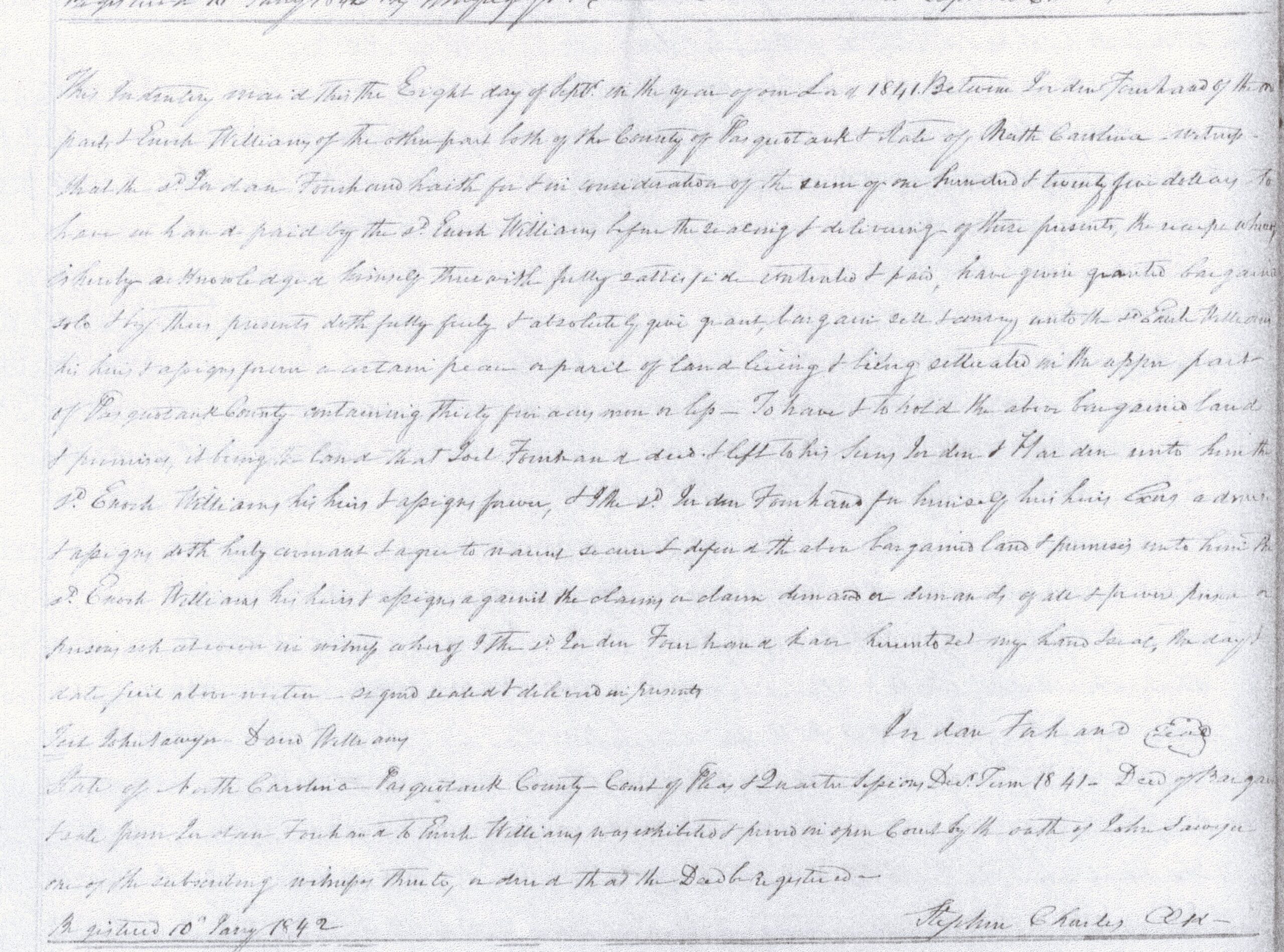
Division of Joel's land followed several years later. In December 1839, Hardin sold Jonathan Brite his inherited interest in a tract estimated at sixty acres. By August 1841, Jordan had reached twenty-one, and he and Brite divided the property. The road from Crooked Run bridge toward an ash below the bridge helped define the division. Brite took the northern portion; Jordan received the southern part with the dwelling house. A month later, Jordan sold thirty-five acres to Enoch Williams. That deed calls Jordan and Hardin Joel's sons. These are historic bounds; the house site and bridge have not been fixed to a modern parcel.4
Hardy was also buying land beyond his paternal inheritance. In March 1839 he purchased fifty-five acres from William Albertson and his wife Susan for $875. Five days later, he placed fifty acres bought from the Albertsons in trust to secure a debt of $437.50. In August he sold fifty acres to Jesse Sawyer, with a similar sequence of neighbors in the bounds. The three deeds very likely trace the same purchase, financing and resale, though their acreage and some boundary wording differ. Hardy was dealing in land and credit while still in his early twenties; the transactions' purpose and ultimate financial result remain unknown.5
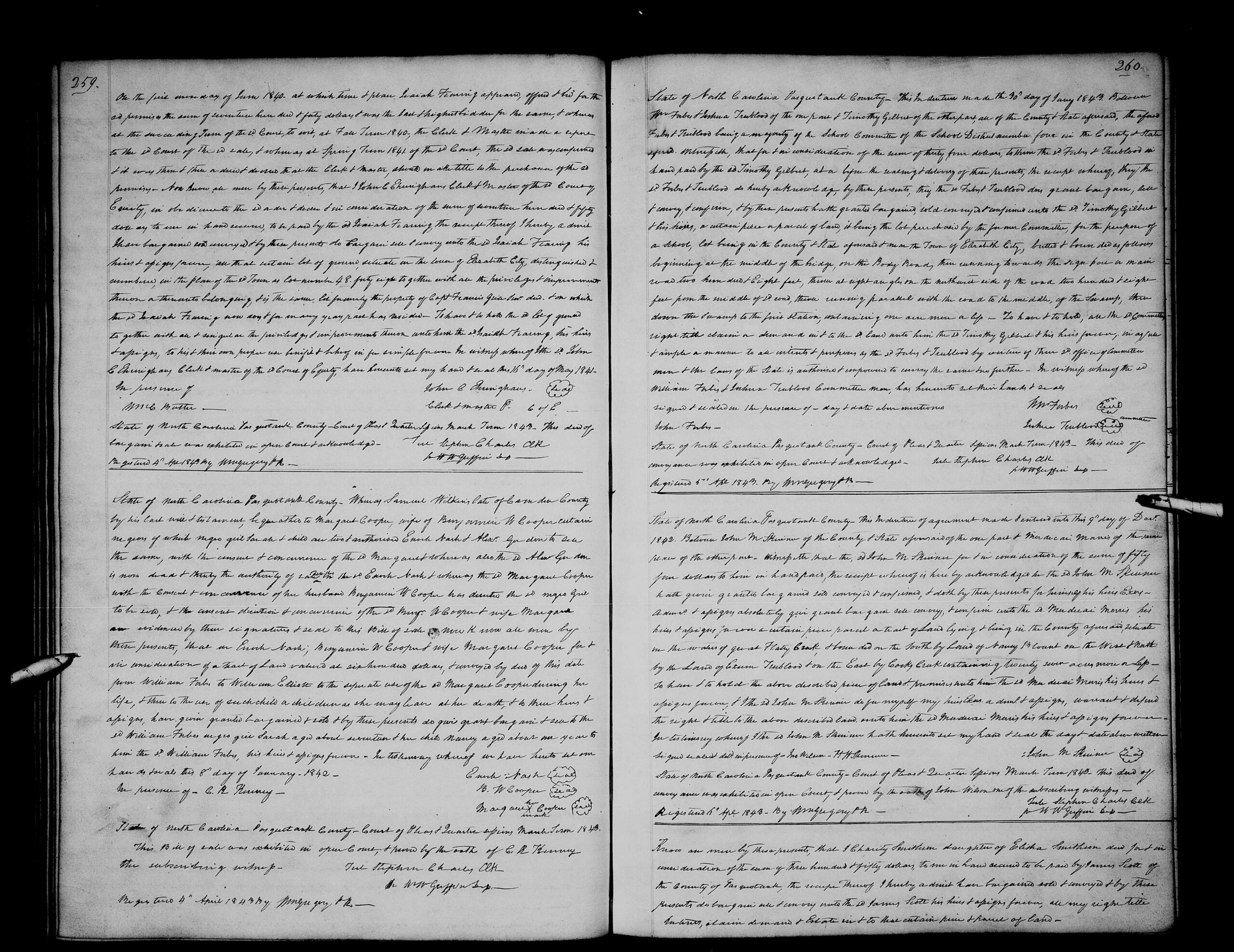
Charity's own transactions began with an interest in land formerly belonging to Enoch Scott. On 10 November 1842, she conveyed that interest to James Scott for $350 secured to be paid. The deed supplies the plainest statement of her parentage: Charity Smithson was a daughter of deceased Elisha Smithson. In December came her purchase near Richardson's Landing. In December 1843 she and Hardy conveyed that property to Lewis R. Hinton for $150; both acknowledged the deed at the following March court, when Charity was examined separately. These sums belong to distinct transactions and cannot by themselves establish a gain or loss.1
Their household comes into view on 17 September 1850. Hardy was thirty-three, a farmer; Charity was twenty-seven. A two-year-old boy followed them on the census page, his abbreviated given name difficult to read, resembling “Will[?]. R.” All three were recorded as North Carolina-born. The boy was probably their son. Hardy's real-estate column was blank, leaving his landholdings at that time unclear.6
Five years later, Hardy and Charity's names appeared in the records of a calamity reaching far beyond a single household. The Dismal Swamp Canal joined the Pasquotank and Elizabeth rivers, connecting the Albemarle country with Norfolk and Portsmouth. Its twenty-two miles between South Mills and Deep Creek made the Virginia ports part of the region's waterborne life. That connection helps explain the setting of their story, although their own journey to Portsmouth has not been recovered.15
The epidemic was traced to the steamer Benjamin Franklin, which arrived from St. Thomas on 7 June 1855 seeking repairs. Released from quarantine on 19 June, she went to the shipyard at Gosport, beside Portsmouth. Fever spread among waterfront households and into Norfolk. By August, residents who could leave were fleeing; quarantine restrictions met many of them elsewhere. Shops and markets closed, food grew scarce, and the ordinary work of both towns faltered. Relief associations organized supplies, nursing and burials while help came from other communities.14
The response reached back into northeastern North Carolina. Norfolk's Howard Association later credited Elizabeth City with $561 in contributions received during August and September. The surviving account records people sending money from the Pasquotank to the afflicted city across the state line, a measure of the help coming from the region Hardy and Charity had called home.15
The naval hospital stood in Portsmouth, across the Elizabeth River from Norfolk. During the emergency it received civilian fever patients. Its epidemic admissions numbered 587, of whom 208 died. Physicians did not yet understand the mosquito transmission of yellow fever; their explanations often centered on foul air or contaminated belongings.14
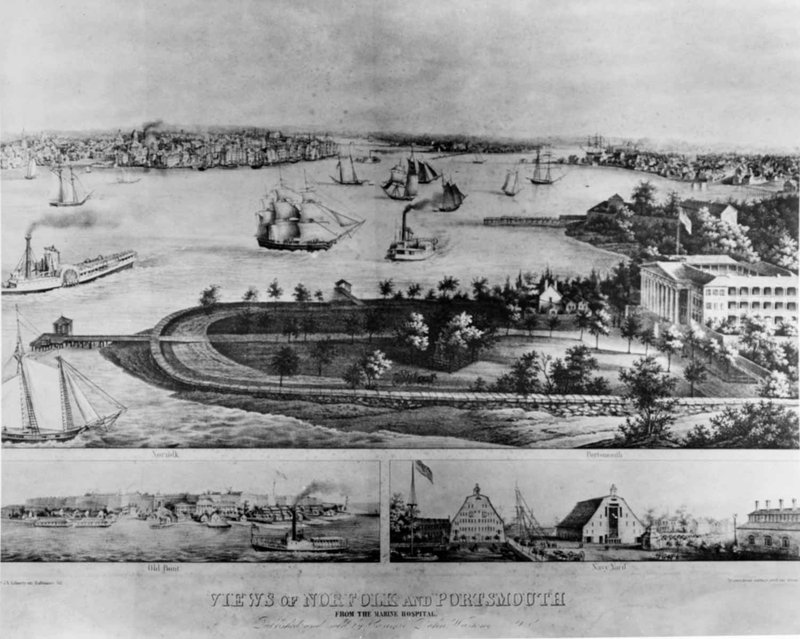
Richmond's Daily Dispatch published Hardy and Charity Forehand's names on 21 September among the hospital deaths from 1 through 31 August. The hospital pair were very likely the Pasquotank husband and wife. The record fixes the month but gives neither person's death day, admission date or circumstances of arrival. The Portsmouth Relief Association subsequently included both among the epidemic's dead.78
Its treasurer also paid for Hardy and Charity's burials. The association purchased ground at Oak Grove Cemetery for victims of the epidemic, making it a possible place to look for their graves. The expense list gives no cemetery beside either name. Hardy and Charity's burial places remain unknown.816
The association's report also recorded the children left by the fever. Three Forehand entries appear together: Wm., six months; Josephine, five; and Lizzie, with no age entered. Beside Wm. stand the words “Parents dead,” carried by ditto marks beside the other two. These were very likely Hardy and Charity's children. Their common surname within the same Portsmouth epidemic, the loss of both parents and the named adult deaths form a strong cumulative case. Collected family notes also explicitly assign a corresponding group to Hardy and Charity, although the notes' origin is uncertain and their children's names and ages differ.89
That discrepancy matters to the children individually. The notes call the boy Wm. Riley and make him seven, an age that would fit the two-year-old in the 1850 household. The printed report instead makes Wm. an infant. The notes give Joseph, four, where the report has Josephine, five; they give Lizzie an age of two that the printed list leaves blank. The evidence supports the parents more strongly than it supports joining every one of these child entries into a single, settled identity.9
Josephine offers the clearest later trace. In August 1860, a nine-year-old Josephine Forehand lived in Portsmouth in the household of Jno. W. H. Wrenn, which also included Mary E. Wrenn. She was probably the orphan of the relief report, although no placement record yet connects them. The census records her presence, not adoption or guardianship.10
Charity's childhood is preserved in accounts for her care. Between those accounts and the fever report lay her schooling, her land transactions, her marriage and the small Pasquotank household of 1850. The report records three children very likely hers and Hardy's among those whose parents had died. Josephine's probable appearance in the Wrenn household carries their history beyond the fever; no later record has yet been securely connected to Wm. or Lizzie.26810
Read the record: Charity names her father
Read the record: Joel’s sons
Family Ties
Hardy or Hardin Forehand was born about 1816–1817, according to his age and North Carolina birthplace in the 1850 census. He was very likely Joel Forehand's son and Jordan's brother (High confidence). Joel's fatherhood of the two sons named in the 1841 deeds is Established; identifying that Hardin with Charity's husband is the separate inference. Joel's widow Polly is documented, but her biological maternity of Hardy is Possible, not established. No other sibling of Hardy has been securely identified in this investigation.346
Charity Smithson Forehand was born about 1822–1823, also from the 1850 census. Her identification as Elisha Smithson's daughter is High confidence, combining the explicit daughter clause with the purchase-and-resale chain. Polly, later called Mary Smithson, was very likely her sister; whether they were full or half sisters is unknown. Charity's mother remains Unknown.126
Hardy and Charity were married by 1 December 1843 and very likely both died at Portsmouth's Naval Hospital during August 1855. The marriage is Established; the identification of the Portsmouth deaths with this Pasquotank couple is High confidence.17
| Child or household entry | What can presently be said |
|---|---|
| Wm. Forehand, six months in the epidemic orphan list; birth and death dates unknown | High confidence that he was their child. The printed infant has not been securely identified with either the 1850 boy or the notes' seven-year-old Wm. Riley. |
| Josephine Forehand, five in the orphan list; birth and death dates unknown | High confidence that she was their child. Identification with Josephine, nine, in the 1860 Wrenn household is Moderate confidence. Her reported ages suggest birth around 1850, without supplying an exact year. |
| Lizzie Forehand, age unstated in the printed list; birth and death dates unknown | High confidence that she was their child. Age two belongs to the collected notes only. No later life has been securely connected. |
| Will[?]. R. Forehand, two in the 1850 household; born about 1847–1848, death unknown | Moderate confidence that the boy was their son. Keep this entry separate from the infant Wm. until the conflict is resolved; the separate entry does not assert that there were two sons. |
The 1840 Hardy household contained an unnamed woman aged twenty to twenty-nine and two girls under five. Charity's later age does not fit that woman's category exactly. An age error, an earlier marriage or another household relationship could explain the difference; none has been established. Those unnamed girls cannot yet be added as identified daughters of Hardy and Charity.6
Between the Lines
Possibilities, not proven relationships.
The Scott connection. Charity and her sister shared in land distributed through a Samuel Scott branch in an 1831 equity case. Their guardian received the proceeds, and Charity later conveyed an interest in Enoch Scott's land. These are real property connections, but they do not name Charity's mother. Margaret Scott remains a Possible maternal candidate. The 1823 will of Enoch Scott, probably part of this same family cluster, names children of his sister Margaret Simpson, leaving a relationship and marriage sequence to explain; the Smithson interest could also have come through Elisha or another title route. A marriage record or an explicit inheritance recital connecting Elisha, Margaret and the girls would test the proposal.11
Joel's earlier family. An older Jordan Forehand remains a Possible father of Joel. Of the Jordan candidates, David Forehand's son associated with Guilford County is the leading man to investigate. The recurring witness in David's Pasquotank and Guilford deeds is probably his named son (Moderate confidence), but identifying him as the 1800 Camden householder is still Possible, as is making that householder Joel's father. A deed, estate distribution or court record naming Joel in that family would be decisive. The later Daniel Forehand of Pasquotank's sixth tax district also remains a possible father; proximity and compatible ages alone have not resolved the choice.12
The children's changed names and ages. A source behind the collected orphan notes might explain why they name Wm. Riley and Joseph where the printed report has an infant Wm. and Josephine. Until it is found, neither list should be rewritten to match the other. A birth, guardianship or placement record naming Hardy or Charity would test both the family attribution and the children's individual identities.9
A Life in the Records
This chronology gathers the currently identified appearances and later references to Hardy and Charity. It is not an inventory of every surviving county record. Returns and registrations are distinguished from the acts they record; a later filing does not prove a person's attendance or survival on that date.
| Date | Appearance or reference |
|---|---|
| About 1816–1817; about 1822–1823 | Hardy's and Charity's approximate birth periods, respectively, derived from their reported 1850 ages.6 |
| September 1823; February 1824 | Guardian-bond charge for Elisha Smithson's children, followed by the account's return. The generic children heading precedes Charity's first named account.2 |
| 7 February 1825; 6 February 1826 | Polly and Charity expressly named as heirs in the first account; a later account concerns Elisha's unnamed heirs/orphans.2 |
| 1825–1827; February 1827 and February 1828 returns | Board and clothing for two wards, Polly's schooling in 1825–1826, and the following year's care and property expenses.2 |
| February 1828–February 1829; 1 February 1830 | The account returned in February 1829 names Charity as youngest heir and pays for twelve months' care. A February 1829 debit pays for another year's keeping; that account was signed 1 February and returned at February Term 1830.2 |
| February 1831–January 1832; February 1832 return | Guardian's rent-and-tax account for the Smithson heirs.2 |
| 30 April and 18 July 1831; 11 January 1833 | Equity petition, land sale and guardian's later receipt connect the Smithson wards with the Scott land proceeds; these are property references, not records of Charity's attendance.11 |
| February 1832–4 February 1833 | Guardian credits the heirs' share in the equity-sale proceeds. A reverse endorsement says February Term 1832, a dating discrepancy rather than an additional appearance.2 |
| February 1833–February 1834; February 1834 return | Further account for Elisha's heirs.2 |
| 29 October 1834; December Term 1834 | Hardy buys at Joel's estate sale; the sale account is later returned to court. The same October date applies to Polly's year's provision.3 |
| February 1834–February 1835; February and May 1835 endorsements | Guardian's account and recording/probate references for the unnamed Smithson orphans.2 |
| February 1835–February 1836; June Term 1836 | Guardian's account, followed by its court endorsement.2 |
| 10 May and 29 September 1838; 4 and 9 February 1839 | Dated charges against Charity include schooling and board; the account closes 4 February and is filed 9 February. Mary has a separate account section.2 |
| 4, 8 and 9 March 1839 | Hardin buys fifty-five acres from William and Susan Albertson; a note dated 8 March is secured by the 9 March trust. Purchase acknowledged at March Term and registered 19 March; trust proved at September Term and registered 27 September.5 |
| 12 August 1839 | Hardin conveys fifty acres to Jesse Sawyer for $900. Proved at March Term 1842; registration 9 April 1842, with the day a preferred reading.5 |
| 18 December 1839 | Hardin conveys his paternal inherited interest to Jonathan Brite. Proved at March Term 1840; registered 6 April 1840.4 |
| 1840 | Hardy heads the Pasquotank household containing two adults aged twenty to twenty-nine and two girls under five; the others are unnamed.6 |
| 10 August and 8 September 1841 | Division and sale of Joel's heirs' land name Hardy/Hardin retrospectively. Division proved at September Term, registered 21 September 1841; sale proved at December Term, registered 10 January 1842. These do not establish Hardy's attendance.4 |
| 1 June 1842 | Mortgage to Redden Sawyer for $550, covering land and personal property. Proved at June Term; registered 28 June 1842. The eight-acre description and separate forty-eight-acre life-estate wording remain distinct.13 |
| 10 November and 27 December 1842 | Charity Smithson sells her Scott interest and buys from McLain. The first is proved at March Term 1843, registered 6 April 1843; the second is proved at March Term 1844, registered 30 March 1844.1 |
| 11 January 1843, preferred reading | Hardin and Reden Sawyer convey seven acres to Isaac Forbes. Proved at March Term 1845; registered 8 July 1845.13 |
| 3, 5, 6 and 7 June 1843 | Debt due 3 June; Hardin executes a seventy-five-acre trust 5 June to secure $48.75 to Jonathan Brite, with John T. Williams as sale agent. Proved and received 6 June; registered 7 June. No foreclosure is established.13 |
| 1 and 9 December 1843; March Term 1844 | Hardy and Charity execute the Hinton sale; C. R. Kinney separately releases his interest 9 December. The spouses personally acknowledge at March court; registered 13 March 1844.1 |
| 25 April and 17 June 1844 | McLain's later Hinton conveyance and registration refer back to Hinton's Forehand purchase; neither is a new personal appearance by the couple.1 |
| 17 September 1850 | Hardy, Charity and the two-year-old boy enumerated in Pasquotank, dwelling/family 1003.6 |
| 1–31 August 1855; published 21 September 1855 | Named deaths at the Naval Hospital, Portsmouth, reported in the Daily Dispatch. Individual death days are unstated.7 |
| Summer 1855; report published 1856 | Relief Association death list and epidemic orphan list name the adults and children in separate sections.8 |
| 21 January 1856 | Date of the treasurer's burial-expense statement, which includes Hardy and Charity; not a burial date.8 |
| 8 August 1860 | Probable later appearance of orphan Josephine in the Wrenn household in Portsmouth; not a new record of her parents.10 |
Undated and disputed evidence. The collected fever notes have no established author or compilation date. Their parental attribution has limited supporting weight; the printed child-name and age conflicts remain above. An old manuscript's 1827 birth year for Hardy is contradicted by his adult appearances and census age. No currently identified militia appearance belongs securely to this couple; the relevant collection inventory did not establish one.69
The Family as We Currently Understand It
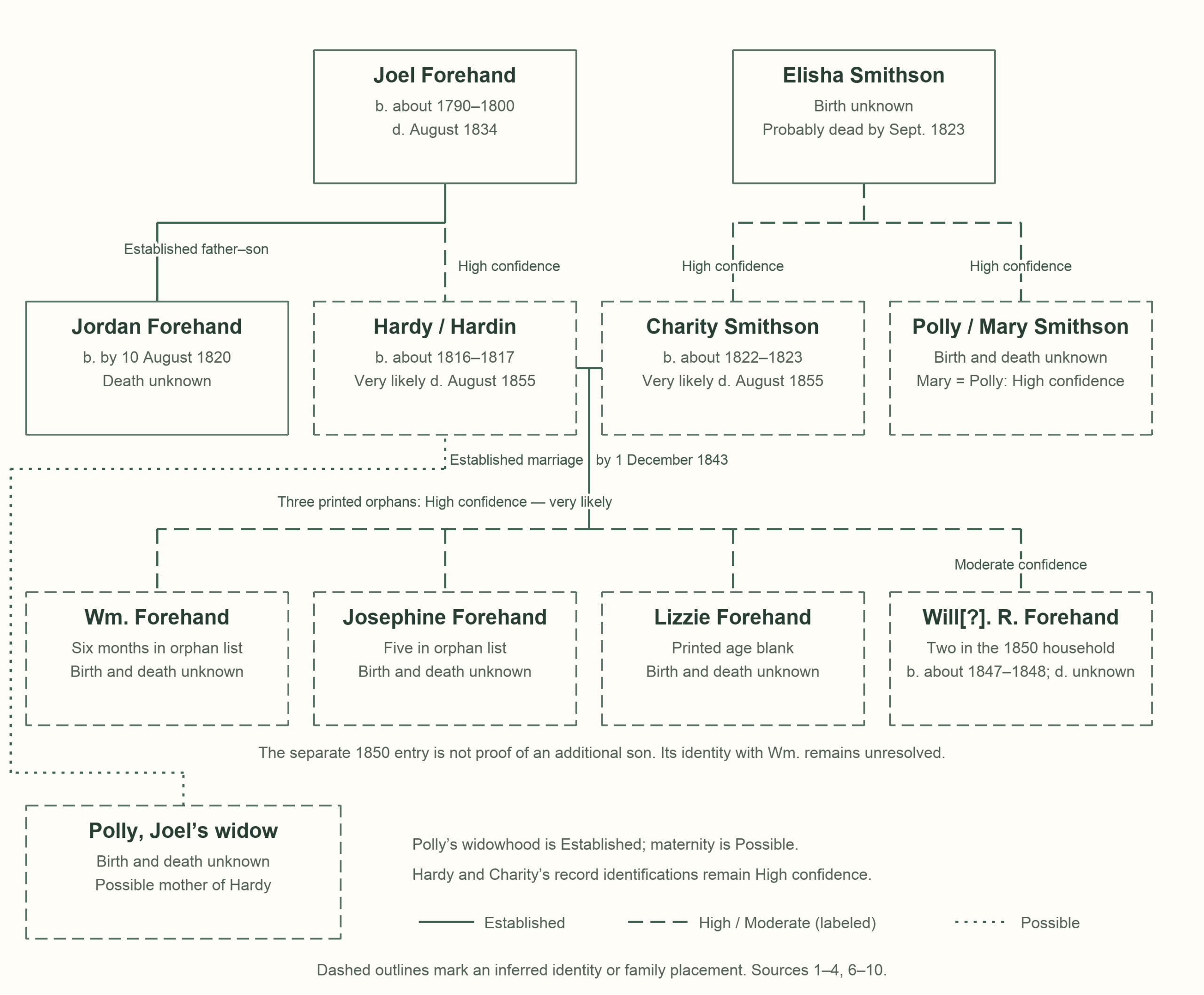
Solid lines show Established relationships; long dashes show High or Moderate confidence as labeled; dots show Possible relationships. Dashed outlines mark proposed identities or placements. The direct son and daughter clauses are Established for the people named in those deeds; linking them to this married couple remains High confidence. The separately shown 1850 boy does not assert a fourth child or a second son.1234689
Sources
- Pasquotank County, North Carolina, deed register EE:260–261, Charity Smithson to James Scott, 10 November 1842; EE:365, John J. McLain to Charity Smithson, 27 December 1842; EE:348–349, Hardy and Charity Forehand to Lewis R. Hinton, 1 December 1843, with 9 December release and March 1844 acknowledgments; EE:377–378, McLain to Hinton, 25 April 1844. Original register images, with exact proof/registration dates and source links in the deed analysis (collection copy). FamilySearch DGS 7538674, images 451–452, 505 and 511 for the retrieved Smithson/McLain deeds; the Forehand sale survives in supplied register photographs. HC-S07–S10.
- Pasquotank County, North Carolina Estate Files, 1663–1979, packet cataloged Smithson, Elisha (1826), 28 original manuscript images, accounts September 1823–February 1839. The catalog year is not a death date. Image-by-image findings (collection copy) and archive URLs and native-file manifest (collection copy), especially E08, E12, E14–E19, E25 and E27. HC-S11. Simpson's given name remains uncertain; guardianship and care do not establish kinship.
- Pasquotank County, Joel Forehand estate packet, 1834, seven selected original manuscript images: year's provision and estate sale 29 October 1834, sale returned December Term 1834; Polly's dower petition December Term 1841, retrospectively dating Joel's death to August 1834. Packet manifest (collection copy), HC-S04. Polly's maternity is unproved.
- Pasquotank deed register DD:275, Hardin to Jonathan Brite, 18 December 1839; EE:26, Jordan–Brite division, 10 August 1841; EE:59, Jordan to Enoch Williams, 8 September 1841. Original register images. DD:275; EE:26 saved image (collection copy); EE:59 saved image (collection copy). HC-S03, HC-S05.
- Pasquotank deed register DD:69, William and Susan Albertson to Harden/Hardin, 4 March 1839; DD:159–160, Hardy to Job Carver, trustee, 9 March 1839; EE:110, Hardin to Jesse Sawyer, 12 August 1839. Original register images. New-deed readings and boundary comparisons (collection copy) and native-image manifest (collection copy); trust opening and continuation. HC-S06, HC-S35–S36.
- United States census, 1840, Pasquotank County, p.352, Hardy household; 1850, Pasquotank County, stamped p.358, dwelling/family 1003, lines 9–11, enumerated 17 September. Original scans: 1840 (collection copy), 1850 (collection copy). HC-S01–S02. The 1850 census has no relationship column. Birth periods are age-derived estimates; the child's name remains uncertain. The integrated research report (collection copy) describes the bounded family/county inventory and superseded birth claim.
- Daily Dispatch (Richmond, Virginia), 21 September 1855, p.1, “Virginia / Progress of the Fever,” list of Naval Hospital, Portsmouth, deaths 1–31 August inclusive. Original issue, Library of Congress; retained partial image showing heading and both Forehand names (collection copy). HC-S23. The locality and adult identity conclusions reuse the separately reviewed research; the list itself gives no marital relationship or North Carolina residence.
- Portsmouth Relief Association, Report of the Portsmouth Relief Association to the Contributors of the Fund for the Relief of Portsmouth, Virginia, during the Prevalence of the Yellow Fever in that Town in 1855 (Richmond: H. K. Ellyson's Steam Power Presses, 1856), pp.185, 187 (death heading/list), 194–195 (burial expenses), 200, 202 (orphan heading/list). Digitized volume; saved orphan entries (collection copy). Contemporary printed record inspected in partial-page captures; source details in death findings (collection copy), HC-S12. Death and orphan sections belong to one volume and are not counted as independent publications.
- Family – Forehand/documents/yellow fever 1855.txt, undated collected notes, authorship/provenance unresolved, HC-S13. A derivative source, not a parent-naming original. Full comparison and cumulative parentage assessment (collection copy); separate original-image and argument review (collection copy), 15 November 2026. Parentage is High confidence; the specific child-identity conflicts remain unresolved.
- United States census, 1860, Jackson Ward, Portsmouth, Virginia, p.187, dwelling 1460/family 1448, line 20, 8 August 1860; Josephine Forehand, nine, female, Virginia-born. Original image, FamilySearch, image 104 of 708; saved full page (collection copy). HC-S14. Same full name, city and approximate age support Moderate-confidence identity, not adoption.
- Pasquotank County, civil action X-3885, petition 30 April 1831, land sale 18 July 1831, guardian's receipt 11 January 1833, in packet Scott, Reuben (1831); original manuscript images and relocatable findings (collection copy), HC-S21. Samuel Scott will, 2 September 1807, register M:171–172; Enoch Scott will, 7 April 1823, M:374–375; original register screenshots and will comparison (collection copy), HC-S40–S41. The Scott ownership branch is documented; its connection to Charity's mother is not.
- Joel Forehand: parent candidates and regional family inventory (collection copy), research synthesis revised 15 November 2026, with original-source locators and independent review. It distinguishes the younger Jordan, Joel's son, from earlier adults; David's son from Solomon's son; and dated tax evidence from pencil-attributed years. This synthesis is an evidence guide, not an independent genealogical source.
- Pasquotank deed register EE:142, Hardy/Hardin mortgage to Redden Sawyer, 1 June 1842; EE:473, Hardin and Reden Sawyer to Isaac Forbes, preferred 11 January 1843; EE:275–276, Hardin's trust securing debt to Jonathan Brite, 5 June 1843. Original register images, new-deed readings (collection copy), image manifest (collection copy) and EE:473 (collection copy). HC-S17, HC-S37–S38. Registration of the Forbes conveyance is 8 July 1845; an incidental later index reading does not replace the inspected deed.
- Encyclopedia Virginia, “The Norfolk and Portsmouth Yellow Fever Epidemic”, scholarly historical overview, accessed 16 November 2026. Used for the ship’s arrival and quarantine, disruption of the two cities, relief work, civilian hospital use and reported 587 admissions/208 deaths. These are regional circumstances, not proof of the Forehands’ movements or place of infection.
- NCpedia, “Dismal Swamp Canal”, for the South Mills–Deep Creek route connecting the Pasquotank and Elizabeth rivers. Howard Association of Norfolk, Report … to All Contributors … during the Summer of 1855 (Philadelphia: Inquirer Printing Office, 1857), p.35, digitized original. The original printed page, inspected as an image, credits Elizabeth City, North Carolina, with $5, $10 and $546 in August–September 1855, totaling $561. Neither source identifies a Forehand journey through the canal or a Pecan Farm stop.
- Portsmouth Relief Association, Report (1856), pp.47, 194–195, 199, digitized original. The inspected original pages name Hardy and Charity among people whose burial expenses were paid and record a $480 purchase of specified Oak Grove Cemetery lots. They do not assign either person to a cemetery or lot. The list also includes a minister identified by his parish history as having a grave in Cedar Grove, Portsmouth. That comparison cautions against treating the expense list as an Oak Grove register; any possible reinterment history has not been systematically checked. Oak Grove is a Possible lead; their specific burial places remain unknown. No common grave is established.
- Edward Sachse, Views of Norfolk and Portsmouth From the Marine Hospital (1851), lithograph. Encyclopedia Virginia’s catalog identifies the naval hospital at right and dates the work. Digital image reproduced from Colonial Williamsburg, “The Independence Hurricane,” figure 1. The full supplied 800 × 639 JPEG is unaltered; the underlying 1851 work is public domain. This is a period harbor illustration, not an image of the Forehands or their arrival.