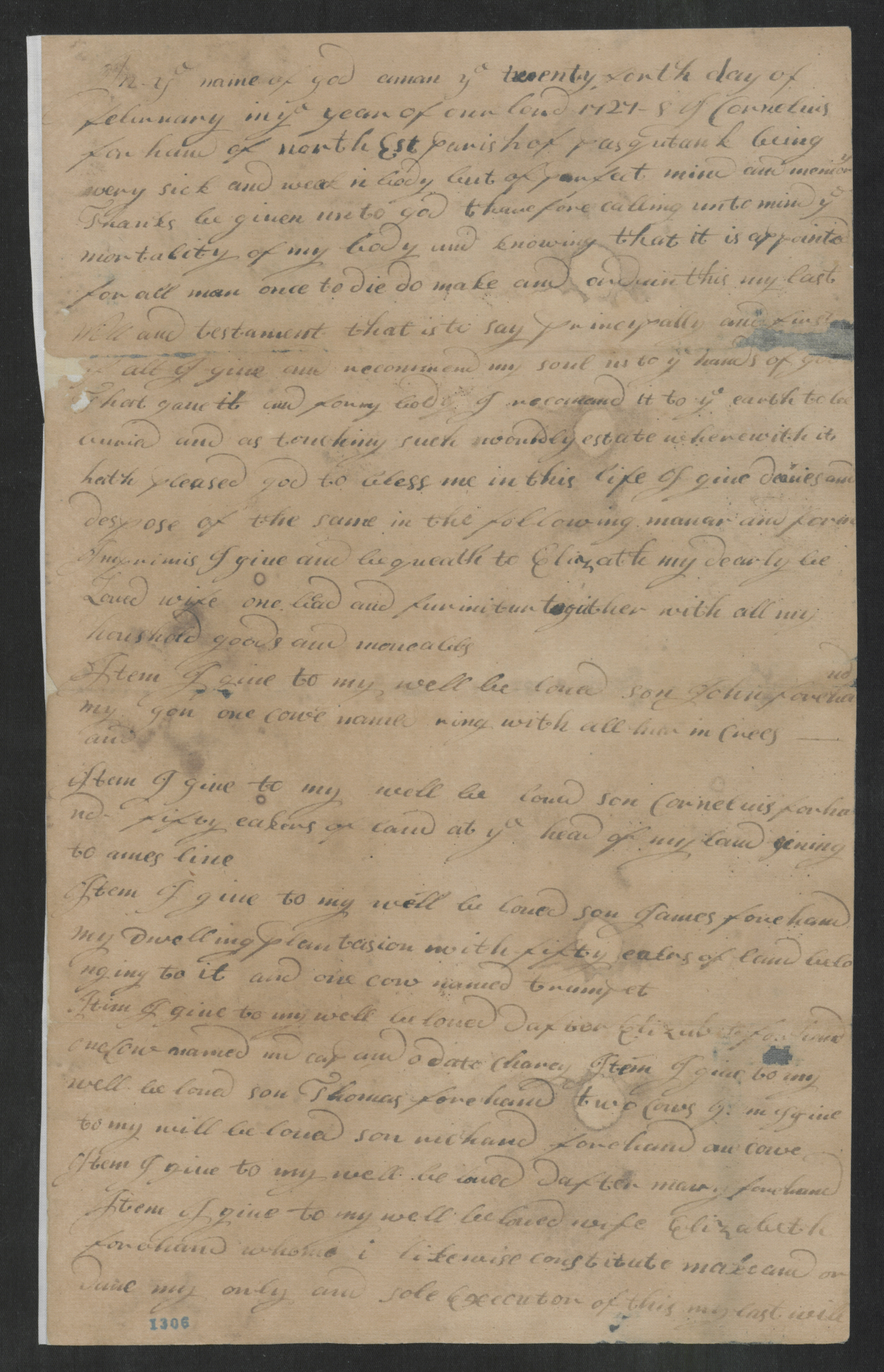
In July 1728, Elizabeth Forehand swore to carry out her husband’s will. Cornelius had left her a bed and its furniture, the household goods and movables, and what remained of his estate after the children received their shares. He had also made her sole executor. His provisions were now her responsibility. The oath places Elizabeth before John Solley that summer; it is the last securely identified act we presently have of her.1
Cornelius had made the will the previous February, while sick and weak in body. He named seven children. The dwelling plantation and fifty acres would go to James; another fifty acres, at the head of the land, would go to the son who bore his father’s name. John received a gun and a cow. Other cattle were divided among the children. Before we know where Cornelius was born, or how he came to North Carolina, we know something of the household he left behind.1
At the Forke of Pasquotank
To look for that household today, begin in the upper Pasquotank country around South Mills, Pierceville and Joyce Creek. Later deeds placed the inherited land in the fork of Pasquotank. The old wording gives this story its title and a regional setting in present-day Camden County, although the house site remains unproved. In Cornelius’s lifetime these were Pasquotank Precinct records. Camden would not be created until 1777, almost half a century after his death.2
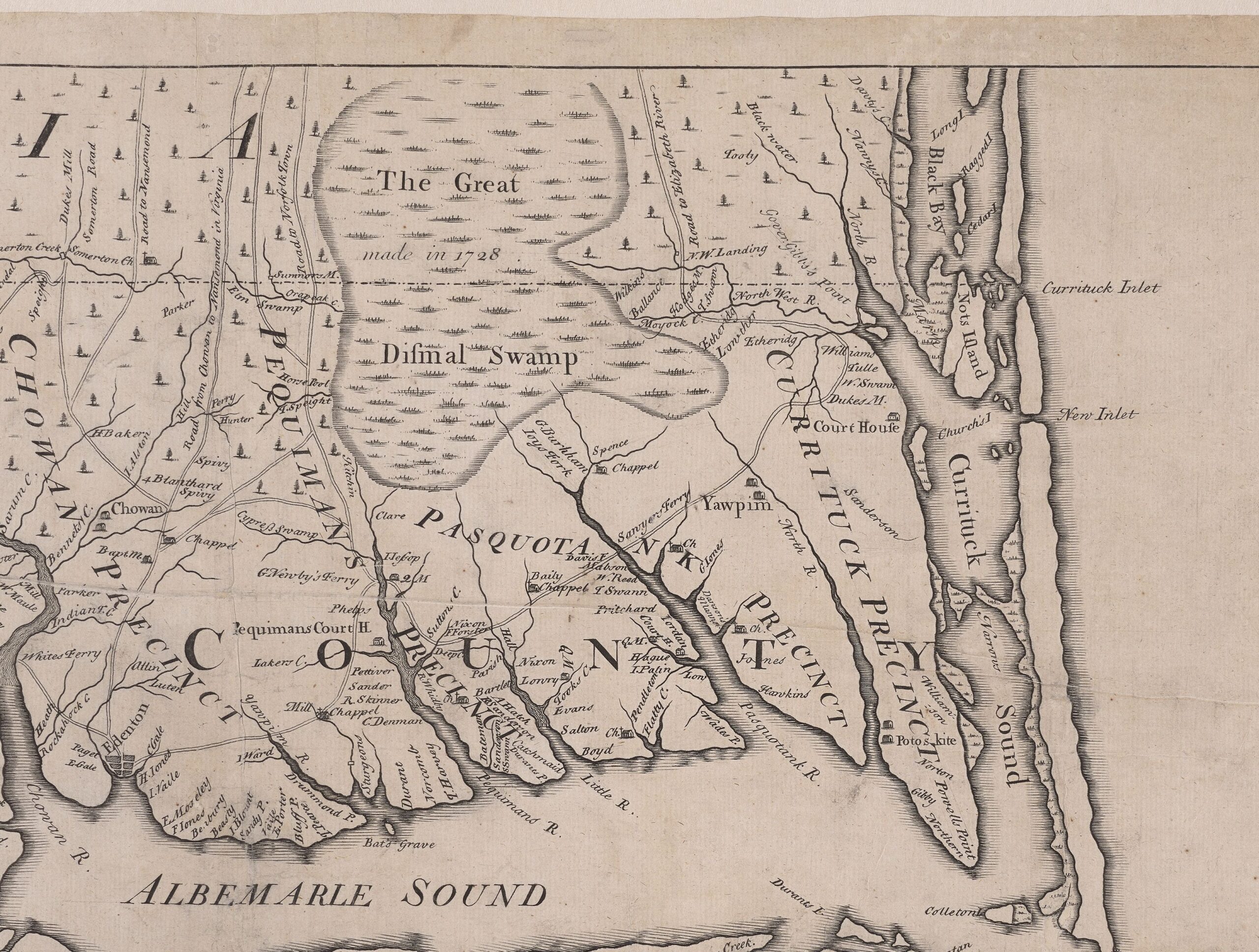
The maps preserve some of the names by which this country was known. Moseley’s 1733 map labels Joys Fork; Price and Strother’s map of 1808 places Joy Creek near New Lebanon. The waterways have since changed through canal construction and the later Turner’s Cut. A modern channel cannot serve unaltered as a colonial boundary. Nor can the northeast side of Pasquotank River, the fork of Pasquotank and the east side of Fork Creek be treated as interchangeable places: each phrase belongs to a particular record.2
Fourteen years before Elizabeth’s oath, William Joy conveyed Cornelius one hundred acres for £6. The date was April 19, 1714, and the parcel lay eastward of Joy’s dwelling plantation. This purchase is Cornelius’s earliest securely verified appearance in the records examined so far. He comes into view as a buyer of land, with no account of the journey that brought him there. Later register copies preserve the full transaction and, after it, the 1739 conveyance by James Forehand, strongly identified with his son.3
On October 20, 1718, Joy conveyed another stated hundred acres for the same price. This instrument expressly calls Cornelius a resident of Pasquotank and connects the land to Joy’s patent of October 16, 1716. It is tempting to put the two acreages together and give Cornelius a two-hundred-acre farm. The instruments do not say that the second purchase was additional. Their relationship—separate ground, overlapping ground or some form of title confirmation—has yet to be resolved.4
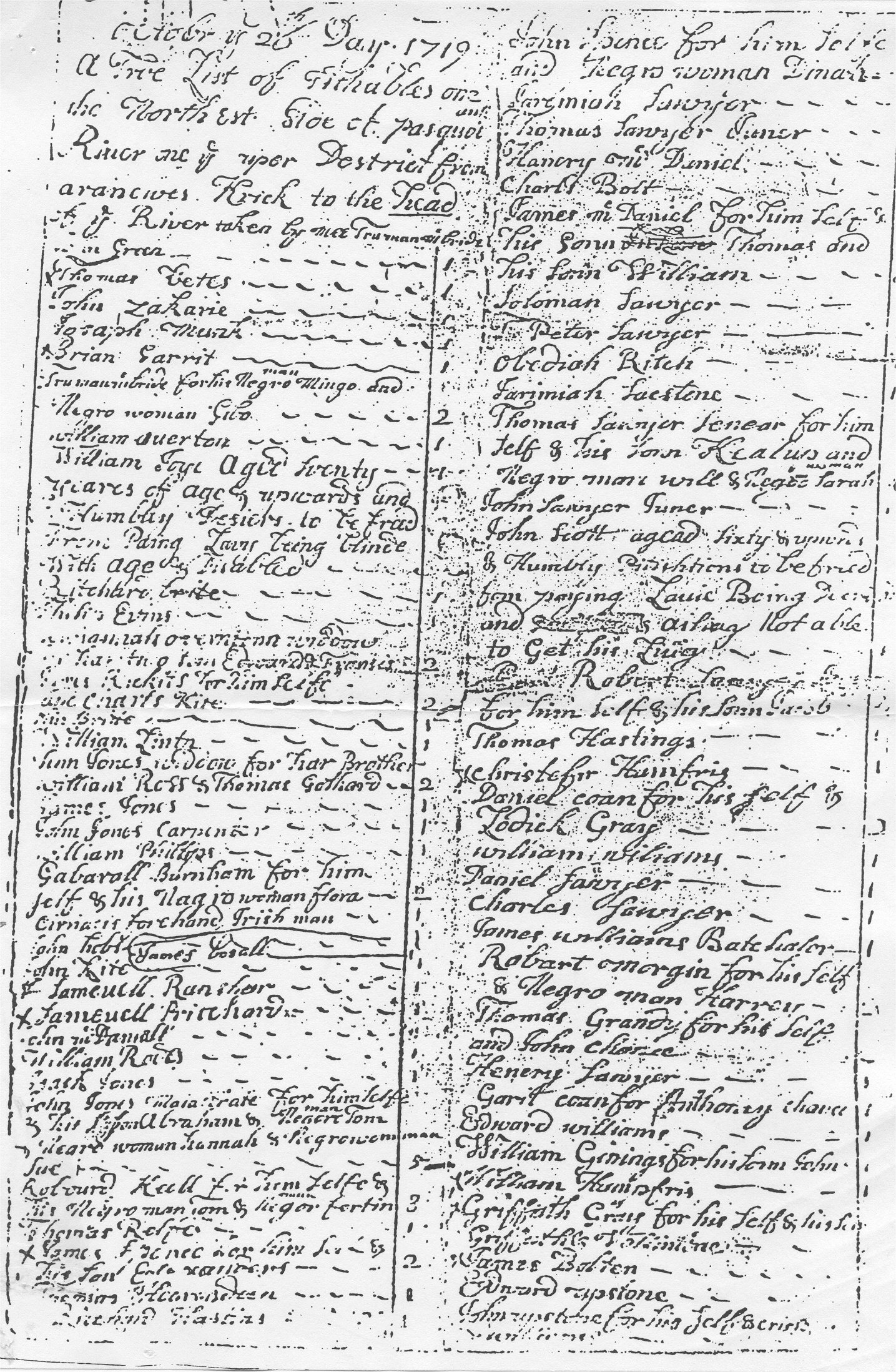
The 1719 tax return supplies a different sort of description. Beside Cornelius’s name appears “Irishman.” It gives the strongest contemporary support for an Irish connection, but no county of birth, ship or arrival year. It does not tell us whether the writer was describing birthplace or family origin. Gabriel Burnham also appears on this return, and John Hobbs is immediately below Cornelius. These were names in his recorded neighborhood; their proximity on paper does not make them relatives.5
By 1723, the colony also knew him as a man to call upon for jury duty. “Cor: Forehand,” number 124, appears on Pasquotank’s statutory list for jury selection. We cannot place him on a particular jury from that list, but his inclusion brings him out of the private business of buying land and into the precinct’s public affairs.6
Family Ties
Cornelius’s will, dated February 24, 1727/8, names his wife Elizabeth, five sons—John, Cornelius, James, Thomas and Richard—and two daughters, Elizabeth and the daughter conventionally called Mary. The second daughter’s name is difficult to read; Mary remains the customary reading. Wife and daughter Elizabeth are separate people, and the will does not expressly identify the wife as every child’s mother. Neither spouse’s parents have been established.1
John received a gun and a cow. Cornelius received fifty acres at the head of the land, beside a line whose name remains uncertain. James received the dwelling plantation and its fifty acres, together with a cow. Thomas received two cows; Richard and daughter Elizabeth received one each. Mary’s clause moves into the next bequest without an identifiable object of gift. Supplying her with a cow would make the pattern neater than the document allows. The gifts establish family relationships, not the children’s ages or birth order.1
Later land records, strongly associated with two of the sons, carry the story forward. In April 1739, James Forehand assigned fifty acres to Richard Fothergale, specifically the portion on which his house stood. The assignment follows the 1714 Joy deed and conveys land out of that title. The dwelling and acreage strongly identify him with the son named in the will, although the assignment does not call Cornelius his father. That October, Fothergale sold the former James Forehand land to Benjamin Burnham.7
In 1750, Cornelius Forehand sold Caleb Burnham fifty acres in the fork, part of Joy’s patent. He is strongly identified with the son who inherited the head-of-land parcel. Once again, the deed’s connection must be made across records: it does not say “my father.” The two inheritance routes lead into Burnham ownership, where the current title research pauses. A later James deed for one hundred acres east of Fork Creek cannot be made their continuation without the missing conveyances.7
Thomas is likely the later Newland landholder whose deeds, taxes and estate extend to 1769, though no later instrument directly bridges him to the son in this will. John’s local and later Edgecombe records require similar care. Richard has no securely identified later appearance. His absence from selected records does not prove that he died in childhood. The daughters’ marriages remain unknown, and Elizabeth’s oath does not establish how long she survived afterward. These gaps leave substantial lives beyond the reach of the present family reconstruction.18
Before the Forke
The surname, or something resembling it, had appeared in the Chesapeake long before Cornelius’s purchase. A Virginia patent issued to William Knott in Surry on November 20, 1653, lists Jno. Forehead among three claimed transportation headrights. Maryland records index Gillian Forehand as transported by 1671. A Henrico patent to Captain John Knowles, dated March 15, 1672 as recorded, includes Tho. Fourehands. Each offers a person to investigate; none supplies Cornelius’s parentage.910
The land-rights system complicates any journey drawn from those dates. Transportation rights could be assigned, and a patent might be issued long after the journey that generated a claim. The people named did not necessarily sail together or settle on the patented land. Gillian’s records involve rights proved by William Jones, master of the Joseph of Bristol, and later assignments. Those transactions trace land rights more securely than they trace Gillian’s subsequent life.910
Thomas has another possible appearance. James Crewes’s will of July 23, 1676, names Thomas Forehand as a witness; its later probate record refers to depositions in December 1677 and recording in August 1680. He may be the man named in the Knowles patent, but that identification is unfinished. The will witness is a firmer starting point for a personal history than a headright alone. It still does not make him Cornelius’s father.9
Names beyond the known household
Later Forehands also appear outside the securely reconstructed family. Susannah Forehand is named on Joshua Gambling’s 1750 return for the upper district on the northeast side of Pasquotank River. The complete sheet gives no husband, widow designation or numerical poll counts. A woman’s appearance there cannot by itself establish that her husband had died. Nor does Cornelius Fourhand’s appearance on the next year’s list record a household passing from mother to son.11
Prudence Forehand enters through a different record in Currituck. On April 4, 1751, Willis Etheridge gave bond to administer her estate. She was already dead. The administrative return dated December 12, 1754, belongs to the settlement of her affairs, not the end of her life. Neither record identifies a husband or children. Prudence and Susannah deserve places in the history under their own names while their connections remain open.12
Josiah appears in Captain Nehemiah Jones’s Pasquotank militia company on a return endorsed 1755. He is not thereby identified with Joseph Forehand in an Edgecombe survey of 1754. Elijah has a closer transaction-level association: he and Isaac Sawyer witnessed Lemuel Forehand’s conveyance to Daniel on October 23, 1772. The conveyance concerned two hundred acres of back land patented by Thomas. Elijah might have been a relative, or a neighbor witnessing their deed; the instrument names no relationship. Neither man can yet be placed among Cornelius’s descendants.1314
Between the Lines
Possibilities, not proven relationships. A Chesapeake route for Cornelius is worth investigating through his associates. Jeremiah Everton, a witness to the 1714 deed, may be the man in an earlier Maryland parish record. A demonstrated connection could explain how people known in one colony came together in another. The alternative remains straightforward: Cornelius could have arrived independently, and the older Forehead, Forehand and Fourehands entries could represent unrelated families. His Irish designation cannot decide between those histories.15
If Susannah was the widow of one of Cornelius’s sons by 1750, James and Richard are the first candidates to test. James’s 1739 transaction leaves room for a later death, unless his proposed continuation in Edgecombe is established. Richard’s documentary gap leaves room too, without supplying positive evidence of either marriage or death. John remains possible with a separate identity problem around later records. Cornelius’s 1750 sale and Thomas’s much later activity make them weaker candidates under the working identifications. But the premise itself is unproved: Susannah could have had a living husband, borne Forehand as a birth surname or belonged to another branch.11
Prudence has likewise been proposed as Richard’s wife. His unknown later life permits the idea, but her administration bond supplies no connection. A distribution, guardianship or deed naming a spouse or child would matter far more than the empty years in his chronology. The same principle applies to Josiah and Elijah: their own associates and property must lead the search, rather than a vacant space on Cornelius’s tree.121314
The land offers a different kind of unfinished connection. Family tradition locates Cornelius opposite McBride Church on Old Swamp Road, near Muddy Road. An earlier interpretation of Joy’s patent and the Moseley map challenged that placement. The modern church identifies where the tradition points; it does not settle the old title. Following the two Burnham branches, recovering Joy’s patent and tracing later owners could bring the household into sharper geographical focus. Until then, the Forke is a defensible region, not a pin on a particular yard.27
For now, the family’s clearest beginning lies in these small, particular provisions: James’s house and fifty acres, John’s gun, the cattle, and the household goods left to Elizabeth. The later land sales let us follow part of that inheritance beyond Cornelius’s death. Elizabeth’s oath records her undertaking to carry out his wishes. She remains there in the record in July 1728, responsible for settling the household whose descendants we are still trying to trace.1
The Family as We Currently Understand It
The will supplies this family’s firm outline. Solid borders and connectors represent relationships explicitly stated in it. The children’s dates below belong to the people named in the will; later identifications remain qualified in the note beneath the tree.
Birth unknown · Living July 1728
Birth and death dates unknown
Birth and death dates unknown
Birth and death dates unknown
Birth and death dates unknown
Birth and death dates unknown
Birth and death dates unknown
Birth and death dates unknown
Elizabeth is named as Cornelius’s wife, but the will does not expressly identify her as every child’s mother. The order here is not a proposed birth order. Thomas is likely the later Newland man who died in 1769; that later identity remains unproved. The later James and Cornelius landholders are strongly correlated with the named sons. 7, 8.
Susannah — recorded 1750
Prudence — deceased by April 4, 1751; estate return December 12, 1754
Josiah — militia return endorsed 1755
Elijah — deed witness October 23, 1772; recorded April 13, 1773
These names are deliberately unconnected to the tree. Shared surnames and gaps in other people’s records do not establish their relationships. 11–14.
A Life in the Records
This chronology separates Cornelius’s recorded acts from later family and title evidence. The earlier Chesapeake names are separate people.
| Date | Evidence and limits |
|---|---|
| November 20, 1653 | Jno. Forehead in William Knott’s Surry patent headrights; not an established Cornelius relative.9 |
| By 1671 | Gillian Forehand’s transportation in the Maryland index; later land-right assignments do not establish subsequent residence.10 |
| March 15, 1672, as recorded; July 23, 1676 | Tho. Fourehands in Knowles’s Henrico patent; Thomas Forehand witnesses Crewes’s will. Same-man identification remains open; probate references December 10, 1677 depositions and August 2, 1680 recording.9 |
| 1706 and July 20, 1708 — unverified leads | Earlier correspondence reports a Cecil Joyce–Cornelius transaction in 1706; the instrument remains unrecovered. A reported Joy–Everton conveyance of July 20, 1708 is an associate lead, not a verified appearance by Cornelius. Neither extends his established chronology before 1714.15 |
| April 19, 1714 | Joy conveys Cornelius 100 acres, £6; acknowledged April 20, registered May 6. Earliest securely verified Cornelius event.3 |
| 1715, reported | A partial transcription reports Cornelius in tithables; underlying dated record not verified. It does not move the secure chronology earlier.5 |
| October 20, 1718 | Joy conveys stated 100 acres, £6; acknowledged October 21, registered October 23; Joy’s patent dated October 16, 1716. Relationship to 1714 acreage unresolved.4 |
| October 1719 | Cornelius described as Irishman, one tithable, northeast upper district. Day readings conflict; household membership is not enumerated.5 |
| 1723 | No. 124 on Pasquotank list accompanying November 23 jury-selection act; actual jury service unproved.6 |
| February 24, 1727/8 | Will names wife and seven children. No established birth years or birth order.1 |
| July 1728; July 28 preferred | July Court proof; Elizabeth’s personal oath before John Solley, preferred day 28, superseding older 26. Cornelius died after execution and by the oath; exact death day unknown.1 |
| August 23, 1732; April 23, 1735 | Neighboring conveyances name James’s line; useful context, not a modern survey of Cornelius’s land.7 |
| April 10 and October 9, 1739 | James’s fifty-acre assignment to Fothergale; Fothergale’s sale to Benjamin Burnham. Direct link to 1714 title; James’s sonship identification is strongly correlated.7 |
| 1750–1755 | Susannah’s 1750 return; Cornelius seller’s October 30, 1750 deed, proved April 1751, registered April 18; Cornelius Fourhand on the separate 1751 tax return, without proof of household succession from Susannah; Prudence deceased by April 4, 1751, with December 12, 1754 administration return; Josiah on endorsed 1755 militia return. These records do not join everyone into one household.7111213 |
| October 23, 1772 | Elijah witnesses Lemuel–Daniel deed; proved December 1772, registered April 13, 1773. No stated kinship.14 |
Sources and further reading
1. Cornelius Forehand, will dated February 24, 1727/8, North East parish, Pasquotank Precinct; July Court 1728 proof and Elizabeth’s oath before John Solley, preferred July 28, 1728. State Archives of North Carolina, Secretary of State Wills, MARS 12.96.8.86, DOC557892, two original-record color images. Official will images. Images inspected in the family research and freshly checked for this article; writer directly viewed front. The clearer reverse favors 28 over the superseded 26. Daughter Mary is a conventional reading of irregular handwriting; no identifiable gift follows her name. The will does not identify every child’s mother or state ages. Elizabeth’s oath is a probate act, not Cornelius’s death date.
2. Regional geography: Edward Moseley, map of North Carolina, 1733, upper Pasquotank detail, Joys Fork; Jonathan Price and John Strother, North Carolina map, 1808, Library of Congress G3900 1808 .P7, resource g3900.ct003493, label Joy C near New Lebanon, Library of Congress exemplar; USGS South Mills, 1982, 7.5-minute sheet; Adriana T. Moss and others, R-5717 Historic Structures Survey Report, February 2018, printed pp. 116–118, official survey, McBride Church at 228 Old Swamp Road. Selected map/survey images inspected in the underlying geographic research. Channel-change findings follow the inspected 1880 federal water-route report, p. 36, and National Register canal documentation, continuation p. 3; modern channels are not colonial parcel boundaries. The McPherson/McBride tradition and a contrary patent interpretation are preserved in an earlier March 24, 2013 article, a research narrative rather than independent title proof.
3. William Joy to Cornelius Forehand, April 19, 1714, 100 acres, £6; acknowledged April 20, registered May 6. Pasquotank original reference A:78; complete later copy B:264, DGS 7517571, image 269, copied August 3, 1819, followed by James’s 1739 assignment. B:264 image. Further recopy pp. 618–619, DGS 7539385, image 547, retranscribed December 19, 1874, complete title and assignment. Historical recorded copies inspected, not the executed original. The older incomplete family copy was transcribed July 19, 1816. Multiple copies preserve one transaction.
4. William Joy to Cornelius Forehand, October 20, 1718, Pasquotank A:200; 100 acres, £6; acknowledged October 21, registered October 23, copied September 29, 1816. Family photograph of historical register copy inspected in the underlying deed research. The recital names Joy’s October 16, 1716 patent, not a Cornelius arrival event. No direct archive-image URL or fuller digital-book locator has yet been recovered for this copy; FamilySearch catalog is a retrieval route. Separate acquisition, overlap and title-confirmation interpretations remain unproved.
5. Pasquotank upper-district northeast-side tithable return, October 1719, Cornelius/Cornel. Forehand entry, “Irishman,” one tithable; retained historical-record photograph inspected. The September 30 report read October 26, while the October 3 deed audit read October 21. Fresh review finds the supplied copy insufficient to settle the day; this article uses the month and year. Full archival series/item citation remains unrecovered. The reported 1715 appearance rests on a partial transcription, not a newly verified dated original. State Archives of North Carolina is the repository retrieval route, not a direct image link. List neighbors do not establish kinship or adjoining parcels.
6. The State Records of North Carolina, vol. 25, pp. 184–188, chapter I, act dated November 23, 1723; Pasquotank roster p. 187, “Cor: Forehand,” no. 124. UNC Documenting the American South transcription. Inspected scholarly electronic transcription, not original manuscript. The act provides for subsequent selection and summons; listing does not prove attendance or service on a particular jury.
7. Dwelling title: James Forehand to Richard Fothergale, April 10, 1739, fifty-acre assignment following the 1714 deed, B:264 and recopied pp. 618–619, image links in source 3. Fothergale to Benjamin Burnham, October 9, 1739, original folio 415; later Pasquotank B:286–287, DGS 7517571, images 291–292, registered October 13, 1739, copied August 23, 1819. Separate Cornelius Forehand to Caleb Burnham, October 30, 1750, fifty acres, £10, proved April Court 1751, registered April 18, copied June 30, 1819; retained register-copy photograph, fuller book locator unrecovered. Adjoining evidence: Margery Joy to Gabriel Burnham, August 23, 1732, C:327–328, DGS 7517572, images 353–354, record image; Solomon Everton to Gabriel Burnham, April 23, 1735, recopied pp. 444–446, DGS 7539385, images 453–454, record image. Inspected recorded copies; later sellers’ identities as the sons remain supported correlations. Camden B:56–57, James to William Whitehurst/Whitehouse, May 23, 1778, is a separate hundred-acre Fork Creek tract without a Joy/Cornelius recital.
8. Working adult-son identifications rest on the separately reviewed Pasquotank/Edgecombe John and Newland Thomas record groups, rather than on a new relationship clause. Thomas executed Newland deeds September 7 and 9, 1769; his inventory preferably reads December 7 and his administration bond is December 15, 1769. His identity as Cornelius’s son remains unbridged by an explicit later instrument. Selected John tax/court records and later Edgecombe deeds do not all identify the same man. Richard’s later biography and the daughters’ marriages remain unproved. The secure family anchor is the original will, source 1. FamilySearch catalog provides a public retrieval route for county deed/estate collections; this note does not claim a fully recovered citation for every later appearance.
9. Virginia Land Office, Patent Book 3 (1652–1655), p. 232, William Knott, Surry, November 20, 1653, 112 acres, headright Jno. Forehead; reel 2, image 002_0661.tif, Library of Virginia image. Patent Book 6 (1666–1679), p. 446, Captain John Knowles, Henrico, March 15, 1672 as recorded, headright Tho. Fourehands; reel 6, image 006_0457.tif, patent image. Both patent-book images visually checked. James Crewes, Turkey Island, Henrico, will July 23, 1676, witness Thomas Forehand; recorded probate references December 10, 1677 depositions and August 2, 1680 recording. Retained handwritten court-record photographs inspected; exact volume/page not recovered. The two Thomas identities and the Forehead surname relationship remain unproved. Context: Library of Virginia, The Virginia Land Office, Research Notes 20, pp. 1–2, on headright transfer and delayed patents. Headright dates are not exact arrival dates.
10. Maryland State Archives, Early Settlers of Maryland, MSA SC 4341-357, Gillian Forehand, transported by 1671; original Liber WT, folios 465 and 479, film SR7547; transcript Liber 16, pp. 435 and 447, SR7357. Official index; original WT volume catalog. Index and retained transcript images inspected in the arrival research, original WT pages not newly inspected. The Joseph of Bristol and William Jones occur in the land-rights records; assignments concern transportation-generated land rights and do not establish Gillian’s personal transfer as a servant. Maryland Archives explanatory guidance. Gillian is not a documented relative of Cornelius.
11. Joshua Gambling, Pasquotank upper-district northeast-side return, 1750, Susannah Forehand near foot of middle column; complete historical-record photograph in county collection, no numerical poll counts or widow designation. Companion 1751 return names Cornelius Fourhand but records no household succession. Full archival reel/item locator remains unrecovered. Images freshly re-examined for the November 4 brief. The conditional widow comparison follows separately reviewed dates/identifications for the five sons; it is not a proved marriage. Tax-return context: 1743 act, chapter II §II, and 1749 act, chapter III §§III–IV, State Records 23:210, 345, printed pages checked in the underlying review; UNC Colonial and State Records is the public edition retrieval route. A master or mistress making a return is not an express widow designation.
12. Prudence Forehand, Currituck County administration bond, April 4, 1751; Willis Etheridge administrator, Thomas Burgess and Nehemiah Bennet among obligors. Original-record photograph freshly inspected for the November 4 brief; full archive series/item locator not recovered. Derivative note cites Early Records of North Carolina, vol. 1, 1753–1790, p. 31, William Shergold’s December 12, 1754 administrative return; that return’s original image has not been checked here. State Archives and FamilySearch catalog are retrieval routes. The 1751 bond establishes that Prudence was already deceased; neither source establishes husband, children or Richard connection.
13. Captain Nehemiah Jones’s third company, Colonel Robert Murden’s Pasquotank regiment, Josiah Forehand entry, second retained company photograph, right column between Thomas Overton and Thomas Bright. State Archives of North Carolina, Troop Returns Collection, TRPR; official finding aid identifies endorsement “Returns from Pasquotank County 1755.” Company images freshly inspected; endorsement itself outside the photographs, year supported at catalog level. Do not merge Josiah with Joseph Forehand in the Edgecombe survey of June 7, 1754. No kinship or battle participation is stated.
14. Lemuel Forehand to Daniel Forehand, Pasquotank, October 23, 1772, 200 acres out of 320 acres of Thomas Forehand’s back land, southwest side of Pasquotank River, £100 proclamation; witnessed by Isaac Sawyer and Elijah Forehand; proved December Court 1772, registered April 13, 1773. Recorded-deed photographs freshly inspected for November 4 brief. Full book/page and direct archive-image locator remain unrecovered; FamilySearch county deed catalog is a retrieval route. No Elijah relationship clause or exact age follows from witnessing. The 1773 filename dates registration, not execution.
15. Jeremiah Everton, witness in the April 19, 1714 Joy–Forehand deed, source 3; retained Maryland parish-register photograph identified in family research as All Hallows, Anne Arundel County, marriage of Jeremiah to Hannah, written March 21, 1702, provisionally normalized 1702/3, with the bride’s surname difficult in the supplied image. Historical register photograph inspected in the arrival investigation; original volume/full archival locator and calendar convention still need confirmation. Maryland State Archives Guide is a public repository retrieval route. The Maryland man–Pasquotank witness identification remains a hypothesis. A reported July 20, 1708 Joy–Everton conveyance and a supposed 1706 Cecil Joyce–Cornelius transaction are precise but unverified leads in earlier family research, not earlier established Cornelius events.