The doctor’s office outlasted the house. In 2010, when surveyors came to the old Marchant place near Indiantown Bridge, a later dwelling stood where the family had lived. Nearby they recorded a smokehouse, three barns, an old kitchen and the little one-story office associated with Dr. Gideon Marchant.2
Indiantown Creek runs into North River, and the bridge brought the roads and households of Camden and Currituck into a common neighborhood. Jesse Pugh placed Marchant’s residence on the Currituck side, near Indiantown Bridge. A mill and a shipyard belonged to the creek’s earlier history. In time, its water and roads would carry timber, troops and news of war past a place still called by the doctor’s name.34
One account of life along this creek came down through the Currituck County Historical Society. Its author remembered Thomas McKnight’s shipyard and the Native people who had lived at Indiantown. Farther along in the same account, a fiddler and a sawmill operator take their turns telling us where we are. The creek runs through all their stories.1
Many interesting things have been told about Indiantown and its people, from way back when it was one of North Carolina’s first ports of entry and had a shipyard there. The shipyard was operated by Thomas McKnight. Mr. McKnight was a colorful character having to deal with the Indians who lived at Indiantown. Indian relics that remind us of the first settlers that lived along this quiet and scenic creek that enters into the North River, can still be found nearby.
Unidentified author, The Journal of Currituck County Historical Society, vol. 1, no. 3, checked against photographs of the printed article.1
A bride at the back door
In the neighborhood telling, a maid carried word to a bride on her wedding day. A man was waiting outside on horseback. The bride slipped out the back door and went with him. That was how the story said Gideon Marchant got married. The writer left the bride unnamed. A Camden County marriage can be dated more precisely. On January 8, 1829, Dr. Gideon C. Marchant married Mrs. Emily Trotman, according to a published abstract of the Edenton Gazette notice. Whether Emily was the woman on the horse remains an open question.16
Dr. Marchant had somewhat a hectic romance. His fiancee’s parents wanted her to marry someone else. He was away, probably at Medical School, when he received word that his fiancee was to marry someone else. He hurried home and arrived the day she was to be married. The guests were arriving. Dr. Marchant sent word in the house by a maid to tell his fiancee he had come for her. She went out the back door, jumped on the horse with him, and rode away to get married. They left the guests and bridegroom in shock. They lived an interesting and happy life together.
Unidentified author, The Journal of Currituck County Historical Society, vol. 1, no. 3, checked against photographs of the printed article.1
One young man came to practice medicine at Indiantown through Marchant’s help. Henry M. Shaw studied at the University of Pennsylvania with Marchant’s sponsorship, according to the Museum of the Albemarle. When Shaw had his degree, he joined the older doctor in practice.5
By June 1835, Marchant’s standing had taken him to Raleigh as one of Currituck’s two delegates to the state constitutional convention. Isaac Baxter was the other. On June 13, Marchant voted for a resolution calling for the removal of voting rights from free Black and mixed-race men covered by its terms. The resolution instructed a committee to draft an amendment; the vote was a step toward changing the constitution, rather than the final enactment. It records his part in the effort to restrict the political rights of North Carolina’s free Black population.9
At home, his name also appeared in the affairs of Hall Lodge No. 53 at Indian Town. The Grand Lodge’s proceedings for 1839 list G. C. Marchant as master and Alfred Perkins as secretary. The initials and locality fit the physician, though the roster does not spell out his name. The local article later remembered Masonic meetings in his house and Seth Forbes carrying the papers to safety when it burned.101
The plantation where Dr. Marchant lived was, in its day, one of the finest in the Albemarle area. Colonel Draper described it when he camped there as looking like a complete village with around twenty or more buildings with brick walks connecting many of them. The house caught fire and burned down. Mr. Seth Forbes saved the Masonic papers that were upstairs before the house burned. This was where the Masons were having their meetings. The Indiantown Academy which was founded in 1789 had been their meeting place until it was burned December, 1863, by the Yankee Troops.
Unidentified author, The Journal of Currituck County Historical Society, vol. 1, no. 3, checked against photographs of the printed article.1
In January 1849, Marchant named an Alfred Perkins to serve as trustee for his daughters. The will names them as Elizabeth F. and Archann D. and makes provision for his wife, Emily S. Two other people appear by name. Marchant assigned Lettice and Pricilla, whom he enslaved, along with a plantation to Thiresy Marchant during her life or widowhood. Afterward the will named Johnston and Emily, the children of Thiresy’s late husband Johnston, as beneficiaries. We know what Marchant intended for Lettice and Pricilla because his instructions survive in a transcription of the will. Their own wishes went unrecorded there.710
The household’s history continued through the daughters. A published biography of Lucien Douglas Starke identifies his wife as Elizabeth Ferebee Marchant of Indiantown and describes the family moving inland during the Civil War. That account has not yet been followed through the underlying marriage and family records.8
The historical society article gives Marchant’s dates as January 23, 1798, to January 21, 1861. By the February term of the Currituck court, both Gideon and Emily had died, according to the probate entry. Soldiers would still know where to find “Marchant’s place” when the war reached Indiantown.17
Letters across the lines
On June 10, 1862, Union naval forces under Lieutenant Charles W. Flusser entered North River and burned the schooner Scuppernong, laden with oak timber intended for Confederate shipbuilding. The same creek that served local work had become part of the war’s supply routes.24
At Indian Ridge on January 28, 1863, Joseph B. Morgan wrote to his son Patrick, a cadet at the Virginia Military Institute. The last letter he could remember receiving from Patrick was dated in November. Albert had come home with news, but he had destroyed the letters he carried for fear they would be captured. Uncle James and his family were now under the Morgans’ roof after shelling drove them from home. Two of Mr. Baxter’s children had died of diphtheria. Everyone in the Morgan house had had a sore throat, and Joseph wondered whether little Jodie had suffered a mild case. Now Jodie was playing about the house again, and Lillie and Ida were going to school.11
In that same letter Joseph passed on news from Indian Town. A few weeks earlier, he wrote, troops had burned the academy and the buildings on Marchant’s property opposite the place where the doctor used to live. Joseph did not say he saw the fire. But he had heard of it by January 28, nearly eleven months before the December 1863 date remembered in the historical society article. His description puts the burned buildings across from the former residence. When the house itself burned remains uncertain.111
In December 1863, General Edward A. Wild’s expedition brought United States Colored Troops into the district, freeing enslaved people and pursuing Confederate forces. Colonel Alonzo G. Draper’s men fought around Indiantown and Sandy Hook. Their arrival offered enslaved families an opportunity for freedom and brought Confederate households the prospect of seizure and destruction.24
Pugh says the troops collected poultry from surrounding farms, ate at Marchant’s residence and camped there. The local article approaches the fighting through Bill Hutchins’s interrupted square dance and men taking up the bridge boards. The Civil War Trails panel explicitly identifies the Hutchins episode as local tradition. The historical society article’s remembered confrontation between Draper and Mr. Williams, and its claims about burials in Marchant’s yard, have not been independently established in the records examined here. They cannot yet identify particular graves or soldiers.34
Indians that were killed in Colonial Days as well as troops that were killed in the War Between the States at Indiantown Bridge are buried in the back yard of Dr. Marchant’s home.
Unidentified author, The Journal of Currituck County Historical Society, vol. 1, no. 3, checked against photographs of the printed article.1
Bill Hutchins was fiddling for a square dance at Indiantown when news came that troops were coming down Trotman Road. The ladies were sent home and the men went to take up the bridge that crossed Indiantown Creek. Several troops were killed there and were carried to Dr. Marchant’s yard to be buried.
Unidentified author, The Journal of Currituck County Historical Society, vol. 1, no. 3, checked against photographs of the printed article.1
Colonel Draper and his staff rode back to a Mr. Williams’ home and asked him to get his cart and go bury the men the Rebels had killed. He asked the wrong man for he was a Confederate soldier on leave home. He was sick with arthritis and was bent over so he had to turn his head sideways to look up at Colonel Draper who then drew his pistol, pointed it at Mr. Williams, and demanded he obey his orders. Mr. Williams looked him in the eye and told him, “You don’t have the guts to shoot me.” Mr. Williams lived to tell this story, and is remembered as a man who said what he meant and meant what he said.
Unidentified author, The Journal of Currituck County Historical Society, vol. 1, no. 3, checked against photographs of the printed article.1
On January 3, 1864, Joseph wrote Patrick again. This time he had crossed Union lines himself. After Wild’s expedition, Currituck residents sent five men, Joseph and Dr. Cowell among them, to ask General Benjamin Butler what families must do to keep their houses from being burned. The delegation went by way of Deep Creek and took a boat to Old Point. Joseph wrote that Butler asked them to remain peaceful and use their influence against guerrilla fighting and blockade running. By the end of the letter Joseph had come back to a matter closer to Patrick. His mother, recovering from an illness, was trying to get some shirts ready to send him.11
What the grappling hooks brought up
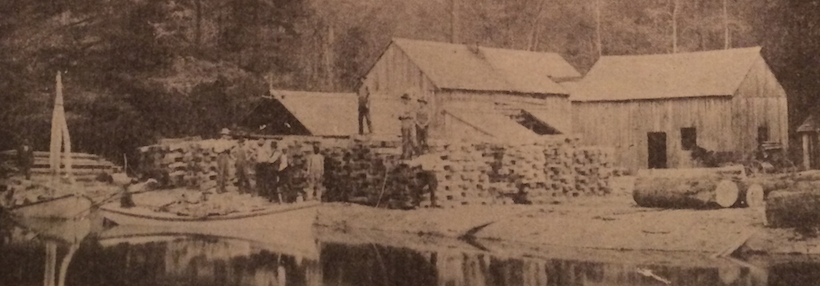
In later years Pent Gibson worked this stretch of creek for a different reason. When business at his sawmill was slack, he went out for logs that had sunk. Time and again his barge struck something under the water. At low tide, according to the local account, Gibson got his grappling hooks into it.1
Mr. Pent Gibson ran a saw mill at Indiantown. During slack seasons, he would get up sunken logs but would often strike something with his barge that mystified him. He hooked on to it at low tide with grappling hooks and almost sinking his barge, began to raise the sunken object slowly. What came up looked like Noah’s Ark. The old men of the area said it was Dr. Marchant’s rail barge. The barge was sunk by Dr. Marchant to save it from the enemy during the war. It was around thirty feet long, twelve feet wide, and six feet deep and built of juniper two inches thick, with a two inch copper band fastened with screws around the top.
Unidentified author, The Journal of Currituck County Historical Society, vol. 1, no. 3, checked against photographs of the printed article.1
Mr. Gibson sold the barge to a man from Baltimore who wanted to put it in a museum. It was carried to Shawboro and loaded on a flat rail car to be shipped to Baltimore. This was around 1910. Efforts have been made to locate the barge but to no avail as yet.
Unidentified author, The Journal of Currituck County Historical Society, vol. 1, no. 3, checked against photographs of the printed article.1
The old men gave Gibson’s find a name. The dates leave one part of their story in doubt. Marchant had died before the war began, too early to have sunk the barge himself to keep it from the enemy. The last place the local account traces it is Shawboro, loaded on a flatcar for Baltimore. The buyer wanted it for a museum. Where it went after that remains unknown.17
Another object required no salvage from the creek. The historical article records the gift of Marchant’s medical chest by Dr. Pool’s family of Elizabeth City. Its present custodian has not been confirmed.1
We are fortunate to have in Currituck County, the medical chest of Dr. Gideon C. Marchant which was given to us by Dr. Pool’s family of Elizabeth City. This is very interesting to see, and if it could talk, what interesting things it could relate of that tragic era!
Unidentified author, The Journal of Currituck County Historical Society, vol. 1, no. 3, checked against photographs of the printed article.1
In the old account the barge left Shawboro by rail, while the medical chest came to Currituck through Dr. Pool’s family of Elizabeth City. Of the things the neighborhood associated with Gideon Marchant, one was still in the surveyors’ inventory in 2010, on the ground where he had practiced. It was the little office at Indiantown.12
Sources and further reading
1. Unidentified author, “Dr. Gideon Marchant,” The Journal of Currituck County Historical Society, vol. 1, no. 3, reproduced online 28 January 2014, original article. Six photographs added to the research collection on 28 October 2026 show overlapping views of three article pages, headed “DR. GIDEON C. MARCHANT” with the dates January 23, 1798–January 21, 1861. The photographs show no author, issue cover, publication date or readable page numbers; the volume and issue attribution follows the 2014 introduction. All nine historical paragraphs are retained. The quotations correct the website’s “way” to “away,” “feep” to “deep,” and academy-fire year 1864 to the printed 1863. The omitted word “into” in the creek description is restored. Typography and line-break hyphenation are normalized. The printed photograph caption is “Scene at Indian Town Bridge.” These are photographs of a later historical account, not contemporary records of all events described. Source claims are assessed outside the quotations; unchanged photographs and the superseded website text are preserved in the research collection.
2. North Carolina Historic Preservation Office, Currituck County architectural survey (2010), sections E, pp. 43 and 46–47; associated property discussion later in the survey. Saved PDF and decisive page images inspected. A modern architectural/historical synthesis: it records surviving outbuildings and contains conflicting dates in its discussion of wartime destruction. Official survey PDF.
3. Jesse Forbes Pugh, Three Hundred Years Along the Pasquotank: A Biographical History of Camden County (1957), pp. 180–181, East Carolina University copy. Printed spread visually inspected. Secondary narration incorporating older military accounts; its description locates Marchant’s house in Currituck near Indiantown Bridge.
4. North Carolina Civil War Trails, Indiantown: Chasing “Guerrillas”, single-page interpretive panel preserved locally as Camden County/Civil War/document.pdf. Complete panel visually inspected. It explicitly labels the Hutchins dance/bridge episode local tradition; it quotes Flusser’s 10 June 1862 report and describes the December 1863 expedition. Original download date not established.
5. Museum of the Albemarle, “Henry M. Shaw,” Under Both Flags (2011 exhibit). Institutional secondary account of Marchant’s sponsorship of Shaw’s medical training and their practice association; not evidence that Marchant himself attended the University of Pennsylvania.
6. North Carolina Genealogical Society Journal 22, no. 4 (November 1996), p. 377, Miscellany, quoting Edenton Gazette, 27 January 1829. Journal page visually inspected; original newspaper image not yet inspected. The notice calls the bride “Mrs. Emily Trotman.” Her birth surname and earlier marriage are not established by that wording alone.
7. Gideon C. Marchant, will dated 21 January 1849, Currituck County Will Book 4, pp. 241–242, with February Term 1861 probate entry; NCGenWeb transcription. The transcription names wife Emily S. and daughters Elizabeth F. and Archann D.; the probate entry reports both spouses deceased. Original-record image not inspected in this pass. Dates and family statements are presented as the content of this transcription, not as an independently completed lineage proof.
8. “Starke, Lucien Douglas,” Dictionary of North Carolina Biography, via NCpedia. Biographical secondary source for Elizabeth’s marriage and wartime family moves. Search-index text was available, but direct page retrieval returned an access error; underlying family records were not inspected. Exact dates and the children’s full list are therefore omitted pending a fuller source check. The spelling Starke follows this source; the surname also appears as Stark elsewhere.
9. Journal of the Convention, Called by the Freemen of North-Carolina, to Amend the Constitution of the State (1835), pp. 3 and 22–23; complete scan. Printed pages checked: Currituck delegates on 4 June; 13 June resolution and vote. Marchant appears among the yeas. The resolution instructed drafting an amendment and must not be mistaken for final enactment.
10. Proceedings of the Grand Lodge of North Carolina, annual communication beginning 2 December 1839 (Raleigh: T. Loring, 1840), p. 15, DigitalNC scan. Original printed roster visually inspected. Initials and locality match the physician’s record cluster; the roster itself does not give his full name or title.
11. Joseph B. Morgan to Patrick H. Morgan, January 28, 1863 (Indian Ridge), and January 3, 1864 (Currituck County), Morgan Family Letters, Virginia Military Institute Archives, MS 0356. The collection’s transcriptions appear on PDF pages 1–2 and 4–5 of the copy in the family research library. The first letter reports the fire and describes the Morgan household. The second recounts Joseph’s own trip to meet Butler. VMI collection guide.