Gillian Forehand stands first in the list. Beneath the name come the others whose transportation to Maryland William Jones presented as grounds for a claim to land. Jones was master of the Joseph of Bristol. On 7 March 1671/72, he proved rights for forty-six people and 2,300 acres. Gillian’s name entered the register because a crossing of the Atlantic had become part of a transaction on the other side.1
For a Forehand family historian, it is a striking place to begin. Here is the surname in Maryland long before the later generations can be followed through the records of northeastern North Carolina. Yet the surviving entry gives more space to the land rights than to the lives that produced them. Gillian has a name and an association with a ship; Jones has a claim that he can divide and assign. Following that claim reveals something of the world in which Gillian arrived, even while the family connection remains an open question.18
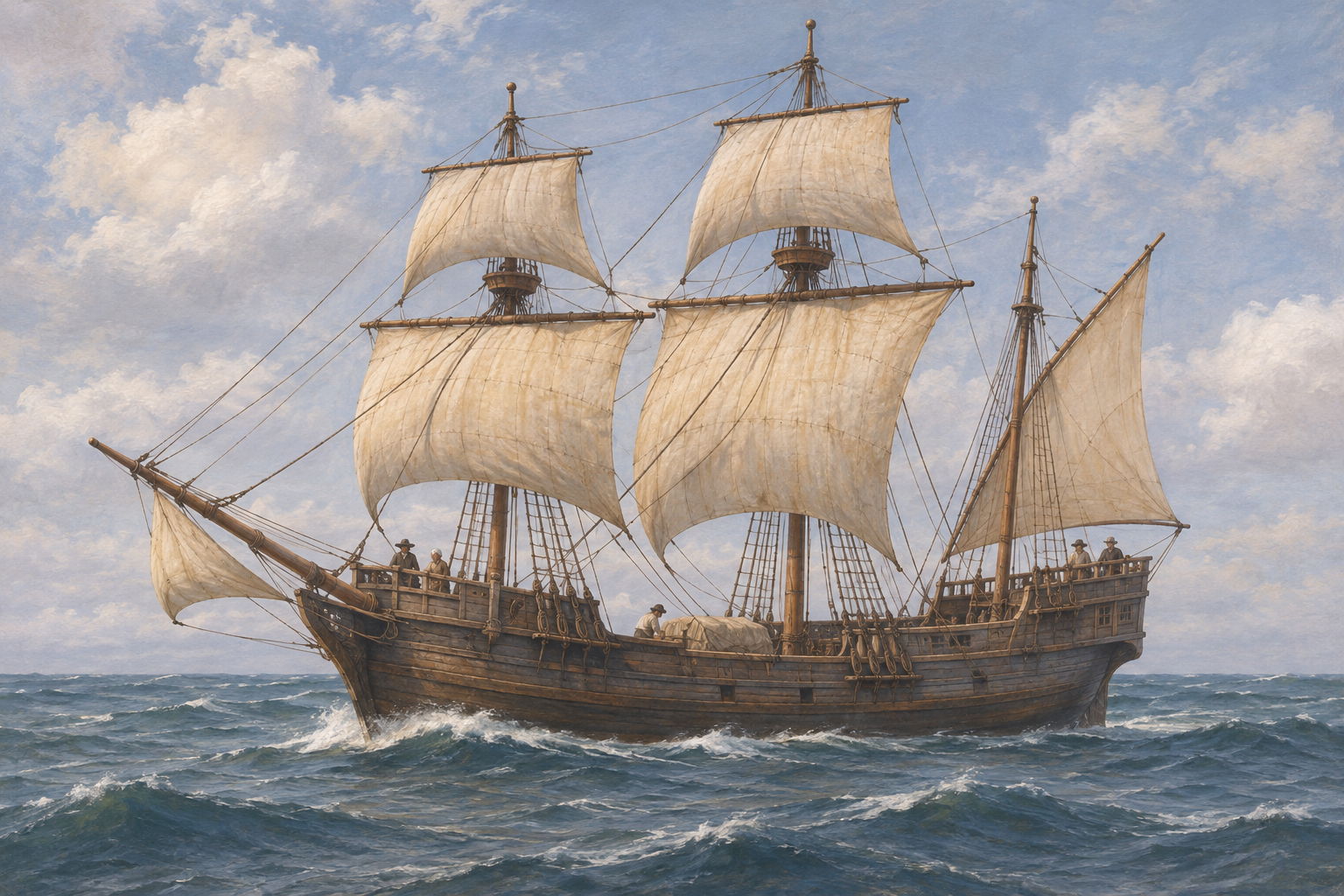
A Bristol ship in the Maryland records
The words of Bristol give the vessel a connection to an English port, and another instrument on the same register spread calls Jones a mariner of that city. They do not tell us where Gillian lived before the crossing or where the passenger came aboard. A ship’s home association was one part of a voyage, not the whole itinerary.1
Bristol should be pictured as the older inland port. Avonmouth, familiar from the modern port’s history, belongs to a much later chapter: its dock opened in 1877. Calling the two places interchangeable would carry nineteenth-century geography into a seventeenth-century journey.2
Jones is the only captain securely identified in Gillian’s surviving record. We have no authenticated picture of his Joseph, no established dimensions or tonnage, and no complete sequence of its masters. The illustration here therefore represents a period merchant vessel. Its timbers, sails and figures help a reader imagine the scale of such travel; they are not recovered details of Gillian’s ship.
Even the familiar year requires care. The assignment was dated 7 March 1671/2 under the old beginning of the year. Written with the year beginning on 1 January, that March falls in 1672. The double date preserves the old convention without moving the historical day and month. It dates the transaction, not the ship’s arrival.13
Forty-six names and a claim to land
Maryland’s transportation system gave the person entitled to a qualifying headright a claim generally worth fifty acres. The right could be used to obtain a warrant, followed by a survey and patent. It could also pass from one holder to another. The official record was concerned with establishing and using those rights; a name in it need not mark the date when its bearer stepped ashore.4
Jones divided his claim. Twenty rights, beginning with Gillian’s, went to William Corrin in an assignment dated 7 March. Six went to another assignee. Jones retained the last twenty for a warrant of 1,000 acres issued on 8 March. The register calls the whole group forty-six persons, although repeated names mean we cannot reconstruct forty-six distinct biographies from the list alone.1
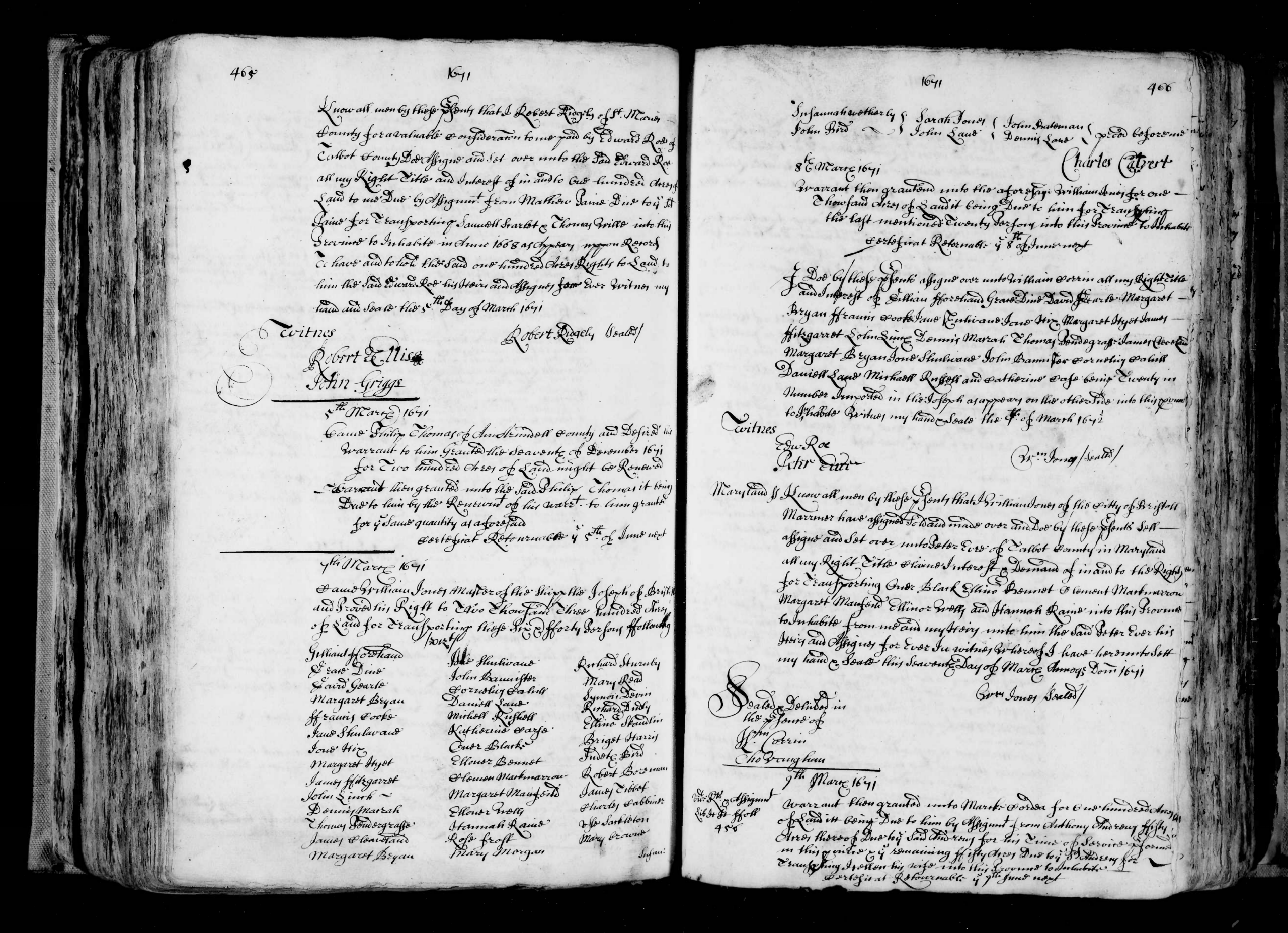
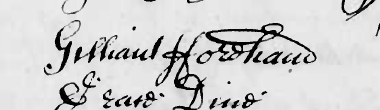
This distinction changes the older account of Gillian. Jones’s 1,000-acre warrant was not payment for handing Gillian over to Corrin. It used a different twenty names. Nor does the assignment itself establish that Corrin acquired Gillian’s labor: land rights could circulate separately from the transported person, even after that person’s death.14
Corrin’s own claim appears farther on in the book. On 26 March 1672, a conditional warrant described him as of Calvert County. On 1 April, “the said William Corrin” received a 1,000-acre warrant using the first twenty names from Jones’s list, Gillian among them. The language joins the two Corrin entries. It places the man who held the rights in Calvert County, but it does not place Gillian in his house, on his land, or even in that county.1
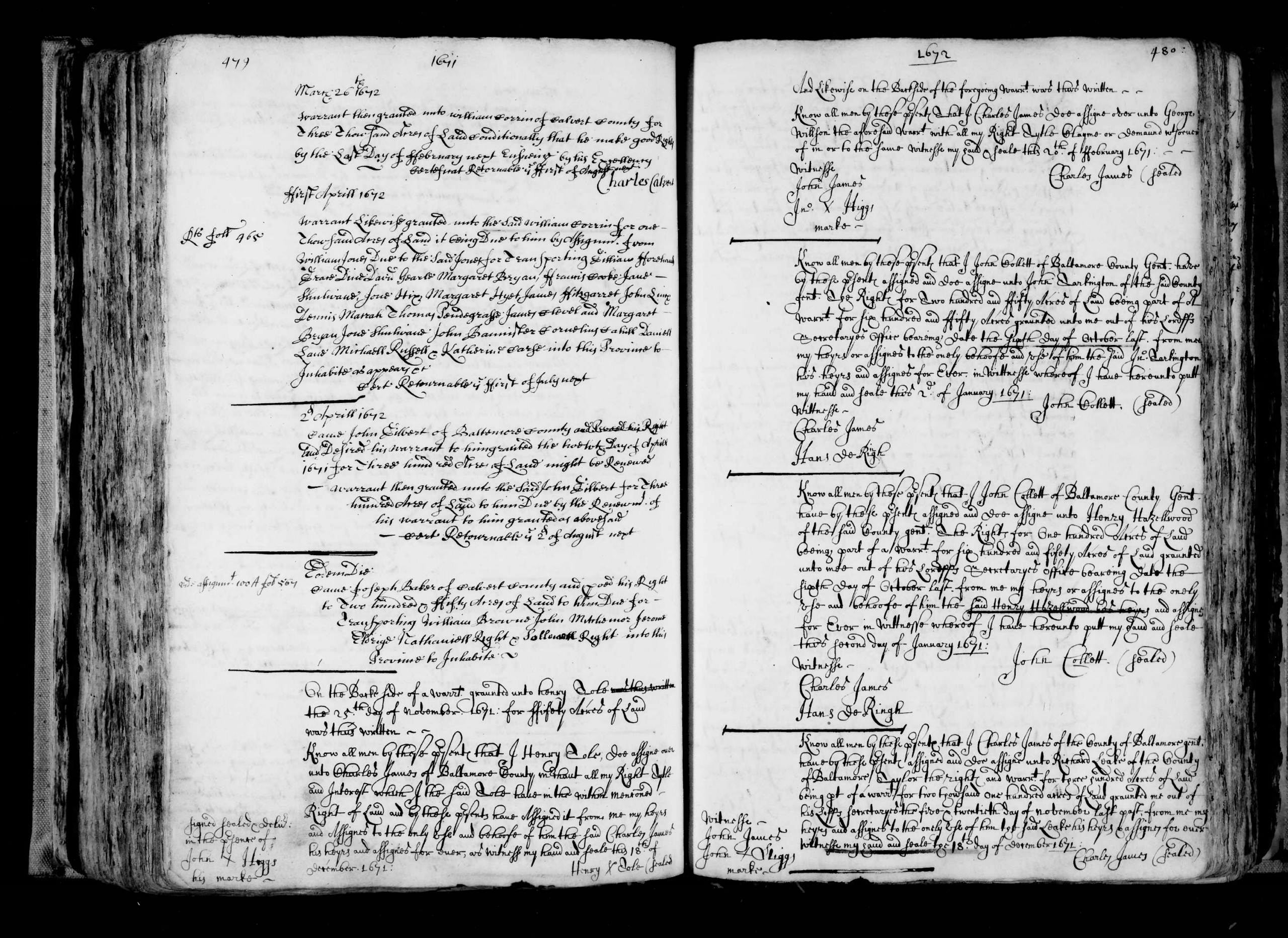
The original pages also give the preferred reading Corrin, replacing the Currin spelling used in the earlier family article. Such a correction is small on the page and useful in the search: the next record may be indexed under the man who acquired the claim rather than the person whose transportation supported it.
Years of service for a passage
An Atlantic passage had to be paid for. Many seventeenth-century migrants met that cost with work promised in the years ahead. An indenture bound a person to serve for an agreed term, while a master undertook obligations that could include transportation, food, clothing and lodging. Four or five years were common, but the agreement and the applicable rules mattered. There was no universal term for every newcomer.5
A servant could not ordinarily leave the employer at will. Remaining service could be transferred, placing decisions about work and residence in another person’s hands. The expected end of the term distinguished ordinary indentured service from lifetime, hereditary racial slavery, which also developed in Maryland. Both involved coercion; a contract’s prospect of eventual freedom did not remove the dependence of the years before it.5
Gillian may have arrived under such an arrangement. That remains Possible, rather than established. The transportation entry contains no personal contract, employer or service term. Another document associated with a ship of the same name gives a much closer view of what an indenture could promise.
On 20 September 1671, at a place written as “Limbrick,” a servant bound himself to John Steephens, described as belonging to the Joseph of Bristoll. The term was four years, to begin when the vessel safely anchored in Virginia. The agreement provided for maintenance during service and promised two suits of apparel and fifty acres at the end. The difference between workday and holiday clothes was worth putting into writing.6
The contract survives here through the printed Archives of Maryland, transcribing Talbot County court records. It contains a troublesome name discrepancy: the opening calls the servant Richard Stormee, while later wording and the signature use Richard Steephens. The next printed page records George Cowley’s obligation, dated 25 December 1671, to keep Richard Stormee at his occupation as a smith unless he willingly accepted other work. That provision preserves a man’s trade and a written limit on the work he could be required to do.6
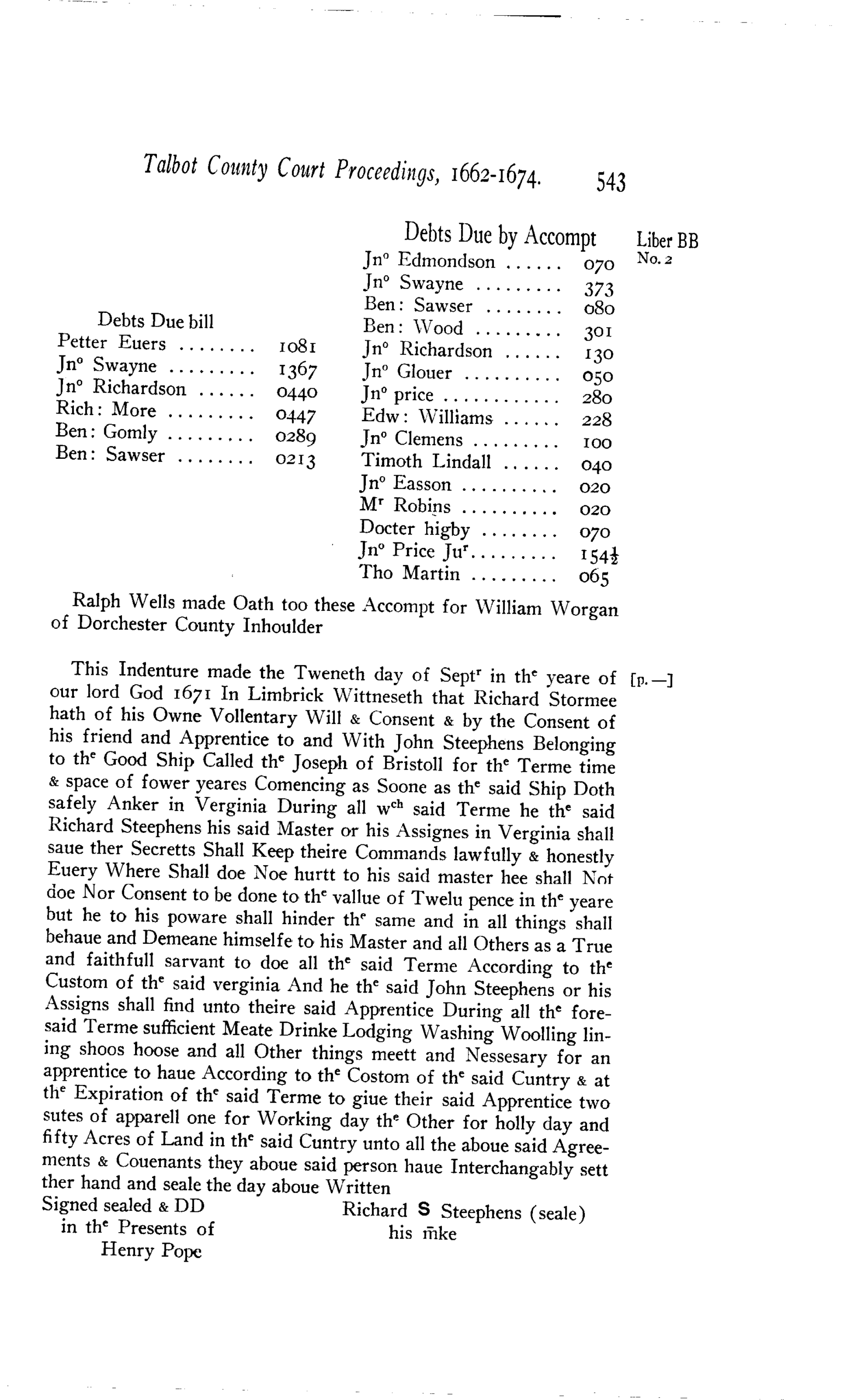
The adjacent smith’s obligation does not explicitly resolve the conflicting names or transfer that particular indenture to Cowley. And John Steephens is a master in the contractual sense here, not a man identified as captain of the ship. William Jones and Gillian are absent from both instruments. The name Joseph of Bristol and the close dates make a connection worth pursuing, but the same vessel and voyage are still Possible, not established. The contract supplies a contemporary example; it does not give Gillian an Irish departure, a four-year term or fifty acres.6
Family Ties
Gillian’s parents, siblings, spouse and children are Unknown in the evidence examined so far. The register gives no age, and the old estimate of birth about 1650 has no identified documentary foundation. It also supplies no decisive sex-specific description. The familiar name alone is not enough to settle that question.17
An earlier family article suggested that Gillian might have been the mother of Cornelius Forehand, the later Pasquotank man whose estate belongs to 1728. That proposed motherhood is Unsupported; the actual relationship is Unknown. The two people are separated by a gap that no named relative, linked household or continuous record trail has yet crossed. Cornelius belongs in the history of the question, but not as Gillian’s established child.78
For now the family history must allow Gillian a place without assigning a descendant. The transportation record is real. Its importance does not depend on making its first name fit an unfinished family tree.
Between the Lines
Possibilities, not proven relationships.
The useful opening is William Corrin. The same twenty names connect his warrant to Jones’s assignment, and his Calvert County description provides a documented place from which to search. An indenture, court dispute, probate record or later deed might identify a member of that group more fully. Yet the land rights could move without the people. Finding Corrin’s property alone would not establish Gillian’s home.14
The surname offers a separate question. Was Gillian related to the later Carolina Forehands, or did the same name reach North America through more than one family? At present, both possibilities remain open. Evidence naming relatives, consistent ages and connected places would carry that inquiry farther than another copied family-tree entry. The broader surname investigation has been recorded as a future research project; it has not supplied a new relationship here.8
A Life in the Records
Gillian’s known chronology is short. The later dates follow the claim made from the transportation, rather than repeated personal appearances.
| Date | What survives |
|---|---|
| Before or by 7 March 1671/72 | Transportation to Maryland recited in Jones’s proof. The exact sailing and landing dates, and certain arrival year, remain unknown. WT 465.1 |
| 7 March 1671/72 | Jones proves rights for forty-six named entries and 2,300 acres. Gillian stands first. WT 465.1 |
| 7 March 1671/72 | Assignment of the first twenty rights, including Gillian’s, to William Corrin. A separate six-right assignment completes the division of the claim. WT 465–466.1 |
| 8 March 1671/72 | Jones’s 1,000-acre warrant uses the last twenty names, a different group from Gillian’s. WT 466.1 |
| 26 March 1672 | Corrin is described as of Calvert County in a conditional 3,000-acre warrant. This is an associate’s record, not Gillian’s appearance. WT 479.1 |
| 1 April 1672 | Corrin’s 1,000-acre warrant uses the first twenty names, including Gillian’s. It does not establish Gillian’s presence or survival on that date. WT 479.1 |
The 20 September and 25 December 1671 instruments discussed above concern the separately recorded servant and smith. They are contextual evidence, not additional dates in Gillian’s life. The undated later manuscript copies and modern family accounts likewise preserve or interpret the land claim; they do not add independent appearances. No verified birth, marriage or death record for Gillian has been identified in this bounded investigation.67
The Family as We Currently Understand It
Gillian Forehand — birth and death unknown. Parents, siblings, spouse and children remain unidentified. No family relationship is drawn from the transportation-rights record.
The name at the head of Jones’s list has outlasted the business that put it there. That business explains why Gillian was recorded. The work now is to find a record written for another purpose—one that might tell us something about the person whose name the land office kept.
Sources
- Maryland State Archives, LAND OFFICE (Patent Record, Original), WT 1670–1673, MSA SM215-12 / SR7547, original pages 465–466 and 479; official PDF pages 307 and 315. Original register images inspected and separately reviewed. Catalog; complete official PDF. Gillian’s proof and assignment: 7 March 1671/72; Jones’s separate warrant: 8 March, WT 466; Corrin warrants: 26 March and 1 April 1672, WT 479.
- Bristol Port Company, Our History, sections on the city docks and Avonmouth’s 1877 opening. Institutional history, not evidence of Gillian’s departure port.
- Maryland State Archives, Maryland Session Laws, footnote 1 on the pre-1752 beginning of the year, read with the original double-dated assignment. Dates retain the historical day and month.
- Maryland State Archives, Introduction to the Early Settlers of Maryland, explanation of transportation rights, their independent circulation, and warrant/survey/patent procedure. Official archival guidance.
- Maryland State Archives, Understanding Maryland Records: Indentured Servants, early migration discussion; Historic St. Mary’s City, Indentured Servants, educational text; Ross M. Kimmel, Blacks before the Law in Colonial Maryland, master’s thesis, 24 January 1974, chapter III. General context only; later eighteenth-century examples are not applied to Gillian.
- Archives of Maryland, 54:543–544, Talbot County Court Proceedings, Liber BB No. 2: indenture dated 20 September 1671, “Limbrick,” and George Cowley’s obligation dated 25 December 1671. Page 543; page 544. Complete printed-page images inspected and separately reviewed; underlying original manuscript not inspected. Richard Stormee/Steephens discrepancy retained.
- Later handwritten transcript Liber 16:435, 447, supplied Gillian Forehand JPEGs in the family collection; original comparison in source 1. Earlier article, Gillian Forehand, circa 1650, preserved in the research collection. The article and family manuscript repeat the same argument and images and are not independent corroboration. Birth estimate, female identification and proposed motherhood are not established by the original entries.
- Diamond Dogs, Gillian Forehand, the Joseph of Bristol, and the Maryland transportation records, 17 November 2026, with source catalog, bounded local/web search logs and separate source/argument review; related Cornelius Forehand arrival in North America, begun 30 September 2026. Gillian stable identity P-GF-MD1671; Cornelius P-CF-1728. Research has not exhaustively searched all surviving parish, court, probate or shipping records. Forehand surname research is future idea IDEA-018.