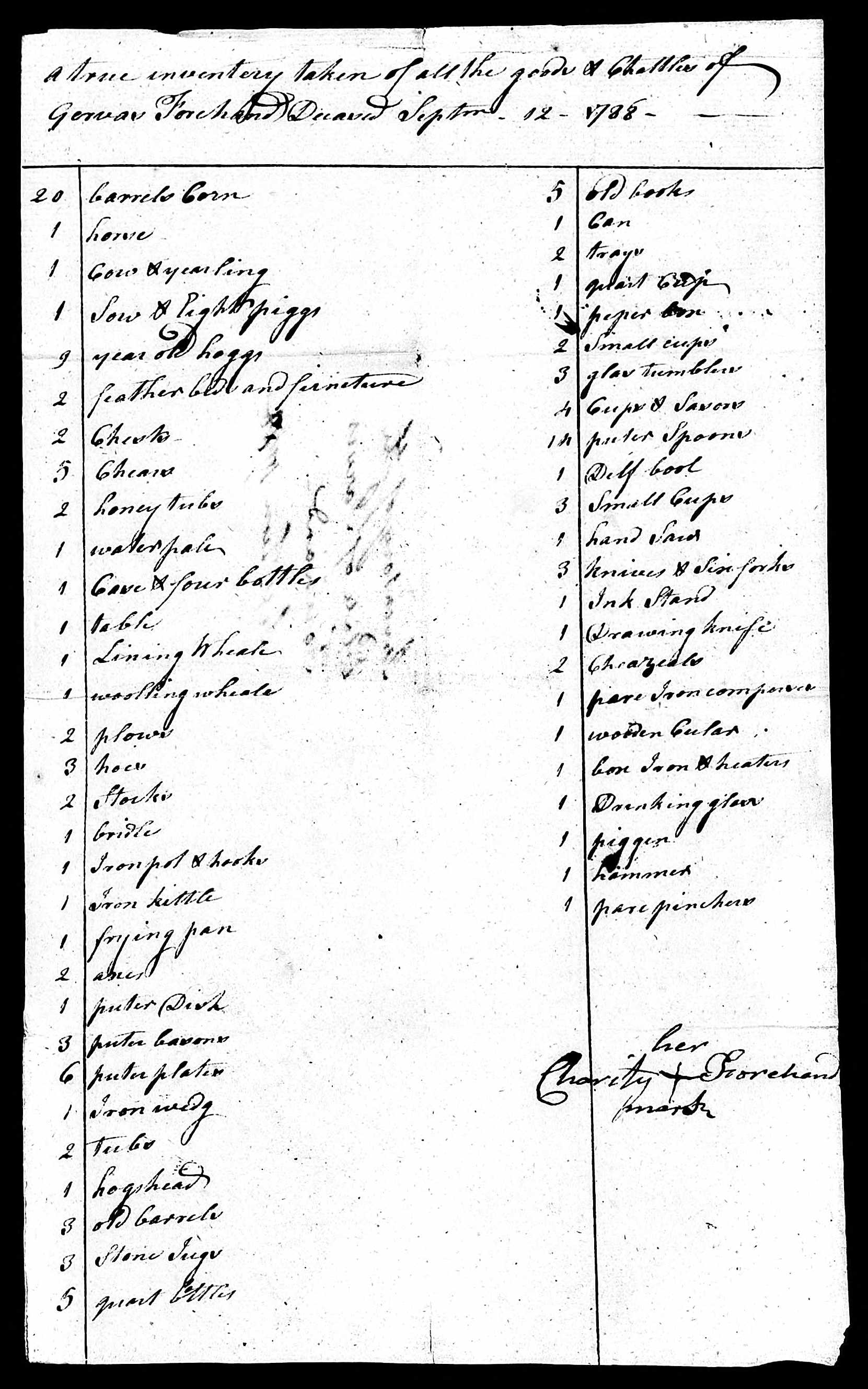
Twenty barrels of corn stood first on the list. Below them came a horse, a cow and yearling, hogs, beds, chairs and the equipment of a working household. An inventory dated September 12, 1788, recorded the goods of deceased Jarvis Forehand. Beneath it was Charity Forehand’s mark. A life that had passed through the farms and river land of northeastern North Carolina had reached the estate court. Charity now had its unfinished business to attend to.12
The most likely reconstruction begins with Jarvis, son of Thomas, in Pasquotank; follows him into marriage with Charity and landholding in Perquimans; and identifies him with the Revolutionary private of the same name. It ends with the estate Charity administered in Chowan in 1788. These records fit an older Carolina man far better than the later Jarvis found in Kentucky and Illinois. Several links are inferred, but together they give us a coherent life to examine—and a reason to distinguish it from the western story.1571114
Family Ties
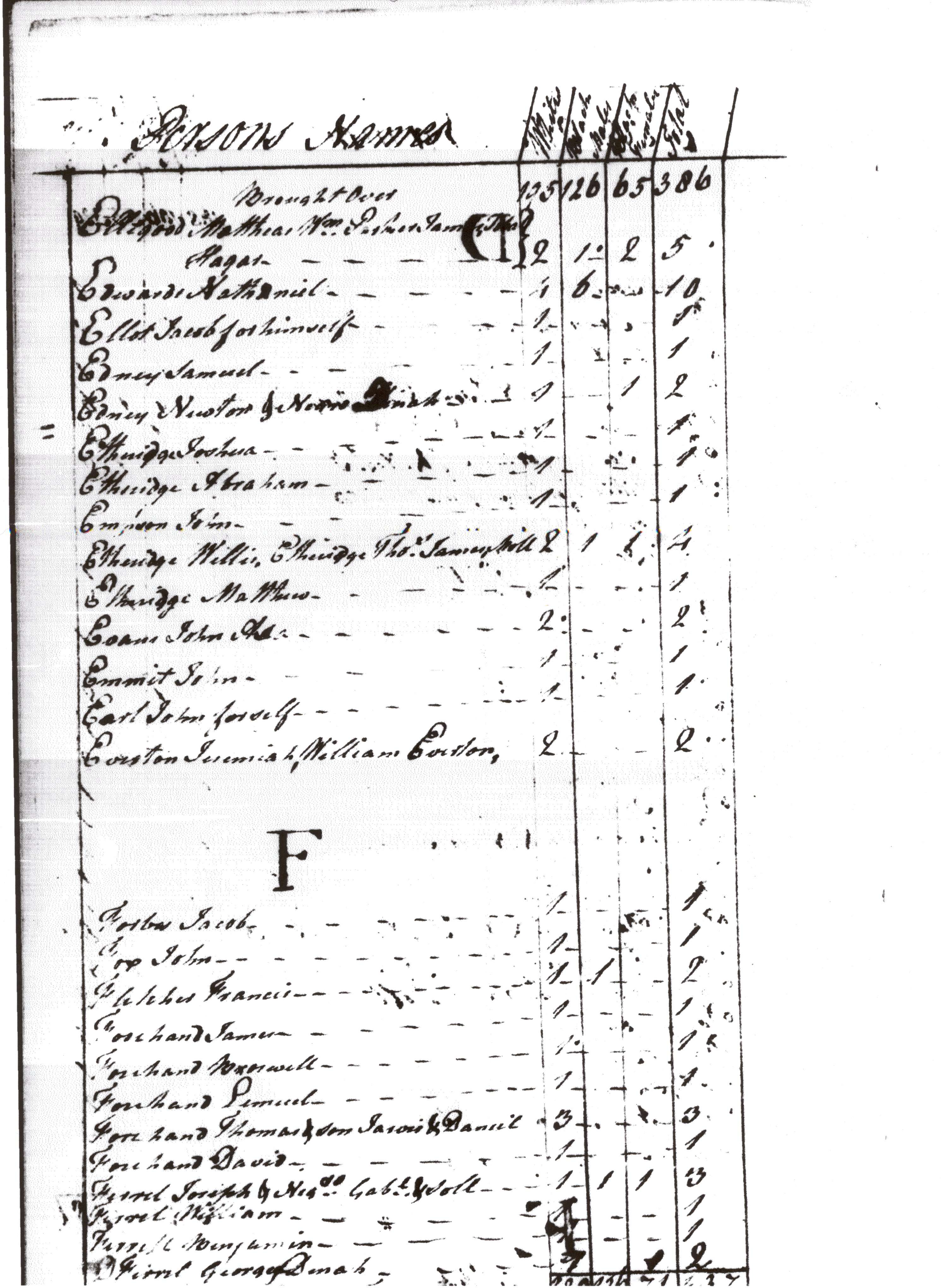
Jarvis’s family begins with a particularly useful tax entry. A Pasquotank return attributed to 1769 lists Thomas Forehand with his sons Jarvis and Daniel, three white taxables together. The relationship is explicit; the year is not visible on the surviving family photograph. This son Jarvis is most likely Charity’s husband and the man whose Chowan estate she administered, although no single document joins those appearances.11
Lemuel was another son of Thomas: a later deed names Lemuel and Daniel as his sons. The Pasquotank David’s land transactions and reciprocal witnessing place him close to this family, and his sonship remains a strong inference. Identifying that David with the later Guilford testator is a further, unproved connection. These relationships establish or suggest a shared father; they do not establish that the brothers shared a mother. The mother or mothers are unknown. Sarah Everton’s often-repeated identification as Thomas’s wife has not been proved.11
Pasquotank is the most likely setting for Jarvis’s birth and upbringing, given Thomas’s Newland household and Jarvis’s early local appearances; no birth record yet fixes the place or year. One generation earlier, Cornelius Forehand’s will of February 24, 1727/8, expressly names a son Thomas and leaves him two cows. That son is likely the later Newland landholder, making Cornelius Jarvis’s probable grandfather, but the identification still needs a direct documentary bridge.11
Charity is the family member named beside Jarvis in his own records: expressly his wife in the 1773 deed, and probably the same woman administering his estate in 1788. Her birth surname remains unknown. No inspected record names their children. The later Chowan Thomas and a proposed son John remain candidates; “Between the Lines” below explores the possible connection to Thomas.125
Land at the head of the river
Before his purchases in Perquimans, Jarvis’s name appears on the roll of Captain Jarvis Jones’s Pasquotank militia company, under Colonel Thomas Taylor. The list is attributed to 1766. Lemuel Forehand is a corporal; James and David Forehand are also among the men named. Read beside the tax return naming Thomas’s sons, it places the likely young Jarvis within a local circle of Forehands before the Revolution. This was militia enrollment, not a record of a battle. The saved face has no year, so the 1766 attribution remains part of the source qualification.1112
On December 27, 1770, Nicholas and John Stallings sold Jarvis 125 acres for £100 proclamation money. He was then described as a resident of Perquimans. The deed began on the southwest side of the head of the Perquimans River, among cypress trees in the swamp; farther along came a pine on high land and marked trees at Thomas Rountree’s line. Those details place his holding where wet ground met usable upland, with the river and his neighbors helping define its edges. Its exact modern parcel has not yet been identified.3
Three years later he bought fifty acres at Grape Tree Ridge from Charles Rountree of Chowan. This was a separate tract, with a title remembered through the Rountrees, Joseph Jessop and Luke Hollowell. Then, in October 1773, Jarvis sold Jacob Winslow 125 acres described as Nicholas Stallings’s former plantation. The deed called him a planter. It also brought Charity into the record as his wife, relinquishing her dower interest in the land.45
The former owner and acreage strongly connect that sale with the 1770 purchase, although the two descriptions disagree over southwest and northwest of the river. They should be followed as a probable title connection, not drawn as a settled modern boundary. What is clear is that Jarvis and Charity were married by October 11, 1773, and that their household’s affairs extended into the Stallings, Rountree and Winslow neighborhoods.35
By March 20, 1776, Jarvis was described as living in Pasquotank again. He sold Grape Tree Ridge to Simon Stallings of Chowan for £10, compared with the £50 purchase price in 1773. The reason for that difference is unknown. The tract itself remained in Perquimans: one transaction could join a Pasquotank seller, a Chowan buyer and Perquimans land. Its earlier owners connect the purchase and sale despite conflicting patent dates copied into the deeds. Charity’s omission from the later instrument does not establish that she had died.6
The name on the army roll
The prewar militia roll and the Revolutionary military register belong to different stages of the story. The latter lists a private Jarvis Forehand in Hall’s company, entering for twelve months in 1781 and leaving service on April 21, 1782. An army settlement account also names private Jarvis Forehand. It concerns military pay, not a later federal pension.712
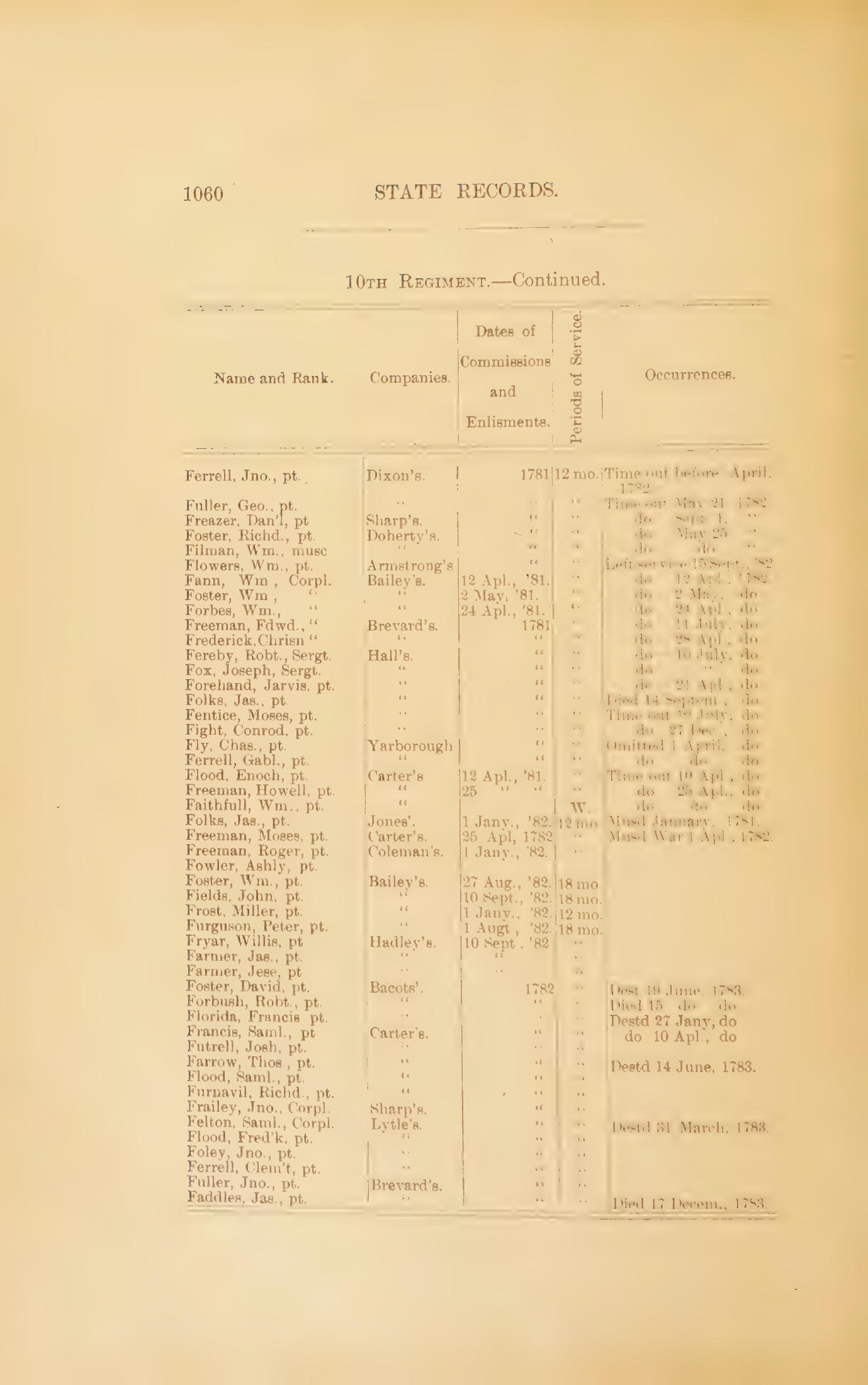
Our working judgment is that this soldier was most likely the older Jarvis, Thomas’s son and Charity’s husband. His established adult life before the Revolution and his earlier militia appearance fit the service dates. The much younger man suggested by the Illinois censuses fits poorly. That is a reasoned identification, not a parent’s or wife’s name written on the army record. We can describe Jarvis as a likely Revolutionary veteran; we cannot yet place him in a particular battle or say where he fought.71214
The year of Jarvis’s recorded enlistment was a hard-fought one in the South. In South Carolina, Nathanael Greene pressed the British inland posts and forced their troops back toward Charleston. The battle at Eutaw Springs on September 8, 1781, belonged to that struggle for the countryside. This was the wider war in which North Carolina’s soldiers were serving during Jarvis’s recorded term.17
The register assigns Jarvis to Hall’s company. A later military compilation identifies the captain as Clement Hall and associates his company with Eutaw Springs, offering a possible connection to that campaign. We do not know whether Jarvis fought at Eutaw Springs: no record yet examined establishes his presence in that battle. His recorded service continued until April 21, 1782. The southern campaign gives his enlistment its historical setting, while the particulars of his own marches and fighting remain unknown.718
The Grape Tree Ridge deed was copied into the register in August 1781, the same year listed for the soldier’s enlistment, but those are different kinds of evidence. Jarvis had executed the deed in 1776. Its later registration did not require him to stand before the clerk in 1781. The military entry, if correctly identified, is what carries his personal story into the war years.67
After the war, the local records bring Jarvis into sharper view. Captain Stallings’s Chowan tax return for 1784 names “Jarvis forhand Constble,” with fifty acres described as the land “Whereon he lives.” The county return lists Jarvis with fifty acres again in 1785, and the Stallings district return does so in 1786. Each year records one free or white poll. Most likely these entries continue the life of Thomas’s son and Charity’s husband, placing him on a Chowan holding in the years before his estate was settled. The constable designation adds a public role to that picture, though his appointment and the precise location of his land remain to be found.192021
Charity’s responsibility
By September 12, 1788, Jarvis was dead. His inventory survives with the Chowan estate papers, and the Chowan court granted administration to Charity on £100 bond and security. She exhibited the inventory under oath. The court did not expressly call her his widow, but her name beside the deceased Jarvis strongly identifies her with the wife named in 1773. These proceedings establish where the estate was handled, not the exact place or day of his death. Perquimans belongs firmly in his life; it cannot yet be given as his proved death county.125
The inventory lets us look beyond the acreage. Two feather beds and their furniture stood alongside chests, a table and chairs. Two spinning wheels belonged to household production; plows and hoes to cultivation. A hand saw, drawing knife, chisels, iron compasses, hammer and pincers suggest work in wood, although they do not establish a carpenter’s occupation. There was an inkstand, too. These were the possessions of a working household; the record does not tell us which member used each one.1
On October 9, Sheriff William Roberts sold part of the perishable estate at vendue, allowing six months’ credit. Caleb, Ichabod and Nathan Jordan were among the buyers, along with John Evans, Amos Perry and others. The partial sale brought £41 17s. 8d.; after commission, £40 16s. 10d. remained. Neither that sum nor Charity’s £100 security was a valuation of everything Jarvis had left. They were steps in the task of settling his affairs.12
The warrant issued in 1797
Nine years after Charity’s estate proceedings, a military land warrant was issued under a name we favor reading as Jarvis Forehand. At Raleigh on December 6, 1797, Secretary of State James Glasgow issued warrant 5074, directing Colonel Martin Armstrong to survey 228 acres within the lands reserved for North Carolina’s Continental officers and soldiers. The recipient is described as a private. His first name is pale: indexes and later original land records render it Harris, so the reading remains qualified. The acreage is clearer: 228, correcting the 278 reported in earlier family accounts.23
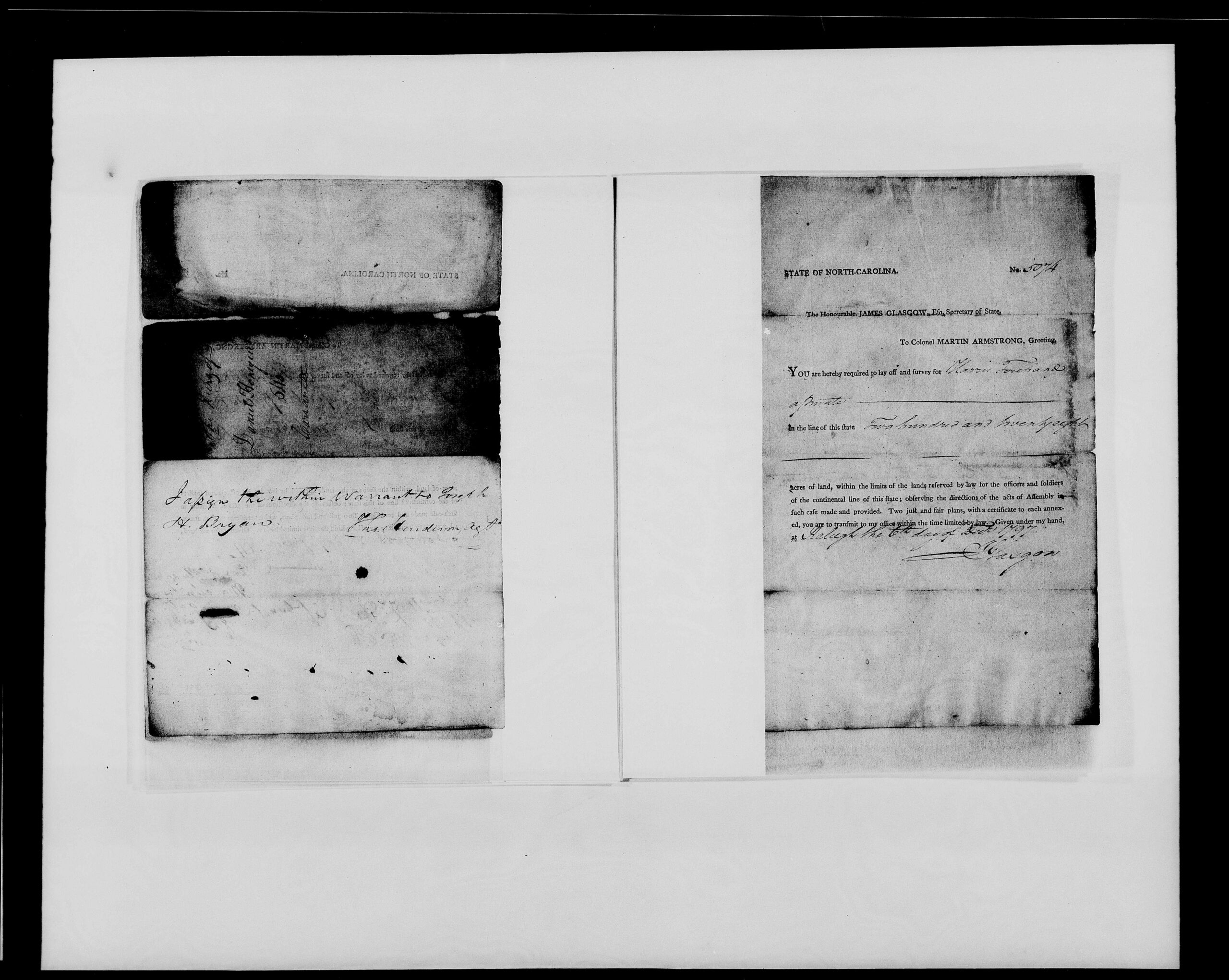
An endorsement on the apparent reverse assigns the warrant to Joseph H. Bryan. Its wording is brief:
I assign the within warrant
to Joseph H. Bryan
Tho. Henderson Agt.Undated endorsement associated with warrant 5074.23
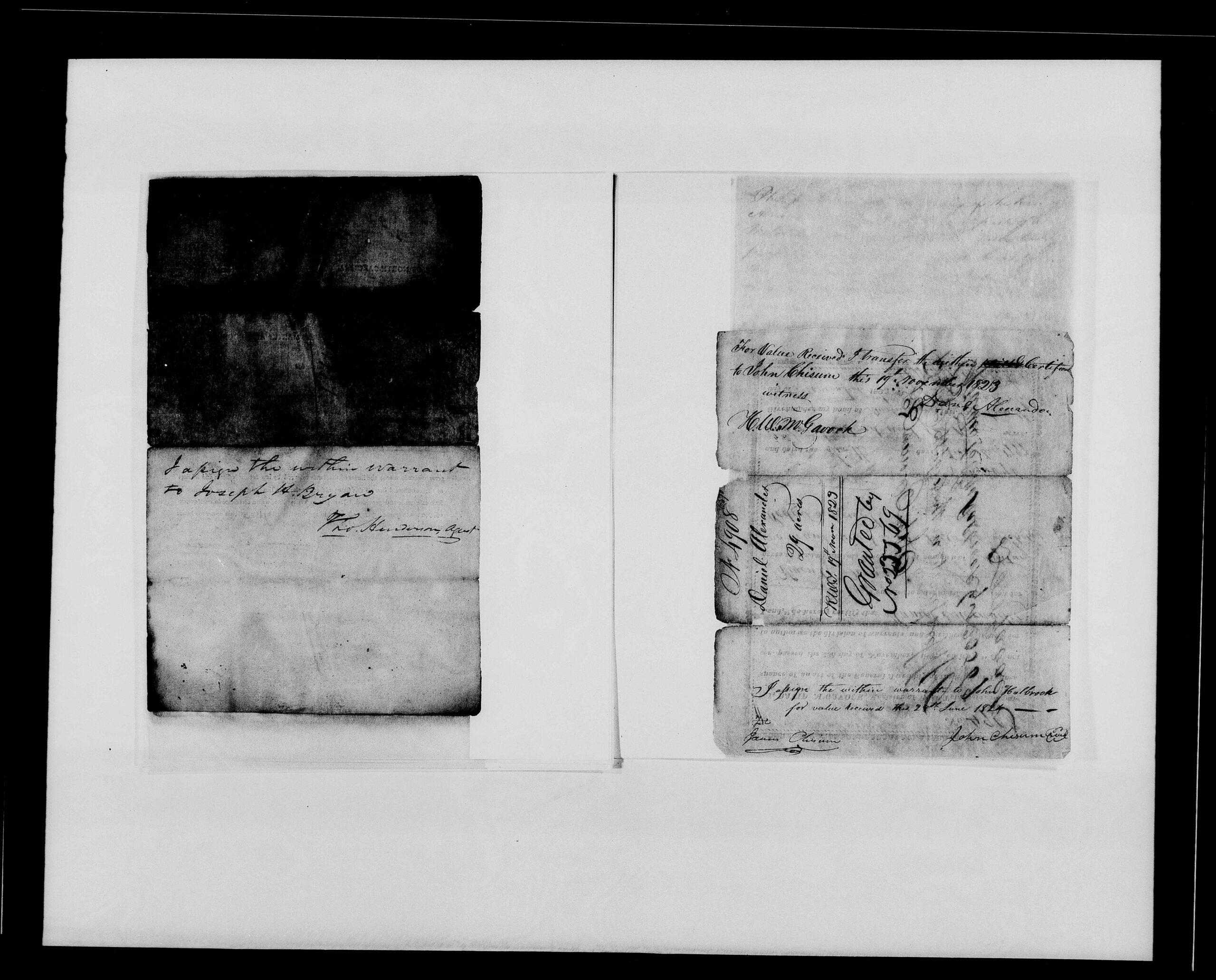
The warrant represented an entitlement earned through military service. It was not a deed to a farm Jarvis had already occupied. Henderson’s endorsement carried that entitlement into another set of hands, and the later papers lead us into the land business of the University of North Carolina. There is no signature or mark by Jarvis on the assignment. Its absence does not prove his death, just as the warrant’s issue in 1797 does not prove he was then alive. If the private was Charity’s husband, the claim continued after the estate proceedings of 1788.2324
Henderson, Bryan and the university
Thomas Henderson Jr. of Raleigh appears in a contract dated August 5, 1821, with William Polk, acting for the committee managing the university’s lands. Henderson was to gather proof of Revolutionary service and death without heirs, obtain warrants and carry the claims through Tennessee adjudication. In return for that work, he was to receive half the successfully adjudicated acreage; the university would retain the other half. This was one way the institution pursued military-land claims under the laws concerning estates without lawful heirs. The agreement explains Henderson’s business, but it contains no finding about Jarvis’s heirs and does not name warrant 5074.25
By March 1, 1822, the university’s instructions addressed General Joseph H. Bryan and Colonel Thomas Henderson together as its agents. They were to attend to the warrants in Tennessee, arrange locations and surveys, and obtain grants. An undated list takes us from those general instructions to Forehand’s particular claim. Headed as warrants placed by Bryan and Henderson with McLemore, Dickins & Co. for location, it includes “Harris Forehand,” warrant 5074, 228 acres, on West Sandy, in range 6, sections 6 and 7 of the twelfth district. Its $2-per-acre figure is a valuation, not a documented price paid to Jarvis or his family.2627
The first name in these later papers is Harris; our preferred reading on the original warrant remains Jarvis. The repeated warrant number and acreage connect the land records despite that name variation. Henderson and Bryan’s handling of this claim is now documented, and the university setting is much clearer. The undated endorsement still does not tell us exactly when Henderson assigned it to Bryan or whether he signed directly for the trustees or in another capacity arising from their arrangement.232427
How the university first obtained this particular warrant remains open. Polk’s December 14, 1821 division report includes one unnamed warrant for 228 acres in the university’s share, a promising correspondence that lacks the soldier’s name or warrant number. Other papers concern unclaimed warrants delivered from the secretary of state’s custody; their delivery did not itself create ownership beyond rights already vested under the escheat laws. No numbered receipt yet identifies 5074 in that delivery. We therefore cannot turn the university’s later involvement into proof that Jarvis died without heirs—or that his warrant was one of the claims affected by the earlier land-office frauds.2528
The land on West Sandy
On December 14, 1822, entry 1120 located the 228-acre claim in the twelfth district, range 6, sections 6 and 7. McLemore, Dickins & Co. appear at the end of the entry. The beginning was sixty poles north of the two-mile post east of the southwest corner of section 7. From there the entry ran south 160 poles, then west, leaving the remaining directions abbreviated. This was the land office’s placement of a claim under Forehand’s name, not his signature or a record of his arrival in Tennessee.29
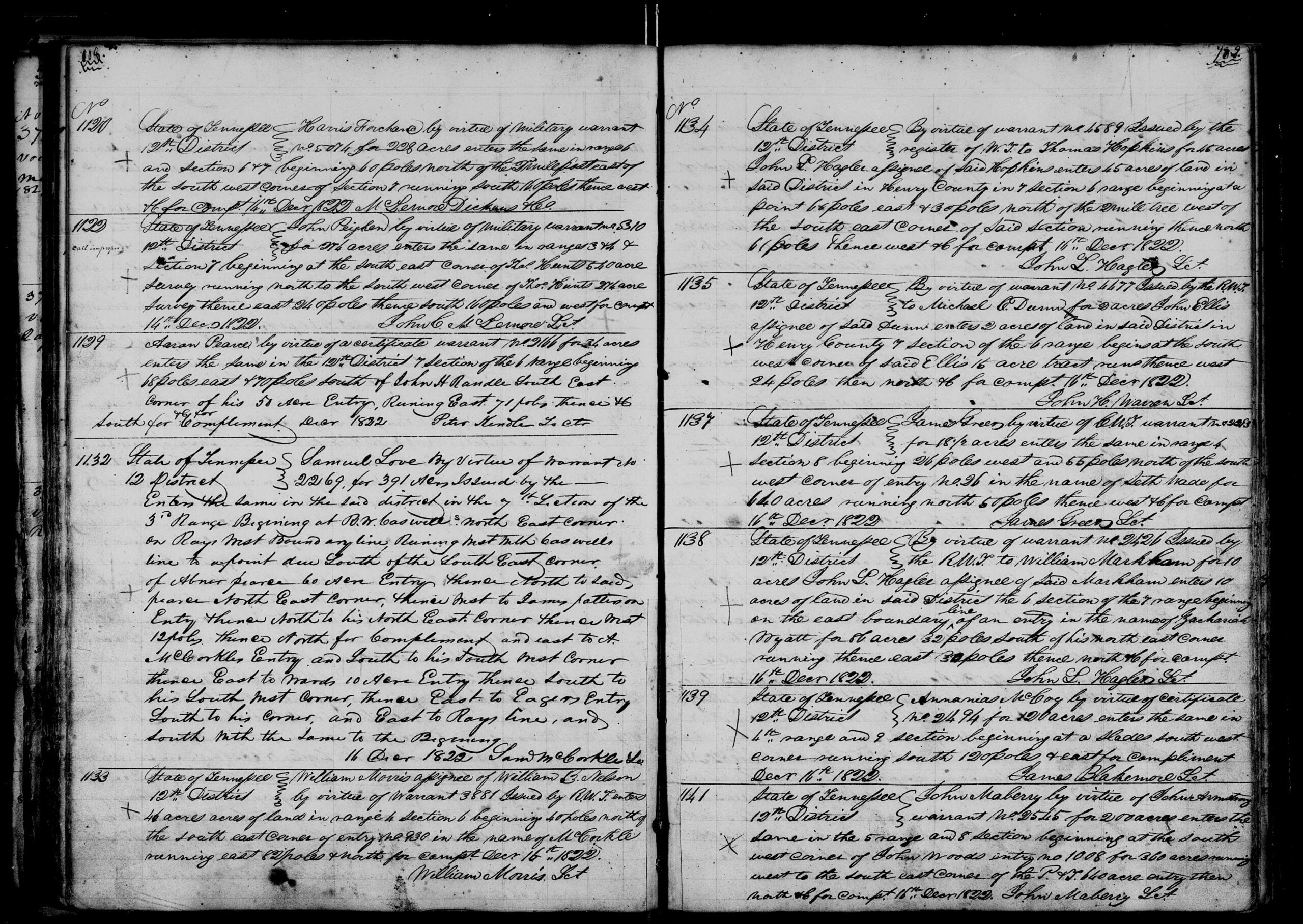
The later grant recites a survey made March 3, 1823. On January 4, 1827, grant 346 issued to Jesse Brown, assignee of the Trustees of the University of North Carolina; it was recorded May 30. It expressly ties the 228 acres to military services and warrant 5074, dated December 6, 1797. The chain thus reaches a named grantee nearly three decades after the warrant was issued. The intervening transactions connecting Bryan’s assignment with Brown’s grant have not yet been recovered.24
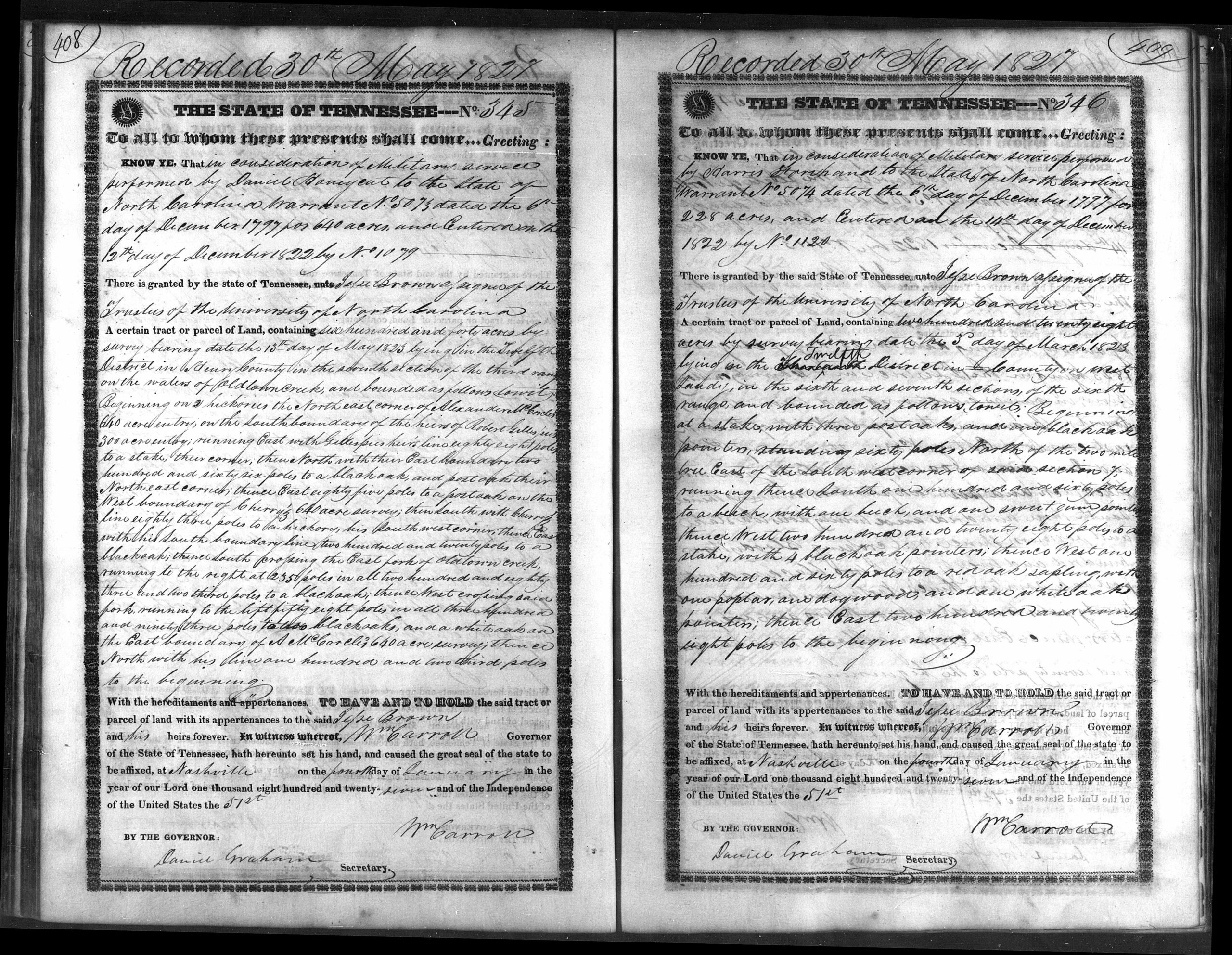
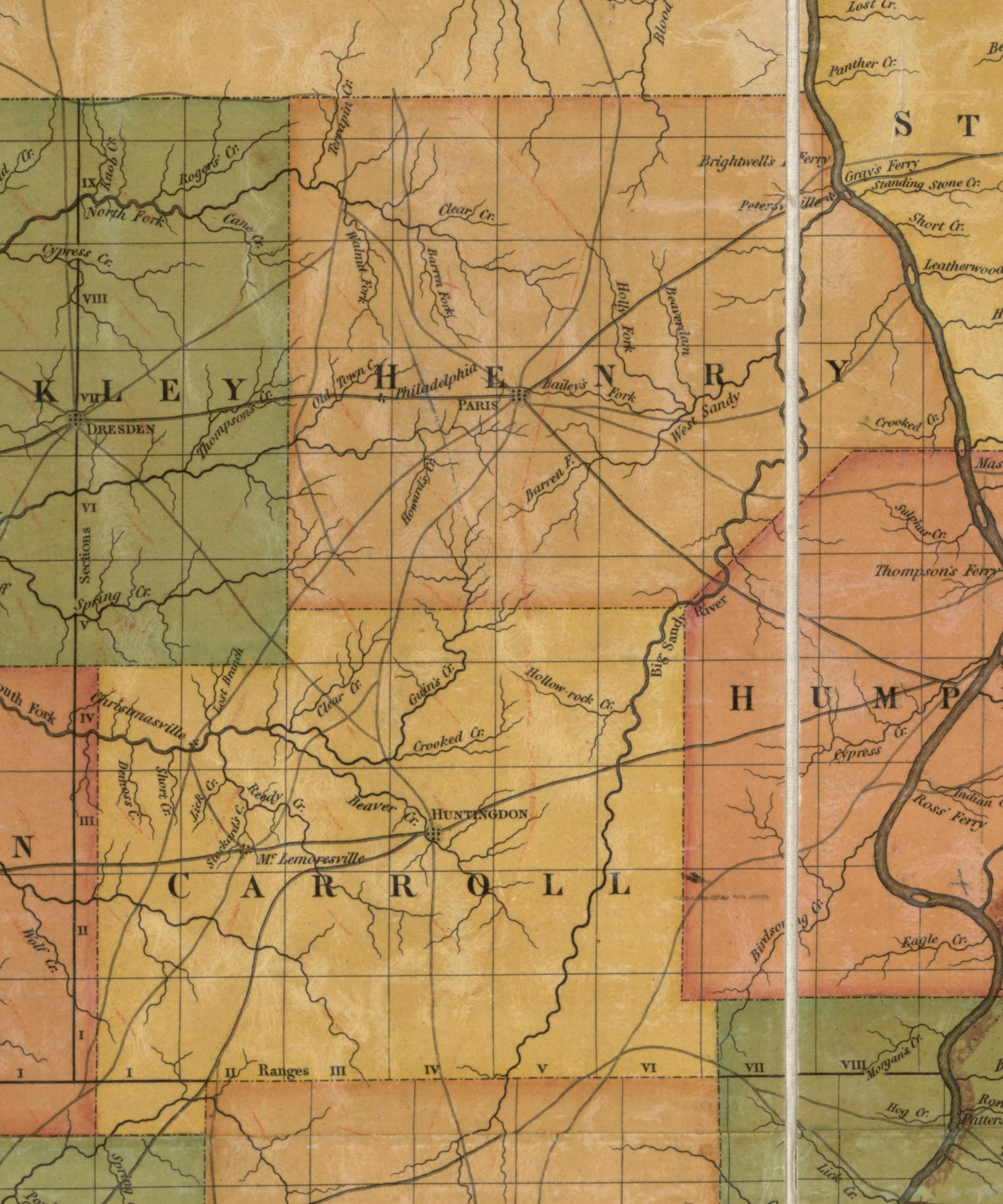
For a present-day reader, the useful orientation is east or southeast of Paris, in Henry County, Tennessee, in the West Sandy drainage. Matthew Rhea’s 1832 map shows Paris, West Sandy and the range-and-section grid used in the records. It gives us the neighborhood of the later grant without pretending to identify a modern parcel. The county space in the grant is blank; Henry County is established here by comparison of the survey locator with the historical map. The original survey plat has not been found, and one direction in the copied grant does not close its boundary. The map below therefore illustrates the general area, not a proved outline of Brown’s 228 acres.2430
Two later Henry County deeds help explain the land business around these names, though neither conveys the 228 acres. In 1829, John Ray sold George Moore Sr. a different 640-acre tract whose title recited Brown as the university’s assignee under Daniel Honeycut’s neighboring warrant, 5073. In 1838, a deed from Jesse Brown to Joseph H. Bryan—both described as of Fayette County—settled a controversy over another 640 acres, grant 337. Their different warrant, grant and survey references keep those properties separate from Forehand’s claim. They add context, not a missing link in its title.31
The Tennessee papers consequently extend the history of the soldier’s compensation, not the proved travels of the soldier himself. The later land was granted to Brown. Nothing in the warrant, university list, entry or grant establishes that Jarvis lived on West Sandy, signed away the claim himself, or survived Charity’s 1788 administration. That distinction matters when we return to the other Jarvis whose western life continued well into the nineteenth century.123242729
The Jarvis who went west
A later Jarvis Forehand appears in Kentucky and Illinois, and earlier family accounts have joined him to the Pasquotank man. The 1788 estate is the first obstacle: the Jarvis whose goods Charity inventoried cannot also have been alive in Illinois decades afterward. The censuses supply a second, independent reason to separate the older militia man from the later western householder.114
| Record | Age evidence and its meaning |
|---|---|
| 1810, attributed to Muhlenberg County, Kentucky | The household includes males aged 26–44 and 45 or older. The named head need not be the older man. Jarvis could be the younger adult; the saved crop lacks its column headings, so this reading remains provisional. |
| 1820, Bond County, Illinois | The federal census crop places an adult male in the 45-or-older category under the standard column sequence. It lacks the headings needed for a fully checked age reading. |
| 1830, attributed to Montgomery County, Illinois | The adult male in Jarvis’s household is 50–59. The column headings are visible. |
| 1840, Montgomery County, Illinois | The older male in Jarvis’s household is 60–69. This agrees with the preceding decade and suggests birth roughly in the 1770s. |
Read together, the 1830 and 1840 ages point to a man born roughly 1770–1780, allowing for census accuracy. He could not ordinarily have been the man enrolled in the Pasquotank militia in 1766. The Kentucky household can fit that younger generation if Jarvis was its younger adult; it does not prove the migration. The two older women in the 1840 household cannot simply be made into two wives, nor do nearby Forehand households establish their relationships.14
There is a documented younger family candidate. On July 6, 1802, David Forehand of Guilford County made a will naming:
“my son Jarvis”
David Forehand’s will, July 6, 1802.13
David’s son is the leading family candidate for the western Jarvis in our present reconstruction. His existence in that family gives the hypothesis more substance than a repeated name alone, and the later western ages fit a younger generation. But the will does not place him in Kentucky, Tennessee or Illinois. The exact family or land record joining him to those places is still missing. We therefore treat David’s son as the working candidate, rather than assigning every later mention of Jarvis to him automatically.1314
The Illinois man left an estate of his own. A notice dated March 29, 1848, and printed in the Illinois Journal on April 13, announced George Forehand’s intended petition to sell land of deceased Jarvis Forehand, late of Montgomery County, because his personal estate was insufficient to pay the allowed debts. It names George as administrator, not as a son. Its land description gives a firm route for tracing the western family, but it does not bring that man back to Charity’s 1788 household.15
The 1797 warrant should therefore be kept distinct from the western man’s later purchases. The Illinois patent dated January 1, 1840, expressly records paid public-land purchase under the 1820 act; it is not a Revolutionary bounty award. Neither paper supplies a bridge from Charity’s household to the later western Jarvis. A Tennessee connection still requires an actual residence or family record.1523
Between the Lines
The following connections are possibilities to investigate, not established family relationships. Was Charity born a Stallings? Jarvis bought from Nicholas and John Stallings, dealt with Simon Stallings and repeatedly encountered Stallings witnesses and boundary owners. That pattern makes a family connection worth testing. It also describes ordinary dealings among people in the same locality; none of the inspected deeds calls a Stallings her parent or sibling.3456
Earlier research reports a Charity in Nicholas Stallings’s will, but the will pages themselves have not yet been inspected. The official index points to Perquimans Will Book C, pages 67 and 76, under 1767, a year conflicting with dates reported in the earlier notes. The will and any distribution naming that Charity after marriage are the necessary next records. A shared given name alone would not identify Jarvis’s wife.8
Their children remain another open question. Neither the complete five-image estate packet nor the inspected administration entry names any. That does not establish childlessness, but Thomas and John, proposed in earlier family research, remain unproved sons.12
The later Thomas of Chowan offers enough to keep the question alive. A deed abstract dated 1802 records Joel Byrum selling Thomas fifty acres in Chowan for £75. The 1830 census household attributed to this Chowan Thomas includes an adult man aged fifty to fifty-nine, broadly consistent with birth in the 1770s. That chronology fits a possible son born during Jarvis’s lifetime, and the Chowan setting brings the two documentary histories into the same county. Neither circumstance supplies a parent’s name.9
This candidate must be distinguished from the older Thomas whose tax entry names a son Jarvis. Nor is Jarvis the only proposed father of the later Chowan man. The Ross/Baker family-history draft offered Cornelius III, explicitly describing its missing connection as speculation based on naming. It supplies an alternative to investigate, rather than evidence that decides between the fathers.9
A guardianship naming the younger Thomas as Jarvis’s child, an estate distribution identifying him as an heir, or a title chain connecting their property could provide the missing bridge. The later Thomas family’s 1844–1846 heir transactions deserve examination in their original form. Until a relationship emerges from such records, place and age keep the possibility open without making him a son.9
For the older Jarvis, the best-supported story remains here in northeastern North Carolina: Thomas’s household in Pasquotank, the river land he bought and sold in Perquimans, the likely period of Revolutionary service, and the estate Charity brought before the Chowan court. The western Jarvis deserves his own account. Keeping the men apart allows us to see this household more clearly—especially Charity, whose mark remains beneath the corn, livestock, beds and tools she was responsible for settling.12711
A Life in the Records
This chronology gathers the dated evidence currently identified for Jarvis, including attributed dates and later administration. Entries under the same name do not automatically identify the same man. Court proof, registration and estate dates are kept separate from evidence that he was alive.
- May 24, 1765 — reported
Thomas, Lemuel and Jarvis reportedly registered livestock earmarks. Known through correspondence quoting a Haun abstract; original register and precise page not recovered. Not an independently verified appearance. [12] - 1766 — attributed
Jarvis on Captain Jarvis Jones’s Pasquotank militia roll; enrollment, not battle service. Saved face lacks the year. [12] - 1769 — attributed
Thomas’s tax entry explicitly names sons Jarvis and Daniel. The family photograph lacks a dated heading. [11] - 1770
Jonathan Herring’s Pasquotank tax return lists Jarvis and Daniel separately, one white poll each. The wider image has a 1770 heading. [12] - December 27, 1770
Jarvis of Perquimans purchases 125 acres from Nicholas and John Stallings. [3] - 1771 — attributed
Perquimans tax return lists Jarvis and Cornelius. The family crop lacks a heading, but the earlier research recovered the broader published scan sequence and dated 1771 cover. No kinship stated. [12] - October 1771
Court proof of the December 1770 purchase; not a new personal appearance by Jarvis. [3] - 1772 — attributed
Perquimans tax crop lists Jarvis, Cornelius and Daniel. Complete dated heading absent. [12] - July 27, 1773
Jarvis buys fifty acres at Grape Tree Ridge from Charles Rountree. [4] - October 11, 1773
Jarvis sells 125 acres to Jacob Winslow; Charity expressly named as his wife. [5] - April 1774; July 8, 1774
Court proof and registration, respectively, of the July 1773 purchase. These later recordkeeping dates do not prove Jarvis attended. [4] - 1775 — file label only
Jarvis appears as one white taxable in John Hollowell’s return for Jacob Riddick’s constable district. The final year digit is disputed; this is not a securely dated 1775 appearance. [12] - July 1775; June 19, 1776
Court proof and registration, respectively, of the October 1773 sale. Distinct from its execution date. [5] - March 20, 1776
Jarvis, described as of Pasquotank, sells his Perquimans Grape Tree Ridge tract to Simon Stallings of Chowan. [6] - July 1777; August 29, 1781
Court proof and registration, respectively, of the March 1776 sale. The 1781 copying does not establish survival in 1781. [6] - 1778 — attributed
Jarvis listed under “Taxable Property Not given In”: £60 land valuation plus £5 horse, £65 total, doubled assessment £130. Not sixty acres or proof of personal attendance; date/county attributed on the photographed face. [12] - 1781; April 21, 1782
Published military register: private Jarvis Forehand, twelve-month term, enlistment year 1781, departure April 21, 1782. Most likely the older Jarvis in this reconstruction; the military record does not name his father or wife. [7] - Undated military settlement
Entry 418 names private Jarvis Forehand in army accounts. An account settlement, not a pension award or proof of personal receipt. Saved crops do not supply a date. [12] - 1784
Captain Stallings’s Chowan tax return names “Jarvis forhand Constble”: 50 acres described as “Whereon he lives,” and one free poll. The constable designation is on the original list; an appointment order has not been recovered. [19] - 1785
The Chowan County taxable-property list names Jarvis Forehand with 50 acres and one free poll. [20] - 1786
Captain Stallings’s Chowan district return and the county compilation list Jarvis Forehand with 50 acres and one white poll. These are copies of one annual appearance, not two dates. This tax evidence does not verify the separately reported March 29 census. [21] - September 12, 1788
Inventory of deceased Jarvis/Gervis, bearing Charity’s mark. Establishes death by this date, not on this date; reverse endorsed September Term 1788. [1] - 1788 — court administration
Charity receives administration subject to £100 bond/security and exhibits the inventory on oath. Exact session day unresolved in the inspected spread. [2] - October 9, 1788
William Roberts sells part of the perishable estate on six months’ credit. Posthumous administration, not a living appearance. [1] - December 6, 1797 — later military entitlement
Warrant 5074, issued at Raleigh, directs a survey of 228 acres for a private whose name we read as Jarvis Forehand (indexed as Harris). Does not establish survival in 1797; connection to the 1788 estate decedent remains an identification across records. [23] - Undated assignment of warrant 5074
“I assign the within warrant to Joseph H. Bryan,” signed “Tho. Henderson Agt.” No date, price, named principal or Jarvis signature is visible. [23]
Reported dates still awaiting the underlying records
The original tax returns now verify 1784 and 1785, including the constable notation, and add a 1786 tax appearance. The reported 1787 tax entry and census return dated March 29, 1786 remain unverified. The latter’s household counts must not be treated as named children without the original return and column headings. [12] [22]
The later history of the military-land claim
These dates concern the warrant and the university’s land business. They are not additional living appearances by Jarvis. Some documents establish the agents’ general work without naming his warrant.
- August 5, 1821: Henderson’s contract with Polk for the university; compensation to be half the acreage successfully adjudicated. Forehand and 5074 are not named. [25]
- December 14, 1821: Polk’s division report includes one unnamed 228-acre warrant. Its identification with 5074 remains possible, not proved. [25]
- December 18 and 31, 1821; certified March 1, 1822: legislative inquiry and concurrence concerning delivery of unclaimed warrants, preserved in contemporary certified copies. No individual 5074 delivery is established. [25]
- February 11, 1822: Polk sends Haywood four warrants totaling 1,868 acres and requests a receipt naming each soldier, warrant and acreage. The missing receipt prevents identification of this batch with Forehand’s claim. [28]
- March 1, 1822: joint university instructions to Bryan and Henderson, supported by a committee memorandum recording delivery to Bryan. No warrant-specific power for 5074 appears. [26]
- March 27, 1822: Bryan reports from Nashville that university warrants are filed with the commissioners; Henderson has not yet arrived. His general concern about duplicate warrants is not a finding about 5074. [28]
- Undated location list: Bryan and Henderson place warrant 5074, “Harris Forehand,” 228 acres, with McLemore, Dickins & Co.; West Sandy, range 6, sections 6–7, district 12. Valued at $2 per acre. This is not the numbered 1821 division schedule. [27]
- December 14, 1822: entry 1120 locates the claim in range 6, sections 6–7, twelfth district. Original entry recovered. [29]
- March 3, 1823: survey date recited in grant 346; original survey plat not recovered. [24]
- January 4 and May 30, 1827: grant 346 issued and recorded, respectively, for Jesse Brown as university assignee. These are not Jarvis’s residence or survival dates. [24]
- July 15, 1829; June term and August 17, 1830: Ray-to-Moore deed executed, acknowledged and registered, respectively. Different 640-acre tract under warrant 5073, entry 1079 dated December 12, 1822; its recital gives November 6, 1797 for that warrant, not a correction to Forehand’s December date. [31]
- May 8, 1838 — preferred day reading; August 17 and 30, 1838: Brown-to-Bryan deed executed, proved/certified at Somerville, and registered. Different 640-acre tract, grant 337. [31]
Later records kept separate from this household
These appearances belong to the western investigation or its leads. Listing them together does not establish that every entry is one man, or identify him conclusively as David’s son.
- March 3, 1800 — reported Tennessee deed: a derivative abstract of Davidson County Deed Book E, page 151, names Jarvis Forehand as witness to Isaac Burnham’s sale to William Winstead on Trace Creek of Big Harpeth. It also reports April Term and May 5, 1800 recordkeeping references. The original deed remains uninspected; residence and parentage are not established. [16]
- July 6, 1802: David Forehand’s Guilford will expressly names son Jarvis. This establishes their relationship, not the son’s western identity. [13]
- 1810: the census attributed to Muhlenberg County, Kentucky, includes Jarvis’s household; see the age comparison above. [14]
- 1817–1818 — retrospective account: an 1882 county history places Jarvis among Shoal Creek settlers. [16]
- August 12, 1819 — land index: a retained purchase-index extract records the southeast quarter of section 21, township 8 north, range 4 west. The full purchase record and title chain remain to be checked. [16]
- 1820: Bond County federal census image and a separate Illinois state-census transcription. These are distinct sources; the state transcription is not an inspected original schedule. [14]
- June 17–18, 1824 — retrospective account: the county history names Jarvis as coroner at the Hillsboro court. The contemporary appointment has not been recovered. [16]
- 1825 — transcription: a Montgomery County state-census transcription lists Jarvis in Hillsboro Village; its publisher warns that completeness is unknown. [16]
- 1830: the Montgomery-attributed census places the older male in Jarvis’s household at 50–59. [14]
- April 30 and June 11, 1836 — land index: retained extracts record purchases in the northeast and northwest quarters of the northwest quarter of section 34, township 8 north, range 4 west. Purchase dates are distinct from the 1840 patent date. [16]
- July 21, 1837: an Illinois appropriation act authorizes $2 per day for Jarvis’s attendance on the Council of Revision and other services during the session. It does not establish elected membership or actual payment. [16]
- January 1, 1840: the paid-purchase patent for forty acres in section 34; not a military bounty grant. 1840 census: the older male in Jarvis’s household is 60–69. [14] [15]
- March 29 and April 13, 1848: date and publication of the Illinois estate notice; Jarvis was deceased by March 29. The announced June petition is a proposed proceeding, not an inspected completed sale. [15]
The Family as We Currently Understand It
Our current reconstruction, with documented relationships distinguished from likely identifications and possible connections. Unknown dates are left open.
His identification with Cornelius’s named son remains unproved. [10]
Birth and death dates unknown
Named as wife in 1773; likely the Charity administering the estate in 1788. [2] [5]
Age estimate from the attributed 1830 census household; parentage remains open. [9]
The proposed connection is to Jarvis. Charity’s motherhood is not established. Cornelius III is another proposed father of the later Chowan Thomas; neither theory is proved.
Reading the tree: solid = documented; dashed = likely; dotted = possible. Dashed boxes mark unresolved identifications or placement. “Likely” is a research assessment, not a relationship expressly stated in a record.
Sources and further reading
1. Chowan County, North Carolina, estate file of Jervis/Jarvis Forehand, 1788, North Carolina Estate Files, 1663–1979, DGS 4973679, images 1510–1514: wrapper; inventory dated September 12, 1788, and reverse; sale dated October 9, 1788, and reverse. Original-record images inspected in the underlying research; inventory image also inspected for this narrative. FamilySearch estate image; collection index entry. The inventory is a death upper bound; the sale covers only part of the estate.
2. Chowan County Court of Pleas and Quarter Sessions, minutes, 1788–1798, DGS 008657744, image 30 of 647, orders granting administration of deceased Jarvis Forehand’s estate to Charity on £100 bond and security, and receiving the inventory on her oath. FamilySearch court-register image. Original-register image independently checked in the underlying research. The adjacent dated session opening was not recovered; no exact court-session day is assigned here. Neither children nor an explicit widow description appears in these entries.
3. Perquimans County, North Carolina, deed, Nicholas and John Stallings to Jarvis Forehand, December 27, 1770; 125 acres, £100 proclamation; proved October 1771 Inferior Court. Two register-copy photographs inspected in the underlying research. Visible number 189 has not been securely identified as a page or instrument number; full book metadata remains unrecovered. Repository: Perquimans County Register of Deeds; historical deed copies may also be located through the FamilySearch catalog. This catalog link is a retrieval route, not an inspected image link.
4. Perquimans deed, Charles Rountree to Jarvis Forehand, July 27, 1773, instrument 265, continuation p. 387 visible; Grape Tree Ridge, fifty acres, £50; proved April 1774 Inferior Court, registered July 8, 1774. Register-copy images inspected in the underlying research. Book designation not recovered. The copied patent recital says July 27, 1772, conflicting with the 1723 recital in source 6. Repository: Perquimans County Register of Deeds; FamilySearch catalog retrieval route.
5. Perquimans deed, Jarvis Forehand to Jacob Winslow, October 11, 1773, instrument 370; 125 acres, £112 10s.; Charity expressly identified as wife and relinquishing dower; proved July 1775 Inferior Court, registered June 19, 1776. Register-copy images inspected in the underlying research. Book designation not recovered. Repository: Perquimans County Register of Deeds; FamilySearch catalog retrieval route.
6. Perquimans deed, Jarvis Forehand of Pasquotank to Simon Stallings of Chowan, March 20, 1776, instrument 122; Grape Tree Ridge, fifty acres, £10; proved July 1777, registered August 29, 1781. Register-copy images inspected in the underlying research. Book/page metadata not visible. Patent recital gives August 4, 1723. Repository: Perquimans County Register of Deeds; FamilySearch catalog retrieval route.
7. Walter Clark, ed., The State Records of North Carolina, vol. 16, p. 1060, military register entry “Forehand, Jarvis,” with company, enlistment year, term and departure date carried by ditto marks; heading “10th Regiment—Continued,” regiment attribution unresolved in this research. Digitized volume. Published historical copy of muster/payroll information, visually checked in the underlying research; not an inspected original enlistment paper. Most likely the older Jarvis in this reconstruction; the military record does not name his father or wife.
8. North Carolina State Archives, Mitchell will index, Nicholas Stallings, catalog year 1767, MARS 5200.77.1201, series 843856; recorded copies Perquimans Will Book C, pp. 67 and 76; original held at the State Archives. Official catalog entry. FamilySearch Perquimans will catalog 263439, volume C, 1761–1794, film 19551, DGS 4770578. Catalogs inspected, will pages not yet inspected. Earlier derivative notes report a Charity and dates March 10, 1755/March 9, 1768; neither the daughter wording nor those dates has been verified against the will.
9. Chowan Thomas evidence: 1830 federal census schedule image attributed to Chowan County, Thomas Forehand household, adult male in the fifty-to-fifty-nine category; retained family research image, full archival page/roll citation not yet recovered. The related local census series is attributed 1800–1840; appearances alone do not prove one continuous identity or parentage. Chowan deed abstracts: Joel Byrum to Thomas Forehand, headed 1802, fifty acres, £75, proved September 1803 by William Byrum; November 15, 1844 life-estate conveyance and related widow release, January 31, 1845 conveyance to Thomas Senior’s heirs, and October 29, 1846 conveyance by Thomas Junior’s heirs. Abstracts lack book/page citations; original instruments remain to be checked. FamilySearch catalog retrieval route for Chowan census/deed records. Alternative parentage proposal: Ross/Baker draft revised August 14, 1998, Elizabeth (Betsy) Ross Genealogy Files, East Carolina University, collection 1454, Box 7, folder m, Part 1, PDF scan p. 3 / printed pp. 5–6; its Cornelius III–Chowan Thomas connection is expressly speculative. ECU collection finding aid. Distinction from the older Thomas follows the separately retained tax sheet attributed to 1769 naming Thomas with sons Jarvis and Daniel; the year is not visible in the family crop. None of these sources establishes the younger Thomas as Jarvis’s son.
10. Cornelius Forehand, will dated February 24, 1727/8, Pasquotank precinct, naming son Thomas; widow’s oath in July 1728, day preferably read as 28. State Archives of North Carolina, Secretary of State Wills, MARS 12.96.8.86, DOC557892. Original will and endorsements. Cornelius died between execution and the July oath, not necessarily on the oath date. Thomas of Newland: Pasquotank estate inventory preferably dated December 7, 1769, and administration bond dated December 15, 1769; alive at execution of his September 9, 1769 deed. Original-record images inspected in the underlying Thomas research. Their birth years are unproved. The chart uses the likely identification of Cornelius’s named son with Newland Thomas, agreed for this draft; the later records do not expressly establish that identity.
11. Family relationships: Pasquotank County tax return attributed to 1769, Thomas Forehand entry naming sons Jarvis and Daniel, three white taxables; surviving family photograph lacks dated heading and full archival citation. Lemuel Forehand to Benjamin Jones, February 9, 1796, Pasquotank deed-register copy, visible p. 431, recital naming Thomas’s sons Lemuel and Daniel; full book designation and final probate continuation not recovered. Thomas Forehand to David Forehand, September 7, 1769, Pasquotank Deed Book I, p. 99, proved June 1770 and registered July 18, 1770, together with Thomas’s September 9, 1769 conveyance to Lemuel and their reciprocal witnesses; no express David sonship clause. Cornelius Forehand will, February 24, 1727/8, naming son Thomas and bequeathing two cows; State Archives of North Carolina, MARS 12.96.8.86, DOC557892; see the direct archive link in source 10. These images and readings were examined in the underlying family research; the tax photograph was also directly inspected for this insert. North Carolina State Archives and FamilySearch catalog are repository/retrieval routes, not claimed direct links to these photographs. The adult Newland Thomas–Cornelius identification and later Jarvis identification remain cross-record conclusions; David’s sonship is a strong inference. No inspected marriage, deed, probate or court statement establishes Sarah Everton as Thomas’s wife or identifies the sons’ mother.
12. Record chronology: retained Pasquotank militia image, Captain Jarvis Jones’s company under Colonel Thomas Taylor, attributed 1766; face has no year, endorsement year reported through an earlier official-finding-aid review. Pasquotank tax returns: Jonathan Herring, dated 1770 (crop compared with wider county image); attributed 1778, “Taxable Property Not given In.” Perquimans tax photographs for 1771 and attributed 1772; the earlier investigation recovered a broader published scan sequence and dated cover for 1771, while the family crop lacks its heading; John Hollowell return, Jacob Riddick district, filed as 1775 but year reading unresolved. Original-record images checked in the existing tax/militia audit; incomplete archival citations and uncertain dates retained. Livestock-mark entry, May 24, 1765: correspondence quoting a Haun abstract, original and precise page unrecovered. Army account, entry 418: North Carolina Treasurer and Comptroller military accounts, volume III, p. 8, folio 4, catalog DOC579317 / MARS 13.30.19403; undated local crops, not a pension. Archives military-accounts finding aid. The remaining unverified tax/census dates derive from prior family compilations, including the earlier Jarvis biography; its obsolete lifespan is not adopted here. These derivative claims remain leads rather than corroboration; the newly recovered 1784–1786 tax originals are cited separately below.
13. David Forehand/Fourhand, Guilford County, will dated July 6, 1802, two overlapping original-manuscript photographs retained in the family collection and independently reread for this revision. Expressly names son Jarvis. State Archives Mitchell Will Index: MARS 5200.46.585, series818520; recorded-copy locator Guilford Will Book A, p.121, with original at the State Archives. Official will catalog. The catalog is a locator, not a second independent statement of parentage. Neither the will nor its sonship clause identifies Jarvis with a western resident. The proposed Pasquotank–Guilford David identification is a separate unproved link.
14. Retained census images: 1810 schedule attributed to Muhlenberg County, Kentucky, p.391, Jarvis Forehand; 1820 federal census, Bond County, Illinois, sheet15; 1830 schedule attributed to Montgomery County, Illinois, p.192 (also marked392), Jarvis household; 1840 Montgomery County schedule, Jarvis household. Original schedule photographs inspected in the underlying research; 1830 and1840 age columns independently reread for this revision. The1810 and1820 crops lack column headings, so those interpretations remain qualified. Full roll/image citations have not been recovered; no archive identifier is invented here. These age groups do not name family members or prove a Kentucky–Illinois migration. The separate 1820 Illinois state-census transcription, entry320, is derivative evidence and places four in the white-females column, correcting an earlier flattened transcription; it is not the federal schedule.
15. Illinois Journal, Springfield, April13,1848, vol.XVII,no.35,p.1; estate notice dated March29,1848, George Forehand, administrator of deceased Jarvis Forehand, late of Montgomery County. Proposed circuit-court petition at Hillsboro, first Monday inJune1848, to sell south half of southeast quarter, section21,township8north,range4west, for debts. Library of Congress full newspaper image; notice detail. Original image inspected in the underlying investigation; it names no parents, widow or kinship to George. Separate General Land Office patent, January1,1840, Jarvis Forhand of Montgomery County, Edwardsville office, northeast quarter of northwest quarter,section34,township8north,range4west,third principal meridian,40acres: retained original patent image states full payment under the April24,1820 public-land sale act. This is not military bounty evidence. The recovered 1797 warrant is discussed separately in note 23.


16. Additional western chronology and leads: History of Bond and Montgomery Counties, Illinois (1882), pp. 181, 187 and 229, retrospective settlement and court accounts, original publication scans inspected in the underlying investigation; digitized history. Illinois public-land purchase-index extracts retained in the family collection: August 12, 1819, volume 321, p. 55; April 30, 1836, volume 325, p. 21; June 11, 1836, volume 325, p. 40; derivative index evidence, not the complete title instruments. 1825 Montgomery County census transcription, Hillsboro Village; original schedule not inspected. Illinois special-session appropriation act approved July 21, 1837, pp. 3–5; official Papers of Abraham Lincoln edition; underlying printed statute previously inspected. Tennessee lead: Some Koen/Coen/Cowen Family Notes, quoting Davidson County Deed Book E, p. 151, March 3, 1800, Burnham to Winstead, with Jarvis Forehand among witnesses. This last item is a derivative abstract only; its original deed and date sequence require verification.
17. Thomas Buffenbarger, U.S. Army Military History Institute, “At Eutaw Springs the Valiant Died,” September 3, 2010, accessed November 10, 2026. Historical overview of Greene’s South Carolina campaign and the September 8, 1781 battle; supplies campaign context, not evidence of Jarvis’s presence.
18. J. D. Lewis, “The North Carolina Patriots—Capt. Clement Hall,” Carolana, accessed November 10, 2026. Secondary compilation naming Jarvis among men associated with Hall and listing Eutaw Springs among the company’s engagements. Its combined personnel list is not a battle-day muster. The regiment attribution in the printed register remains unresolved (see note 7); neither this compilation nor the other records examined establishes Jarvis’s attendance at Eutaw Springs.
19. Chowan County taxables, 1784, Captain Stallings’s district, FamilySearch DGS 7834320, image 1020. Original image inspected and independently checked November 10, 2026: dated heading, “Jarvis forhand Constble,” 50 acres “Whereon he lives,” one free poll. County compilation heading at image 1033; image 1040 renders his name “Jarvis Farnham” between the same immediate neighbors, with matching acreage. The district return supplies the clearer surname and office. No modern parcel or connection to an earlier fifty-acre tract is established.
20. State Archives of North Carolina, General Assembly, GA 64.1, MARS 66.30.4, Tax Lists, Chowan County, 1785, image 002 dated heading and column titles, image 009 Jarvis Forehand entry. Original clerk’s copy visually inspected and independently checked November 10, 2026. Fifty acres and one free poll; no positive black-poll entry. This county compilation does not label his district beside the entry.
21. Chowan County taxables, 1786, FamilySearch DGS 8547078: image 23, dated Captain Stallings district docket; image 24, “Jarvis forhand,” 50 acres and one white poll. Compiled return: image 45, explicit 1786 heading, and image 53, Jarvis under Captain Stallings’s district. Decisive original images independently checked November 10, 2026. One annual appearance represented by district and compiled records. These tax entries do not name his parents or wife.
22. Remaining retrieval leads, checked November 10, 2026: the reported March 29, 1786 census and 1787 tax appearance remain unverified. The 1786 tax return does not substitute for the census. The formerly unverified warrant has now been recovered and is cited in note 23.
23. North Carolina Secretary of State, North Carolina and Tennessee; revolutionary warrants, 1783–1837, warrants vol. 9, nos. 4713–9053, 1783–1799; Tennessee State Library and Archives microfilm 1013369, FamilySearch DGS 7538484: image 412, right, warrant 5074, and image 413, left, associated reverse and assignment. Original-record microfilm images downloaded, visually read and independently checked November 10, 2026. Raleigh, December 6, 1797; private, 228 acres; preferred first-name reading Jarvis. Ancestry indexes Harris; retained as a search variant, not proof of a separate man. The later original entry, university location list and grant also use Harris (notes 24, 27 and 29); that name form is not confined to an index. Reverse association follows film sequence and sheet features; its dark docket is not independently legible. Image 412’s left paper belongs to the preceding Daniel Honeycut warrant and must not be confused with Forehand’s endorsement. Assignment to Joseph H. Bryan, signed “Tho. Henderson Agt.”; no visible date, price or named principal. Jarvis’s personal sale, survival in 1797 and western residence are not established. Collection catalog.
24. West Tennessee grants, book 1, p. 409, grant 346, FamilySearch film 1013334, DGS 7538450, image 212, right. Original register image inspected and independently reviewed November 10, 2026. Jesse Brown, assignee of the university trustees; “Harris Forehand,” warrant 5074, December 6, 1797, 228 acres; entry 1120, December 14, 1822; survey March 3, 1823; issued January 4, 1827, recorded May 30. Corrected district is Twelfth, range 6, sections 6–7; county blank. A repeated west call prevents treating the copied bounds as a closed, verified parcel.
25. University of North Carolina, University Papers, collection 40005, carton 2, folder 70, original manuscripts and certified legislative copies: PDF pp. 1–3, Henderson–Polk contract, August 5, 1821; pp. 4–10, Polk report, December 14, 1821, division table especially pp. 8–9; pp. 11–13, certified copies dated March 1, 1822, of December 1821 legislative proceedings. Page numbers are PDF sequence, not manuscript foliation. Independently reviewed in the underlying research. The October 3 letter and two committee notes cited by Polk were not recovered. The unnamed 228-acre share is not proved to be warrant 5074; the legislative copies explicitly distinguish delivery from legal rights under escheat law.
26. UNC University Papers 40005, carton 2, folder 74, PDF pp. 7–10, university committee instructions to Bryan and Henderson, March 1, 1822; repository image. Original manuscript images independently reviewed. Revised text and a blank proposed fee ceiling remain; this is not a signed, warrant-specific power of attorney. Supporting committee memorandum, carton 2, folder 71, PDF pp. 3–4, records delivery to Bryan as agent and work with Henderson; no individual warrant numbers. Collection finding aid.
27. UNC University Papers 40005, carton 48, folder 1747, PDF p. 13, continuation p. 14, docket p. 15, undated list of warrants Bryan and Henderson placed with McLemore, Dickins & Co. for location. Original list. Independently read and checked against the individual repository image: Harris Forehand, 5074, 228 acres, range 6, sections 6 and 7, district 12, West Sandy, valuation 2.00 per acre. Not the missing numbered division or state-delivery receipt; no sale price established.
28. UNC University Papers 40005, carton 2: folder 73, PDF pp. 11–14, Polk to Haywood, February 11, 1822, four warrants/1,868 acres and request for itemized receipt; folder 74, PDF pp. 65–67, Bryan to Haywood, Nashville, March 27, 1822. Original manuscripts read in the research and decisive passages independently reviewed. Neither names Forehand or 5074. The requested numbered receipt and the precise university acquisition route remain unrecovered; duplicate-warrant concerns cannot be assigned to Forehand individually.
29. Henry County, Tennessee, Register of Deeds, land entry book A, November 1820–June 1843, “Salt Book,” entry 1120, manuscript page apparently 112; FamilySearch film 575044, DGS 8151140, image 64. Original image independently read November 10, 2026. December 14, 1822; “Harris Forehand,” military warrant 5074, 228 acres, range 6, sections 6 and 7, twelfth district; McLemore, Dickins & Co. The entry says two-mile “post,” while the grant says “tree.” Its directions after south 160 poles and west are abbreviated; it does not resolve the grant’s closing call.
30. Matthew Rhea et al., A map of the state of Tennessee taken from survey (Columbia, Tennessee, 1832), Library of Congress Geography and Map Division, G3960 1832 .R4, LCCN 2011588000, digital ID g3960.tr000180. Map and repository record. Saved full reference image and Henry County detail inspected against the grant and location list. General West Sandy/range VI/sections VI–VII orientation east/southeast of Paris; no exact modern parcel or residence proved.
31. Two separate Henry County deeds, original images independently reviewed November 10, 2026: (a) book C, pp. 311–312, John Ray to George Moore Sr., July 15, 1829, acknowledged June term 1830, registered August 17, 1830; film 575029, DGS 8478355, image 716. 640 acres, district 12, range 3, section 7, Old Town Creek; Brown as university assignee under Daniel Honeycut (preferred surname reading), warrant 5073, entry 1079, December 12, 1822. Its recital says November 6, 1797, and a May 1823 survey, day preferably 19; these are later recitals, not inspected original warrant/survey dates. (b) book F, pp. 253–254, Jesse Brown to Joseph H. Bryan, both of Fayette County, May 8, 1838 (preferred day reading), proved/certified August 17, registered August 30; film 575031, DGS 8478357, image 137. 640 acres, grant 337, district 12, range 5, section 6. Neither is Forehand’s 228-acre grant 346. The Brown-to-Ray transfer and the intervening chain between Bryan and Brown are not supplied by these deeds; shared names alone do not settle every party’s identity.