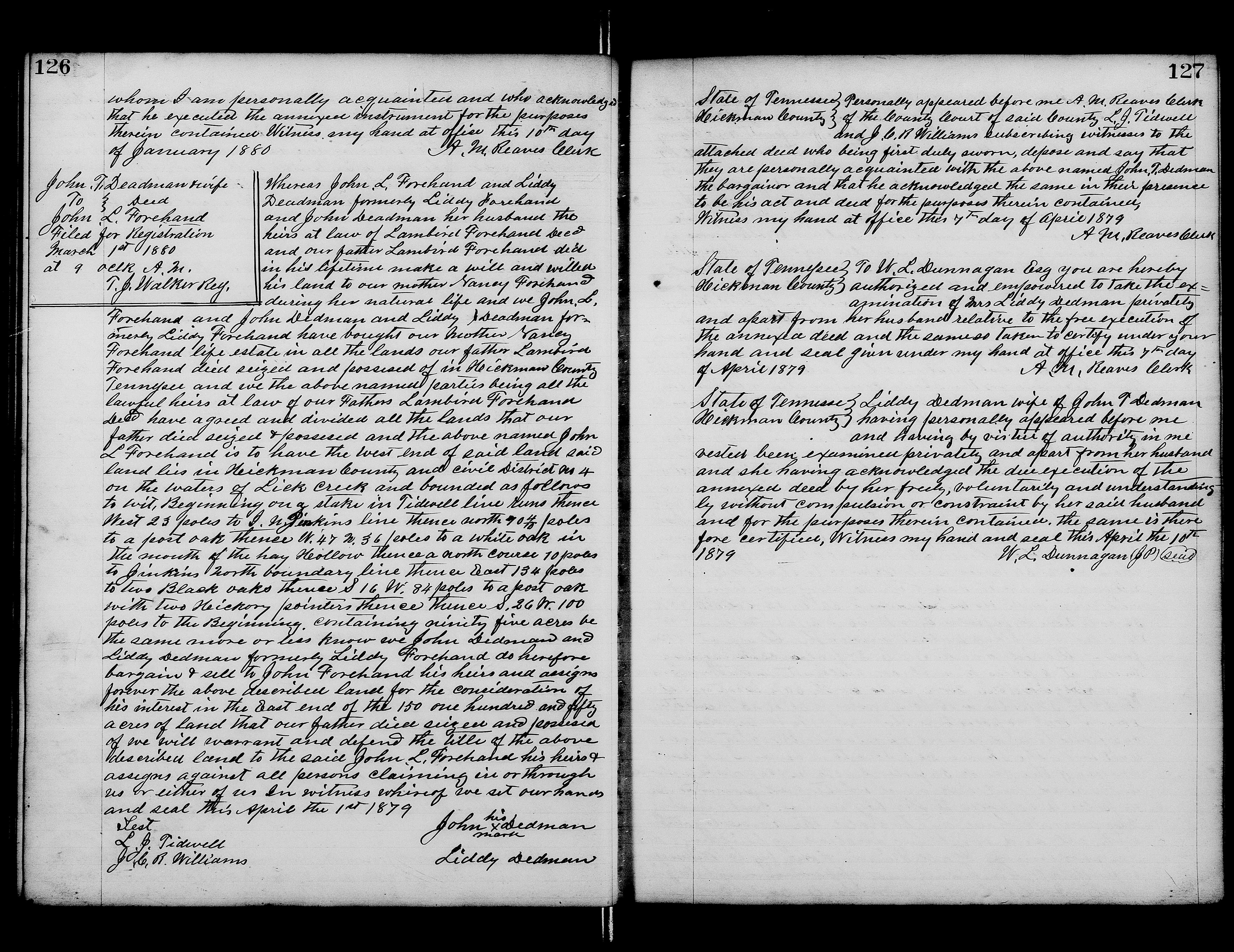
On April 1, 1879, Liddy Deadman and her husband John signed away their interest in the western part of a tract on the waters of Lick Creek, in Hickman County, Tennessee. Liddy had once been Liddy Forehand, and the buyer, John L. Forehand, was her brother. A reciprocal deed later put the eastern part in the Deadmans’ hands. Along the dividing line, the survey calls run in reverse from one deed to the other. Both deeds call him “our father.” It was Lambert Forehand’s land they had come to divide.1
The deeds say Lambert’s will gave their mother the use of the land for her lifetime and that the siblings bought her interest. On that account the two deeds agree. When they name the woman, one says Nancy and the other Sarah. The children’s parentage is clearer than much of Lambert’s own life, and the woman through whom the land passed is still the subject of a question her children’s deeds have left us.1
In 1850, the census taker found a Lambert Forehand in Hickman County. He was recorded as eighty, a farmer with $150 in real estate. Sarah, forty-seven, appears next, with younger people following. Two of those names, John and Lydia, fit the siblings who later divided the land. The census itself gives no relationships, and the $150 entry cannot identify their particular tract. We know the later division took place in the Fourth Civil District on waters of Lick Creek. A present-day parcel remains unidentified.12
On the Pasquotank
John’s death certificate gives North Carolina as his father Lambert’s birthplace. The earliest records carrying that name come from the low country of northeastern North Carolina. On January 21, 1795, Joseph McPherson sold Anthony Forehand thirty-three acres at a place the deed calls “the New land or middle branch or Swamp.” The lines ran past a water oak and a gum and back down the branch. Lambert and Jonathan Harrenton witnessed the sale. That October, Lambert proved the deed before John Williams at Halifax. The land was in Pasquotank County, and its register recorded the deed in December.910
Five years later, a man recorded as Lambard Forehand witnessed Anthony and his wife Sarah’s sale of fifty-one acres in upper Camden County to William Whitehurst. The deed says the land had belonged to Aron Brite, whose name offers a lead for tracing the property backward. These two transactions, with Lambert as a witness to a purchase and then a sale, give him a repeated association with Anthony. He could have been a brother, another relative or a neighbor. Camden had been formed from part of Pasquotank in 1777, so the two county names place these transactions in the same broad river country. Neither deed fixes Lambert’s home or proves a move across the river.1015
In 1800 a Camden census taker recorded a household under Lambert Forehand’s name. It held one male aged sixteen to twenty-five and one female aged twenty-six to forty-four. The schedule gives neither her name nor her relationship to Lambert. Ten years later a Lambert Forehand headed a household in Muhlenberg County, western Kentucky. By 1813, the name appears on a Williamson County tax list in middle Tennessee. The sequence is compatible with a move west. The coastal man’s age category and the eighty years reported for the Hickman farmer in 1850 leave room for an inaccurate age or a mistaken identification.2310
Land helps explain why such a move would have made sense to a household of that generation. North Carolinians were already seeking cheaper land to the west before 1800, and early nineteenth-century outmigration continued as the state struggled with poor transport. For a family looking for ground of its own, Kentucky and Tennessee offered places to consider. The expansion of settler access to land in Tennessee involved treaties that took land out of Cherokee control. News from relatives or acquaintances might also have helped a household decide where to go. The Kentucky census gives no indication of who, if anyone, drew Lambert there. The surviving papers leave his reasons and route open. In Tennessee, they do let us follow him from a tax list with no land entered to a grant that names his dwelling and deeds that trace what he bought and sold.35616
From the Harpeth to Trace Creek
Earlier Tennessee records put the name on the Harpeth side of this story. A Williamson County tax list in 1813 gives Lambard Forehand one poll and no land entered. In January 1814, while the United States was at war with Britain, compiled militia cards place private Lambert Forehand in Captain James Giddens’s company. His individual entry covers January 28 to January 29 and records a discharge. The longer dates across the company rolls belong to the unit. His cards give no reason for the brief service and no evidence that he fought at Horseshoe Bend.34
By 1823 Lambert was assessed for fifteen acres in Williamson. Another fifteen acres enters his story through a Tennessee grant to William Bray. The grant describes land on the little East fork of South Harpeth in Davidson County, including the place where Lambert lived. Bray received the grant. Whether Lambert’s fifteen taxable acres were the same ground remains unresolved. Even so, the grant gives his name a place on the waterway and distinguishes the man occupying the place from the man receiving title.35
On Trace Creek, a tract can be followed more closely. Richard Hobbs sold Lambert seven acres in 1836 for ten dollars. The description starts at a mountain oak on a steep hillside, at Newton Edney’s corner, then follows a line toward a chestnut oak and sourwood. Lambert’s 1848 sale to Andrew Varden describes the same seven acres, tree by tree and turn by turn, along with a separate sixteen-acre tract. Varden’s trust deed that December called the Trace Creek property his residence and put it near Backbone ridge. These descriptions give us a hillside, adjoining owners and a creek, while the exact modern boundaries remain open.6
Two years after the Varden sale a Lambert appears in Hickman. The Davidson deeds and Hickman census make a move within middle Tennessee plausible. The sources leave no account of the move itself. The later register copy of the Varden sale is dated 1853, but Lambert had executed the deed in 1848. By the time of proof, the dead man mentioned in the entry was William Cummins, a witness. That small distinction has a large effect on where a reader might place the last years of Lambert’s life.26
A family Bible gives the preferred death date as October 7, 1857. The same entry appeared in print in 1998, under the spelling “Lumbard Forhand.” Its final digit had also been read as 3, and the publication and photograph represent one underlying record. The Bible’s reported printing details conflict with the history of the Nashville publisher, and the entry’s writer is unidentified. In 1860, Sarah Forehand was enumerated as a widow with John L. in Hickman. If she was the Sarah recorded in Lambert’s household in 1850, as the family evidence suggests, her widowhood supports his death by September 1860. The first division deed establishes his death by April 1879 independently of that identification.178
Family Ties

The Lick Creek deeds name two children directly. John L. Forehand was married to Mary M. Forehand by the time of the reciprocal conveyance. Liddy Forehand married John Deadman. Other young people appear in Lambert’s 1850 household, including James, recorded as eleven. The census leaves their relationships unstated. The two siblings’ claim to be the lawful heirs in these deeds speaks to this division and leaves open the question of other children.12
John’s death certificate names his parents as Lambert Forehand and Sarah Walker. It gives North Carolina as his father’s birthplace and leaves his mother’s birthplace blank. Liddy’s certificate names the same parents. J. R. Dedman supplied both statements, decades after the births. The deeds have their own disagreement. The earlier one calls the mother Nancy twice, and the reciprocal deed calls her Sarah. In 1880 a widowed S. Forehand, seventy-seven, lived with John T. and Lidia Deadman and was listed as his mother-in-law. John and Mary Forehand were in the next enumerated household. Together these records support Sarah Walker’s identification and leave the Nancy recital unexplained. Lambert’s marriage date and any earlier marriage remain unproved.189
The leading reconstruction of Lambert’s North Carolina family places James Forehand as his father and Anthony Forehand as his older brother, with Elizabeth, Esther Spence’s daughter, as the proposed mother. This is the family hypothesis developed below and shown separately in the diagram. It draws on the Spence family circle, repeated dealings between Anthony and Lambert, and a compatible arrangement of census ages. No inspected record yet names either man as James’s son or calls them brothers.101118
Between the Lines
Possibilities under investigation
Esther Spence’s will brings the two surnames together in one household’s affairs. She names Elizabeth Forehand and Merriam Lambert as daughters and Esther Lambert as a granddaughter. James Forehand and John Lambert each receive five shillings as “my Sons.” Elsewhere she calls Isaac Sawyer and William Sikes “sons in Law.” In that setting James is a likely husband for Elizabeth, although Esther never pairs them in a marriage statement. John Lambert carried Lambert as a surname, and his exact place among the named Lambert relatives remains open. Esther’s will names neither Lambert Forehand nor Anthony.11
James as father, Anthony as brother
James is the leading father candidate in this working reconstruction. If he and Elizabeth were Lambert’s parents, the Lambert surname already present among Esther’s family offers a possible source for their son’s given name. Anthony’s estate records name children James and Esther, giving the proposed family another naming connection to test. Neither record explains whom the names honored, but together they make a more specific case than a shared Forehand surname alone. The Anthony intended here is Sarah’s husband in the coastal deeds, provisionally identified with the father whose orphans appear in the 1808 proceedings—not the later Anthony born about 1804.101117
The census ages give the proposed brothers a plausible order. In 1800, Anthony’s Pasquotank household contains an adult male aged twenty-six to forty-four; Lambert’s Camden household contains one male aged sixteen to twenty-five. Taking those males as the named household heads, Anthony was the older man. Ten years earlier, Elizabeth Forehand’s Pasquotank household contained one male sixteen or older and one boy under sixteen. Anthony in the older place and Lambert in the younger would fit those categories. The 1790 return names only Elizabeth, however. It cannot tell us that these were Anthony and Lambert—or that either was her son. The age fit supports the reconstruction without supplying the missing names.18
That possible household gives added interest to Lambert’s later presence in Anthony’s land transactions. In 1795 he witnessed Anthony’s purchase and then proved the deed; in 1800 he witnessed a sale by Anthony and Sarah. A younger brother helping establish an older brother’s title is one coherent explanation for this continuing connection. Cousins, other relatives or trusted neighbors could also have served in those roles. The case for brothers rests on considering the ages, deeds and family names together, while keeping those alternatives in view.101718
James’s land offers the most useful way to test the proposed parentage. He appears in Pasquotank assessments with one hundred acres in 1782, 1786 and 1787; Elizabeth Forehand has one hundred acres on the dated 1789 return. If these entries concern the same property and the couple associated with Esther’s will, an estate account, guardianship or later heir’s deed might show how it passed and name the children. Equal acreage alone cannot establish that succession. Anthony’s 1800 sale recites Aron Brite’s former title, not an inheritance from James. Esther’s executors, Isaac Spence and John Baddeley, also offer a route through receipts and distributions. Those are the records most likely to turn this proposed family into a documented one.101117
The age argument is strongest for the North Carolina pair. It does not settle whether the young Lambert recorded in Camden in 1800 was the man recorded as eighty in Hickman County in 1850. That discrepancy still requires an inaccurate age or a different identification. Proof of James’s coastal family and proof of Lambert’s westward trail are related questions, but each needs its own connecting records.218
Jarvis Forehand is a separate candidate from earlier family research. He was alive in the 1770s and dead by September 1788. The chronology allows the possibility and his inspected estate papers name no child. The earlier case for Jarvis’s own father does not supply the missing connection to Lambert.11
In Tennessee, Lambert’s inclusion in the Bible of the Vinson Forehand family makes a kinship or marriage connection worth investigating. William Cummins witnessed Lambert’s 1848 sale and also administered the estate of a John Forehand who died in Williamson County by September 1837. Those associations bring several people into view without assigning them a relationship. The older John’s estate identifies his own children and says nothing about his father. The Bible’s John and Sarah, the Hertford groom John and Sarah Collins, and the Williamson estate family still need records that join them. This older John is distinct from Lambert’s son John L., who lived into 1921.7912
The difference between Nancy and Sarah might reflect an error in a deed copy or a family circumstance the surviving records have yet to explain. Neither explanation has been established. Lambert’s actual will and the conveyance of their mother’s lifetime interest could tell us more. In the meantime, what can be followed through both deeds is the line on Lick Creek and the brother and sister on either side of it.1
A Life in the Records
The early coastal and Kentucky records and the Tennessee records are shown together to make their dates easy to compare. Their identification as one man remains open. Later proof, registration and family references are dated separately from Lambert’s actions.
| Date and place | Record |
|---|---|
| January 21, 1795 · Pasquotank, North Carolina | Lambert witnesses Joseph McPherson’s conveyance of thirty-three acres to Anthony Forehand. Lambert proves it at Halifax on October 23. Registered December 9, 1795.10 |
| January 1, 1800 · Camden, North Carolina | Lambard witnesses the Anthony and Sarah Forehand deed to William Whitehurst. Registered June 3, 1800.10 |
| 1800 · Camden, North Carolina | Lambert census household has one male aged sixteen to twenty-five and one female aged twenty-six to forty-four. Names and relationships beyond the head are unstated.10 |
| 1810 · Muhlenberg, Kentucky | Lambert heads a census household with an adult male aged twenty-six to forty-four, three boys and a female aged forty-five or older under conventional column alignment. An overwritten female entry prevents a settled full count.10 |
| 1813 · Williamson, Tennessee | Lambard appears on the tax list with one free poll and no land entered. Thomas Forehand has a separate entry.3 |
| January 28–29, 1814 · West Tennessee militia | Compiled service cards give Lambert’s individual start and discharge interval. A company roll running through May 10 does not extend his individual service.4 |
| 1816 · Williamson, Tennessee | Lambert taxed for one white poll, with no land entered. A separately entered name favors Abner.3 |
| 1820 · Davidson, Tennessee, uncertain name | A pale census entry favors abbreviated Abner and is excluded from Lambert’s established appearances.10 |
| March 28, 1822, preferred · Williamson, Tennessee | Lambert co-signs the bond for Josiah Rhodes to marry Nancy Cummins. The county index gives March 20. This was another man’s marriage bond.5 |
| 1823 · Williamson, Tennessee | Tax list gives Lambert fifteen acres and one white poll. Parcel location is unstated.3 |
| August 4 and 6, 1823 to September 8, 1825 · Davidson, Tennessee | Bray tract surveyed August 4 and entered August 6. Grant issued June 15, 1825, recorded September 8. It names the place Lambert lived. Bray is the grantee.5 |
| 1830 · Williamson, Tennessee | Lambert’s census row records a male aged fifty to fifty-nine and a female aged sixty to sixty-nine. The adjacent John household is separately entered.2 |
| September 20, 1835, preferred · Davidson, Tennessee | James H. Smith’s will refers to land bought from Lambert, including a storehouse. Probate October 1845 and recording November 20 or 21. The described purchase has not been equated with Lambert’s 1840 deed.13 |
| February 6, 1836, preferred · Davidson, Tennessee | Hobbs sells Lambert seven acres for $10 on Trace Creek. Proved November 4, registered December 9.6 |
| September 13, 1837, recording · Davidson, Tennessee | Hugh Allison’s estate inventory lists a $1.50 account on Lamberd, considered good. Date of the account itself is unstated.13 |
| 1839 · Davidson, Tennessee, District 14 | Lambert taxed on twenty-five acres valued at 105, with the poll column blank.3 |
| 1840 · Davidson, Tennessee, District 12 | Census household has a male aged sixty to sixty-nine, a female aged thirty to thirty-nine and three children under five. No relationships are stated.2 |
| October 21, 1840 · Davidson, Tennessee | Lambert sells James H. Smith three acres for $35 on Trace Creek. Martin Forehand and Washington G. Smith witness. Proved March 20, 1841. Registration year remains uncertain.13 |
| July 15, 1841 · Williamson court, Davidson land | Partition proceeding names Lambert as a boundary owner. This is a land reference.13 |
| September 1848 · Davidson, Tennessee | Lambert sells Andrew Varden sixteen and seven acres for $200. Main date favors September 27, witness line September 29. William Cummins and Seth E. Davis witness.6 |
| December 16, 1848 · Davidson, Tennessee | Varden trust deed names his purchase from Lambert and describes about twenty-three acres near Backbone ridge.6 |
| 1850 · Hickman, Tennessee | Lambert, eighty, is listed as a farmer in household 976. Sarah, forty-seven, and younger household members follow. Birthplace abbreviation is uncertain.2 |
| February 2–3, 1853 · Davidson, Tennessee | Varden sale proved February 2, registered February 3. The deceased witness was William Cummins. The act of registration gives no new life date for Lambert.6 |
| October 7, 1857, preferred Bible reading | Recorded death of Lumbard Forhand. Earlier 1853 reading, the identity of the entry writer and the Bible edition remain matters of source history.7 |
| September 13, 1860 · Hickman, Tennessee | Sarah Forehand enumerated as widow with John L. Lidia appears nearby. This supports Lambert’s death by then if Sarah is the woman in his 1850 household.8 |
| April 1, 7 and 10, 1879 to March 1, 1880 · Hickman, Tennessee | West tract conveyed April 1, proved April 7, Liddy examined April 10. Filed March 1, 1880. Lambert is described as deceased father and the mother is named Nancy.1 |
| April 1 and 7, 1879; filed February 19, 1883 · Hickman, Tennessee | J. C. R. Williams conveys twenty-five acres to John L. Forehand, adjoining John Deadman’s northeast corner and a line still called Lambert Forehand’s north boundary. Executed April 1, acknowledged April 7, filed February 19, 1883. This separate adjoining purchase is a later boundary reference, not evidence Lambert was living in 1879.14 |
| June 24, 1880, preferred · Hickman, Tennessee | Widowed S. Forehand listed as John T. Deadman’s mother-in-law in the home of his wife Lidia. John and Mary Forehand in the next household.8 |
| April 1 to May 2, 1881 · Hickman, Tennessee | East tract exchange dated April 1 and filed May 2, 1881. Attached dates include April 1879. The deed identifies the same father but calls the mother Sarah.1 |
| May 22, 1921 and January 10, 1922 · Tennessee | Death certificates of John and Liddey name Lambert and Sarah Walker as parents. The informant was J. R. Dedman on both.9 |
Undated and reported leads. Lambert’s will and the transfer of his children’s mother’s life interest are known from recitals. The underlying papers and their dates are still missing. A marriage to Susan, sometimes called Susan Anderson, around 1797 and a marriage to Sarah around 1831 or 1833 survive as compiled claims. The records above establish no such marriage dates or an exact birth year.110
The Family as We Currently Understand It
James Forehand: the leading father candidate
The proposed family: James as father, Anthony and Lambert as brothers. This is the favored working reconstruction, not an established pedigree. Dotted connectors identify the proposed parentage; the census ages make the brother relationship compatible, not proved.
Birth unknown · Died by June 1785 probate
Documented daughter ↓
Esther’s named daughter; proposed mother of Anthony and Lambert
Candidate match: taxpayer 1789; census 1790
Birth and death unknown
Leading father candidate
Probable husband of Elizabeth from the will’s context
Candidate match: 100-acre taxpayer, 1782, 1786, 1787
Birth and death unknown
Elizabeth ⋯ James: inferred marriage
Esther calls James one of “my Sons”; she does not expressly name him as Elizabeth’s husband.
Proposed sons — a family hypothesis
Proposed older brother
Sarah’s husband in the coastal deeds
Candidate census match: adult male 26–44 in 1800
Birth unknown; deceased by March 1808 if identified with the estate
Proposed younger brother
Witness in Anthony’s deeds, 1795 and 1800
Candidate census match: male 16–25 in Camden, 1800
Birth and death not established for this coastal record group
Why the brother hypothesis fits: Elizabeth’s 1790 household has one male sixteen or older and one under sixteen. Anthony in the older category and Lambert in the younger is compatible with their 1800 age brackets. The males are unnamed; their identity and their relationship to Elizabeth remain unproved. Census comparison.
Named among Esther’s “my Sons”; exact relationship qualified, possibly by marriage. Birth and death unknown. He is not proposed as Lambert Forehand’s father.
Esther also names granddaughter Esther Lambert, whose parentage is not assigned here. These Lambert names belong to Esther’s family circle; they suggest a naming connection without proving the proposed Forehand descent. Will evidence.
The James and Elizabeth tax and census entries remain candidate matches to the people in Esther’s will. No inspected record names Anthony or Lambert as their child. Tax and estate evidence.
The coastal Lambert may be the man later recorded in Kentucky and Tennessee. His 1800 age bracket conflicts with the age eighty reported in 1850; the connection remains possible. Early records · Tennessee census.
Birth unknown; census ages conflict
Death: October 7, 1857 favored Bible reading
Documented father of — reciprocal deeds, 1879–1881
December 11, 1837 – May 22, 1921
Birth reported on death certificate
Wife: Mary M. Forehand
October 11, 1835 favored – January 10, 1922
Birth reading and age support 1835; index differs
Husband: John Deadman
Their mother: Sarah Walker is named retrospectively on both children’s death certificates, by the same informant. The reciprocal deeds name their mother Nancy in one and Sarah in the other. This conflict remains unresolved. Sarah’s birth year varies in the censuses; death unknown. Deeds · Certificates
Solid lines: documented kinship. Dotted lines and dashed panels: proposed relationships or identity. An association is labeled as such, not drawn as descent. This is the documented pair of children, not a claim that Lambert had no others.
Sources and further reading
1. Hickman County, Tennessee, deed register group U–V, 1879–1883, DGS 008477841. John and Liddy Deadman to John L. Forehand, pp. 126–127, image 96 of 641, April 1, 1879, proved April 7, separate examination April 10, filed March 1, 1880. John L. and Mary M. Forehand to John and Liddy Deadman, pp. 507–508, images 287–288 of 641, April 1, 1881 main date, filed May 2, 1881, with April 1879 dates in associated acknowledgments. Original register images inspected in the underlying research. Individual book letters within the group remain unverified. The deeds recite the will and life estate and name Lambert as father. They differ on Nancy/Sarah, dates and acreage. The western ninety-five acres and eastern seventy-five acres do not add to the stated original 150 acres, and the later numeral may read 130. West tract deed · East tract deed · East tract continuation.
2. U.S. federal census, original schedule reproductions. Williamson County, Tennessee, 1830, Lambert and John separate rows, local supplied left schedule, visible p. 247, NARA M19 roll 182 per hosting metadata. Hosted reproduction supplies differing page metadata. Davidson County, Tennessee, 1840, District 12, p. 167. Hickman County, Tennessee, 1850, household 976, Lambert age eighty, farmer, real estate 150, followed by Sarah and younger household members. Exact digital locator for the latter two retained schedule images was unavailable in the evidence catalog. 1830 original schedule reproduction · National Archives census collections.
3. Williamson County, Tennessee, Tax Records 1800–1830, 1813 pp. 124–125 image 221 of 760, 1816 pp. 113–114 image 293 of 760, and 1823 pp. 18–19 image 499 of 760. Davidson County, Tennessee, 1839 tax list, District 14, pp. 288–289. Inspected register and manuscript images. 1813 return · 1816 return · 1823 return · 1839 image reproduction.
4. Compiled War of 1812 service cards for Lambert Forehand, private in Captain James Giddens’s company, Colonel A. Cheatham’s West Tennessee militia. Individual interval January 28–29, 1814, discharge recorded. Company roll headings through May 10 are distinct from Lambert’s individual dates. The name index, NARA M602, and institutional regimental history are separate resources and do not place Lambert at a battle. Hosted military record image · National Archives military record guide.

5. Williamson County Marriage Records 1820–1829, image 772 of 1943, original Rhodes–Cummins bond with Lambert, preferred March 28, 1822 against the county index’s March 20. Tennessee general grants 1824–1825, grant 23721, p. 374, image 192 of 414, William Bray, surveyed August 4 and entered August 6, 1823, issued June 15 and recorded September 8, 1825. Original grant-register image gives Lambert’s occupancy as part of the description. Marriage bond · Bray grant.
6. Davidson County, Tennessee, Richard Hobbs to Lambert, preferred February 6, 1836, Land Records 1836–1841, p. 15, image 38 of 707, proved November 4, registered December 9. Lambert to Andrew Varden, September 1848, Davidson deed group 16–17, pp. 18–19, DGS 008265114 image 327 of 633, main date favors September 27 and witness line 29, proved February 2 and registered February 3, 1853. Andrew Varden trust deed, December 16, 1848, Land Records 1847–1849, p. 502, image 598 of 647. The trust deed refers to the purchase as already of record, while the inspected sale copy was registered in 1853. Its complete recording history remains unresolved. Original register images. Hobbs deed · Varden deed · Trust deed.
7. Martha Cooke, “Forehan/Forehand Bible Record,” Middle Tennessee Journal of Genealogy & History 12, no. 1 (Summer 1998), printed p. 41, PDF p. 43. The published transcription and retained family photograph represent one Bible. October 7, 1857 is the favored death reading. The contributor reports former ownership by Vinson and later Warren Forehand and a Nashville printing in 1830. The publisher dates its Nashville operation to 1854. The Bible title page and entry writer remain unverified. The reported John and Sarah parentage of Vinson is supplied by the owner, separate from the entries. Published transcription · Publisher history.
8. U.S. federal census, Hickman County, Tennessee, District 4, September 13, 1860, NARA M653 roll 1257, handwritten p. 173 with 162 above it, stamped 25, rows 7–8 and 14–15. Sarah Forehand is listed as a widow with John L. on the next line. Lidia is in a nearby separate household. Fourth District, June 24, 1880 preferred, ED 84, p. 292B, penciled p. 24, households 132–133, NARA roll 1263. Original schedule images inspected. The 1880 schedule uses the initial S. and the relationship “Mother in law.” 1860 schedule image · 1880 schedule reproduction.
9. Tennessee death certificates, John Forehand, May 22, 1921, DGS 004184018 item 7 image 40 of 107, and Liddey Deadman, January 10, 1922, DGS 004184085 item 7 image 7 of 108. Original certificate images. Both name Lambert Forehand and Sarah Walker, and both identify J. R. Dedman as informant. The statements about their parents are retrospective. John certificate · Liddey certificate.
10. Coastal deed-register photographs, McPherson to Anthony Forehand, January 21, 1795, Pasquotank, continuation p. 86, proved by Lambert at Halifax October 23, registered December 9. Anthony and Sarah Forehand to William Whitehurst, Camden, January 1, 1800, p. 13, registered June 3, names Lambard as witness. Complete digital book locators are unrecovered. U.S. federal census, Camden, 1800, p. 96, NARA M32 roll 30, image 104, FHL 337906, and Muhlenberg, Kentucky, 1810, p. 405, roll 7, image 00416, FHL 0181352 per hosting locator. Original schedule reproductions checked. The 1820 Davidson Abner reading remains tentative. Marriage dates and the early Susan claim derive from older correspondence and compiled accounts. County records catalog · 1800 schedule · 1810 schedule.


11. Esther Spence’s undated original Pasquotank will, June Term 1785 probate, DGS 007665372 images 1679–1680, registered August 11, 1785, Book K p. 126, DGS 004770559 image 486. The will names daughter Elizabeth Forehand and gives legacies to James Forehand and John Lambert as “my Sons.” James’s marriage and Lambert’s parentage are separate inferences. Lodowick Williams meetinghouse deed, April 21, 1791, Pasquotank M:89–90, proved September 1792, registered May 27, 1793, documents Spence–Forehand collaboration. Jarvis’s proposed fatherhood is from older correspondence. His Chowan estate inventory, September 12, 1788, DGS 4973679 images 1510–1514, establishes death by that date and gives no Lambert relationship. Esther’s original will · Probate endorsement · Meetinghouse deed · Jarvis estate image.
12. Williamson County estate papers of John Forehand, widow’s provision September 26, 1837, inventory and sale presented October term, and guardian accounts 1839–1841. Nine retained original-record photographs examined in the underlying research. William Cummins describes his guardianship in his September 1848 court answer, Williamson court book 18, pp. 623–625, DGS 008397917 item 2, images 320–321 of 328, copied at December special term 1855. Lambert’s separate Cummins association appears in source 6. Gates County, North Carolina, August 12, 1799 preferred marriage bond of John Forehand of Hertford and Sarah Collins/Cullins, retained loose-record photograph. Its candidate connections to other Johns remain open. Guardianship statement · Court answer continuation · Gates marriage collection catalog.
13. Davidson and Williamson later references. James H. Smith will, Davidson Wills 1840–1846, pp. 322–323, images 490–491 of 580, September 20, 1835 preferred execution, October 1845 probate, November 20 or 21 recording. Hugh Allison inventory, Davidson Wills 1832–1840, image 387 of 695, recorded September 13, 1837. Lambert to Smith, Davidson Land Records 1839–1842, pp. 638–639, image 299 of 634, October 21, 1840 execution and March 20, 1841 proof. Williamson civil/state Court Minutes 1837–1845, July 15, 1841, pp. 334–335, image 468 of 833. Inspected original-register reproductions. Smith will · Allison inventory · Lambert–Smith deed · Partition entry.
14. Hickman County, Tennessee, J. C. R. Williams to John L. Forehand, twenty-five acres in Civil District 4; executed April 1, acknowledged April 7, 1879, filed February 19, 1883. Deed register group U–V, DGS 008477841, p. 536, image 619 of 641. Original register image inspected. Lambert appears only as a boundary name. Williams deed.
15. North Carolina General Assembly, 1777 session laws, ch. XVIII, printed pp. 30–32, act creating Camden from part of Pasquotank County. The legal boundary uses the Pasquotank River and a line running northwest from its head to the Virginia boundary. Printed act inspected in the project’s county geography research. County jurisdiction provides regional context for the two transactions without identifying Lambert’s residence. 1777 session laws.
16. NCpedia, “The Age of Jefferson, 1801–1825,” on early nineteenth-century North Carolina outmigration and transportation conditions, and “Revivals,” on pre-1800 migration in search of cheap land. Fred S. Rolater, “Treaties,” Tennessee Encyclopedia, describes Cherokee land cessions in 1798, 1805 and 1806. These accounts supply regional context. Lambert’s own motives, route and relation to any particular treaty tract remain unknown. The Age of Jefferson · Revivals · Treaties.
17. Pasquotank County tax list photographs, dated 1782, 1786 and 1787 assessments for James Forehand with 100 acres, and the dated 1789 assessment for Elizabeth Forehand with 100 acres. These are selected original-record views with incomplete digital locators. Pasquotank guardian deed, November 1, 1811, continuation p. 179, recites March 1808 guardianship proceedings and names James, Esther, Rebecca and Parthena as Anthony’s orphans. Register copy photographs examined in the coastal family investigation. The deed does not name Sarah or Lambert. Linking the deceased father to the Anthony in the 1795 and 1800 deeds depends on the broader record group. State Archives of North Carolina repository guide.
18. U.S. federal census, Pasquotank County, North Carolina, 1790, Elizabeth Forehand row: one male sixteen or older, one male under sixteen, one female; retained full-page family-collection photograph. Pasquotank County, 1800, Anthony Forehand row, supplied page numbered 637: one male under ten, one male twenty-six to forty-four, one female under ten and one female twenty-six to forty-four. Full images and headings rechecked November 10, 2026; complete digital-book locators for these two retained photographs remain unrecovered. Camden County, 1800, Lambert Forehand row, p. 96, NARA M32 roll 30, image 104, FHL 337906 per hosting locator: one male sixteen to twenty-five and one female twenty-six to forty-four. These are original-schedule reproductions, not named relationships. Identifying the adult males with the heads is conventional; placing Anthony and Lambert in Elizabeth’s 1790 household is a hypothesis. The ages permit an older Anthony and younger Lambert but neither prove brotherhood nor identify their parents. Lambert’s 1800 schedule · National Archives census collection guide.