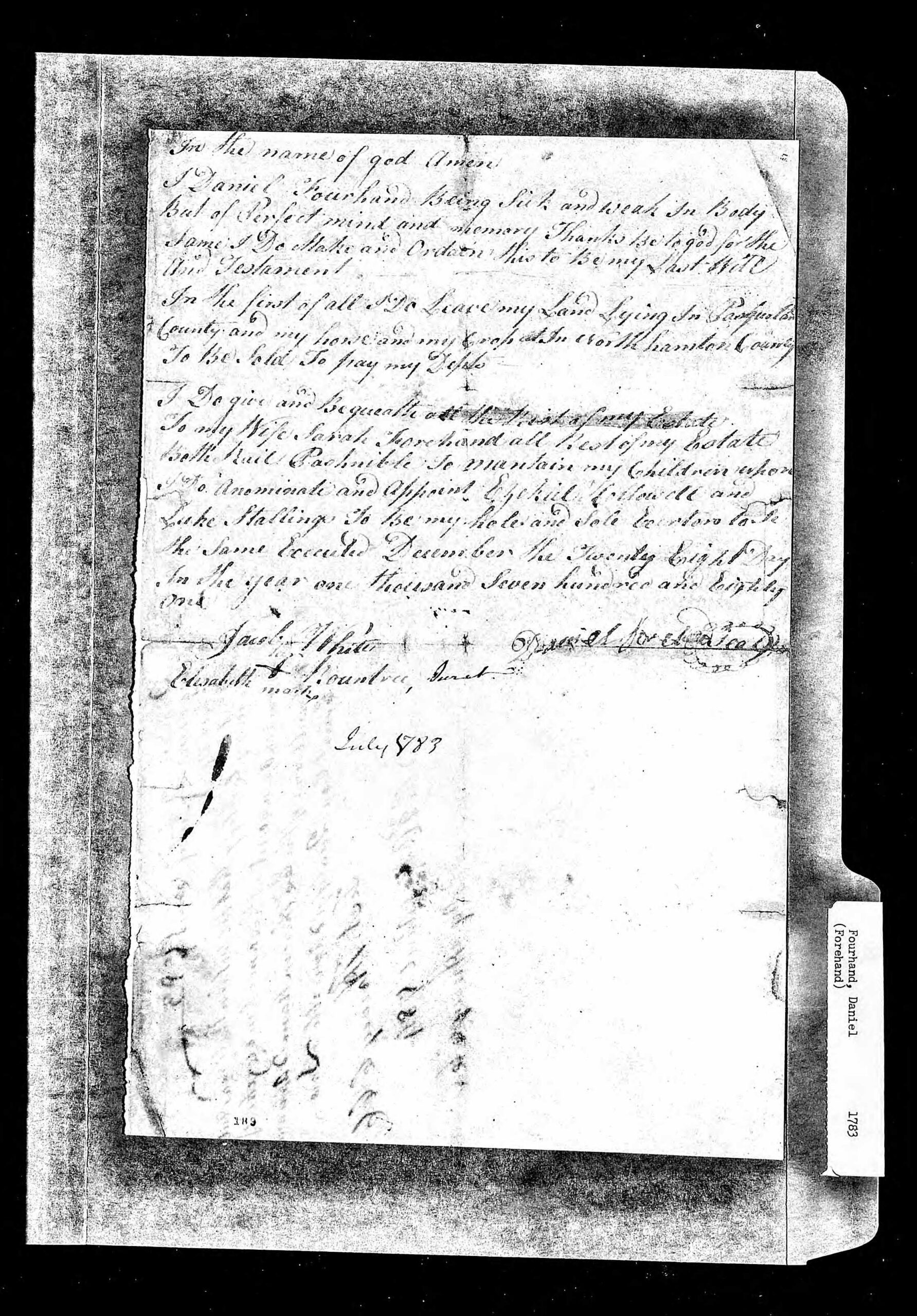
Daniel Forehand’s last will put his wife Sarah and his children at the center of a practical arrangement. His land in Pasquotank was to be sold, along with other property, to pay his debts. Sarah was to receive what remained and use it to maintain the children. Written on 28 December 1781, this brief document joins a family we cannot yet name in full to land whose history reaches back through Daniel’s brother Lemuel to their father Thomas. [R01] [L05]
The Pasquotank property lay on the southwest side of the river, in the district later described in the executor’s deed as Newland. This places Daniel within the same broad landscape as Thomas and Lemuel, on the Pasquotank side rather than across the river in present-day Camden. The surviving deeds give us a family title history and a neighborhood; they have not yet yielded an exact modern parcel or the site of Daniel’s house. [L03] [L05]
Daniel first comes into view beside his father. A tax return attributed to 1769 lists Thomas with his sons Jarvis and Daniel, three white polls recorded together. On the visibly dated return for 1770, Daniel and Jarvis appear separately, each with one white poll. These entries establish his place in the family before the land transactions begin. His birth date is unknown; the 1770 return suggests that he was born by 1754 under the taxable-age rule then in force. [H01] [H02] [H22]
On 23 October 1772, Lemuel sold Daniel two hundred acres for one hundred pounds proclamation money. Both men were described as residents of Pasquotank. The tract came out of a larger piece of back land patented by Thomas, so Daniel was acquiring a share of ground already associated with his father. Isaac Sawyer and Elijah Forehand witnessed the transaction. [L03]
Seven years later Daniel sold Benjamin Cooper one hundred and fifty acres on the southwest side of the river. Ezekiel Hollowell witnessed that deed with Jacob Temple. Ezekiel would have a much larger part in the family’s affairs after Daniel’s death. The sale was made on 15 November 1779, although proof and registration carried the instrument forward into 1781 and 1782. Those later clerical dates do not represent additional sales. [L04]
Daniel’s interests also extended beyond this familiar ground. His will referred to a crop in Northampton County and an accompanying asset best read as a horse. The crop is clear; the earlier reading “house” is not the preferred interpretation of the original. The clause does not name the state, identify a farm or establish that Sarah and the children lived in Northampton. North Carolina is the leading place to search in this family’s context, but the crop’s location and the arrangement under which Daniel held it remain open questions. [R01] [NORTHAMPTON]
For the business of settling his estate, Daniel chose Ezekiel Hollowell and Luke Stallings as executors. Jacob White and Elizabeth Rountree witnessed the will. Daniel’s wording was direct: after the property designated for debts had been sold, Sarah was to have the balance to maintain “my Children.” He did not name those children individually. Their number, ages and later lives are the largest gap in the family record. [R01]
The will was proved in Perquimans County at July Court in 1783, when Ezekiel qualified as executor. Daniel therefore died after making the will and by that court term; neither the probate nor the later inventory supplies an exact death date. By August, the sale he had ordered was under way. Ezekiel, a Perquimans planter, conveyed one hundred and fifty Newland acres to John Walmsley, a merchant of Hampshire, for one hundred pounds on securities. The deed described Daniel as late of Perquimans County, deceased, and recited the passage of the land from Thomas through Lemuel to Daniel. [R02] [R04] [L05]
That title recital provides a strong bridge between Thomas’s son in Newland and the husband of Sarah whose will was proved in Perquimans. We rate the identification High confidence—very likely. Some acreages and patent dates in the deeds disagree, so the land has not been reduced to a tidy modern boundary. The family sequence, executor and estate transaction nevertheless make a substantial cumulative case. [L03] [L05] [L06]
The inventory taken on 30 August 1783 brings the household into sharper focus. Ezekiel listed two feather beds and their furniture, two chests, three chairs and a linen wheel. There were pewter plates, a pewter dish, earthenware plates and two teapots; a Bible and a Common Prayer Book; a pine table, washing tubs, water pails, barrels and bread trays. An ox and a weeding hoe appear among the property. These belongings give substance to the estate Sarah was to receive, although the list does not tell us who used a particular object or which goods ultimately remained with her. [R07]

Family Ties
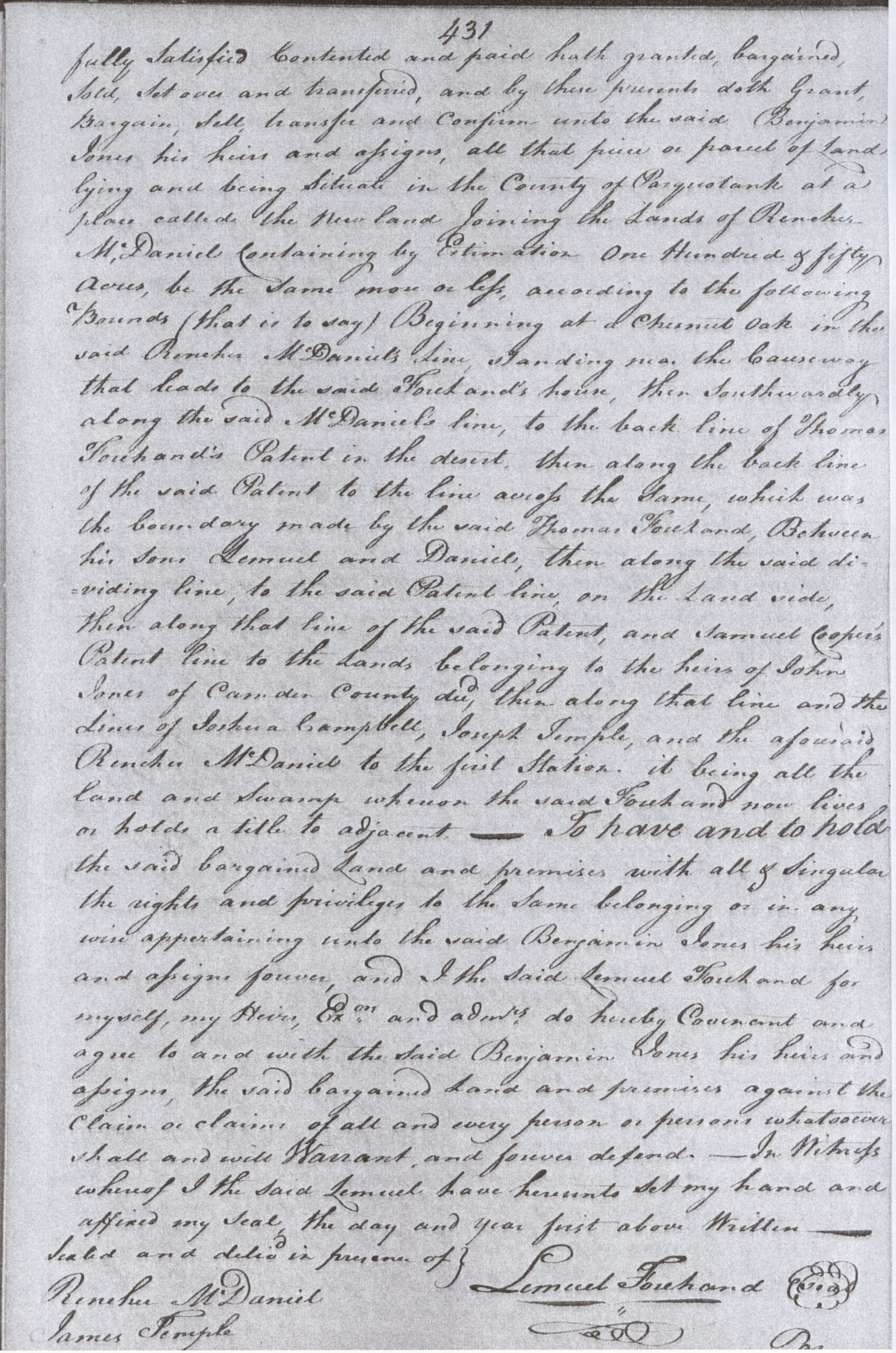
Thomas was Daniel’s documented father; his mother is unknown. The tax return’s sons clause is reinforced by a later deed in which Lemuel described a boundary Thomas had made between “his Sons Lemuel and Daniel.” Jarvis’s sonship is stated in the tax return. Lemuel and Jarvis can therefore be shown as Daniel’s brothers through their shared father, without assuming that all three had the same mother. [H01] [L06]
Cornelius Forehand is Daniel’s very likely paternal grandfather. This depends on the High confidence identification of Newland Thomas with the Thomas named as Cornelius’s son, as discussed in Thomas’s story. It is a separate inference from Daniel’s expressly documented sonship. [THOMAS]
Sarah was Daniel’s wife when he made his will. The children were Daniel’s, but the will does not expressly say that Sarah was the mother of every child. We know no secure marriage date and no child’s name from this estate. Later men named Daniel Forehand must remain separate: the Daniel associated with a 1791 marriage bond, for example, cannot be the man whose will was proved eight years earlier. Whether any of those later Daniels descended from this household is still unknown. [R01] [L09]
Between the Lines
Possibilities, not proven relationships.
Sarah probably belonged to the family of Elias Stallings. His will of 27 November 1778 included a Sarah Forehand among the people who were to share the remainder of his estate. Several members of that group were expressly identified elsewhere in the will as his children. Sarah’s place among them suggests daughtership, although her own clause does not call her a daughter or name her husband. [R06]
The names surrounding the two wills strengthen the connection. Elias expressly called Luke Stallings his son. Daniel appointed a Luke Stallings executor. Ezekiel Hollowell and Jacob White witnessed Elias’s will; Ezekiel was Daniel’s executor and Jacob witnessed Daniel’s will. This is a more particular connection than a shared surname alone. We rate both Sarah the beneficiary’s proposed daughtership and her identification with Daniel’s wife Moderate confidence—probable. [R01] [R06]
The alternative is that these men served a wider neighborhood of relatives and associates, and that the Sarah in Elias’s will was another Forehand woman or a beneficiary related in a different way. No complete inventory of competing Sarahs has yet ruled that out. An estate receipt naming her husband, a distribution identifying her relationship to Elias, or a marriage record could settle the matter. Until then, “probably of the Stallings family” expresses the evidence better than an unqualified maiden name. [DANIEL-RESEARCH]
For the children, the question is more open. The surviving will establishes that they existed and that Daniel placed their maintenance in Sarah’s hands. It does not provide a basis for attaching later Forehands to them by name. The task ahead is to follow the estate beyond its inventory—to the receipts, settlements or guardianship proceedings that might show what Sarah received and who the children became. Daniel left a short will, but his instruction to provide for them gives that search its direction. [R01] [DANIEL-RESEARCH]
A Life in the Records
This is the currently identified record sequence, not a claim that every surviving record has been found. Dates of court proof and copying are kept apart from Daniel’s own acts.
Securely dated acts
- 1770. The dated Pasquotank tax return lists Daniel and Jarvis separately, one white poll each. This supports a conditional birth bound of by 1754 under the sixteen-year taxable-age rule, not an exact birth year or proof of marriage. [H02/H24] [H22]
- 23 October 1772. Lemuel conveyed Daniel 200 acres on the southwest side of the Pasquotank River for £100 proclamation money. Both were described as of Pasquotank. Isaac Sawyer and Elijah Forehand witnessed it. Proved December 1772; registered 13 April 1773. [L03]
- 15 November 1779. Daniel conveyed Benjamin Cooper 150 acres on the southwest side of the river for £500 lawful money. Proved June 1781; registered 4 September 1782. These later steps do not establish Daniel’s attendance. [L04]
- 28 December 1781. Daniel made his will, naming Sarah as his wife, his children collectively, Ezekiel Hollowell and Luke Stallings as executors, and Jacob White and Elizabeth Rountree as witnesses. This is his last secure personal act in the assembled records. [R01–R04]
Attributed dates and abstracted evidence
- Attributed 1769. A Pasquotank tax crop calls Jarvis and Daniel Thomas’s sons. Its date is supplied by the file attribution, not visible on the photographed portion. A by-1753 birth bound is conditional on that attribution as well as the tax-age assumption. [H01]
- Attributed 1772, Perquimans. A saved tax image includes Daniel with one white poll. The year and county rest on the supplied provenance; the exact archival leaf has not been matched. It is not secure proof of a move in that year. [H03/H04]
- 17 May 1780, abstract only. Two reciprocal Luke and Reuben Stallings conveyances name Daniel Forehand and Ezekiel Hollowell as witnesses. The local abstracts provide the date and names; the underlying deed images have not been checked in this investigation. [L12]
Estate proceedings and later references
- July Court 1783. Elizabeth Rountree proved the will in Perquimans; Ezekiel Hollowell qualified as an executor. The term opened 14 July, but the exact day of this entry is unstated. Daniel died after making his will and by this term. [R02/R04] [N-B07]
- 10 August 1783. Ezekiel, acting as executor, conveyed John Walmsley 150 acres in Newland for £100 on securities. The deed calls Daniel deceased, late of Perquimans, and recites the route of title through Thomas and Lemuel. Proved September 1783; registered 1 March 1786. [L05]
- 30 August 1783. Ezekiel made the estate inventory, including 250 acres “by information” and household goods. This is not Daniel’s death date or a surveyed acreage. [R07/R08]
- October Court 1783. The Perquimans minutes record the return of an inventory and order it filed. The term opened 13 October; that is not an independently stated filing day. [N-B08]
- 2 April 1784. The will was recorded, a clerical event after Daniel’s death. [R02/R04]
- 9 February 1796. Lemuel’s deed to Benjamin Jones recalled the line Thomas had made between “his Sons Lemuel and Daniel.” This is direct relationship evidence in a later title recital, not a living appearance by Daniel. [L06]
Selected militia and additional tax images have yielded no further secure appearance of this Daniel. Those bounded checks do not establish that he never served or lived elsewhere. Later Daniels are discussed separately above.
The Family as We Currently Understand It
Documented relationships and inferred identities are labeled separately. Birth bounds depend on the tax or militia assumptions explained in the story.
Cornelius Forehand
Birth unknown · Died 1728
Thomas Forehand of Newland
Born by 1724, conditional tax-age bound · Died 1769
Wife unknown. A common mother for his three documented sons has not been established.
Lemuel Forehand
Born by 1750, conditional militia-age bound
Died 31 January–24 February 1808, under the High confidence identity with that testator.
Daniel Forehand
Born by 1754, conditional tax-age bound
Died after making his will on 28 December 1781 and by July Court 1783.
High confidence: Thomas’s son was very likely the Perquimans testator whose family appears below.
Jarvis Forehand
Tax-record son: birth and death unknown.
Moderate confidence: probably the man whose Chowan estate began by 12 September 1788. The conditional by-1750 militia-age bound belongs to that proposed identity.
Daniel and Sarah
Daniel names Sarah as his wife on 28 December 1781. Her birth, death and marriage dates are unknown.
Sarah Forehand
Birth unknown · Death unknown
Her proposed identification with Elias Stallings’s legatee is shown separately below; her birth surname is not directly documented.
Children, names and number unknown
The will provides for “my children” without naming them. No later Daniel or other proposed child is inserted here.
The proposed Stallings connection
Elias Stallings
Birth unknown · Death date unresolved
Will made 27 November 1778; recorded probate and copying dates conflict.
Sarah Forehand, Elias’s legatee
Birth unknown · Death unknown
Named in his will of 27 November 1778.
Solid: Established relationship. Long dashed: High or Moderate confidence, as labeled. A dashed card marks a proposed identity or placement.
Sources and Notes
Original papers, historical register copies, abstracts and attributed dates are distinguished below. Several views of one instrument remain one source. The supporting research retains full local filenames and the precise scope of image inspections. Archive viewers may require an account.
- R01. Daniel Forehand, executed will, 28 December 1781. Original loose paper, North Carolina wills and probate, Ancestry image 007640070_01717; State Archives MARS 5200.77.401. The viewer places it in a Pender sequence, but the actual probate endorsement establishes Perquimans. Original image.
- R02. Reverse probate endorsement, July Court 1783; recorded 2 April 1784. Original paper, Ancestry image 007640070_01718. Endorsement.
- R03–R04. Perquimans Will Book C:249–250, historical register copy of the same will. Confirms wife, children, two nominated executors, Elizabeth Rountree’s proof, Ezekiel’s qualification and recording. The original witness reads Jacob White; the derivative Joseph reading is incorrect. C:249 and C:250.
- R05–R06. Elias Stallings, will executed 27 November 1778, Perquimans Will Book C:298–299. Historical register copy; Sarah Forehand’s residue clause does not identify husband or father. Its July Court 1785 probate notation conflicts with its 22 March 1785 recording date; the conflict remains unresolved. No exact death date is derived from it. C:298 and C:299.
- R07–R08. Daniel Forehand estate inventory, 30 August 1783, Perquimans; Ezekiel Hollowell, oath before Jacob Perry. Original-paper images 007383969_01493–01494. The land is reported “by information”; no values or children’s names appear on the inspected front. Front and reverse.
- H01. Family photograph of a Pasquotank tax return, attributed 1769, naming Thomas with sons Jarvis and Daniel. Date absent from the photographed portion. Preserved as “1769 – James Boswell Lemuel Thomas David Forehand Pasquotank NC.jpg.”
- H02/H24. Pasquotank tax return headed 1770, four county photographs compared with the family crop “1770 – James Daniel Jarvis Forehand Pasquotank NC.jpg.” No second Daniel Forehand identified in these views; not an exhaustive countywide name census. The conditional birth bound uses the sixteen-year white-male threshold in the previously checked 1760 tax act, rather than an assumed age twenty-one.
- H03/H04. Tax image and saved web page attributed 1772, Perquimans; “1772 – Jarvis Cornelius and Daniel Forehand Perquimans NC.jpg.” Supplied archival reference GA 11.1 / MARS 66.30.1; exact leaf unmatched. Year and jurisdiction are provenance attributions.
- L03. Lemuel to Daniel Forehand, 23 October 1772; December proof, 13 April 1773 registration. Three family photographs of the Pasquotank deed register, filed under 1773; book/page not recovered. Two hundred acres from a recited 320-acre back-land tract.
- L04. Daniel to Benjamin Cooper, 15 November 1779; June 1781 proof; 4 September 1782 registration, ending p.63. Two local photographs of the Pasquotank register. The deed’s recited parent-patent acreage differs from other records and has not been silently corrected.
- L05. Ezekiel Hollowell, executor, to John Walmsley, 10 August 1783; September proof, 1 March 1786 registration. Four local Pasquotank register photographs ending p.405, supplemented by a FamilySearch opening-page comparison, image 412, manuscript p.400. Title recites Thomas → Lemuel as heir at law → Daniel. Opening register page.
- L06. Lemuel to Benjamin Jones, 9 February 1796, Pasquotank register pp.430–431, two local photographs. The sons clause appears on p.431. Retrospective relationship and boundary evidence; no claim Daniel was living in 1796. Original-register detail.
- L12. Local text “Perquimans Deeds.txt,” abstracts 251 and 254, reciprocal Luke/Reuben Stallings conveyances dated 17 May 1780. Daniel and Ezekiel are named as witnesses. These are derivative abstracts; original wording has not been checked here.
- N-B07. Perquimans court records, July 1782–June 1784, box 79, FamilySearch DGS 103787285, images 50–52. Original court-minute images and context establish July 1783 term, proof and executor qualification; the term opening is not an exact probate day. Court entry.
- N-B08. Same court series, DGS 103787285, image 69, manuscript p.73; term heading image 65/p.69 and intervening views checked. October 1783 inventory return; assets and heirs unstated. Court entry.
- L09–L10. Later Daniel’s Perquimans marriage bond, 4 March 1791, local original-record photographs, compared with the compiled county bond index, preferred p.52. A bond anticipates a marriage and does not establish its ceremony date. No parents stated.
- L07–L08. Later Daniel’s 25-acre gift dated 6 April 1795 and corresponding sale dated 5 September 1797, local Pasquotank deed-register photographs. These deeds concern a later Daniel. They do not establish that later man as a child of the testator dead by 1783. The 1795 deed’s separate reference to that later Daniel’s eldest son Cornelius must not be transferred to the earlier household.
- Family context. Cornelius’s will, 24 February 1727/8, proved July 1728, names son Thomas. The adult Newland identification is separately rated High confidence. Thomas’s estate, December 1769–March 1770; related original tax, militia, deed and estate records supporting the qualified dates in this tree are documented in the Thomas story. Its synthesis is not another independent historical source.
- H22. North Carolina, 1760, chapter II, sections I–III, tax act; printed in The State Records of North Carolina, volume 23, p.526; also Davis’s 1773 revisal, pp.250–253. The published statutory page was inspected in the prior tax-law research. Its ordinary white-male taxable threshold of sixteen supports a conditional upper birth-year bound from the 1770 return, not an exact age, marriage date or birth record. The saved page is retained in the research collection.
- Northampton research note. “Daniel Forehand — Northampton connection,” research report dated 2 October 2026, source catalog and independent review in the family research collection. Compares the executed will and registered copy; documents inspected grantor, grantee and older F-index pages, bounded deed searches, and the forty-image 1780 taxable-property item. No secure additional target record was identified within those checks; this does not establish absence or exclude another state. State Archives 1780 Northampton tax collection. The interpretation depends on those records, not on the report as independent evidence.
- Family research synthesis. “Daniel Forehand — life, family and estate,” research report dated 2 October 2026, with source catalog, evidence register and the separate 13 November 2026 editorial source/argument review retained in the family research collection. The current conclusion distinguishes Sarah the wife from Sarah the legatee, records the limited competing-name coverage, and keeps later Daniels separate. The report is a guide to the evidence above, not a separate historical witness.
Editorial review, 13 November 2026: decisive will, inventory, Stallings and land images were separately checked. The full chronology also carries forward earlier documented image reviews; it does not claim a fresh inspection of every source or a complete survey of every namesake.