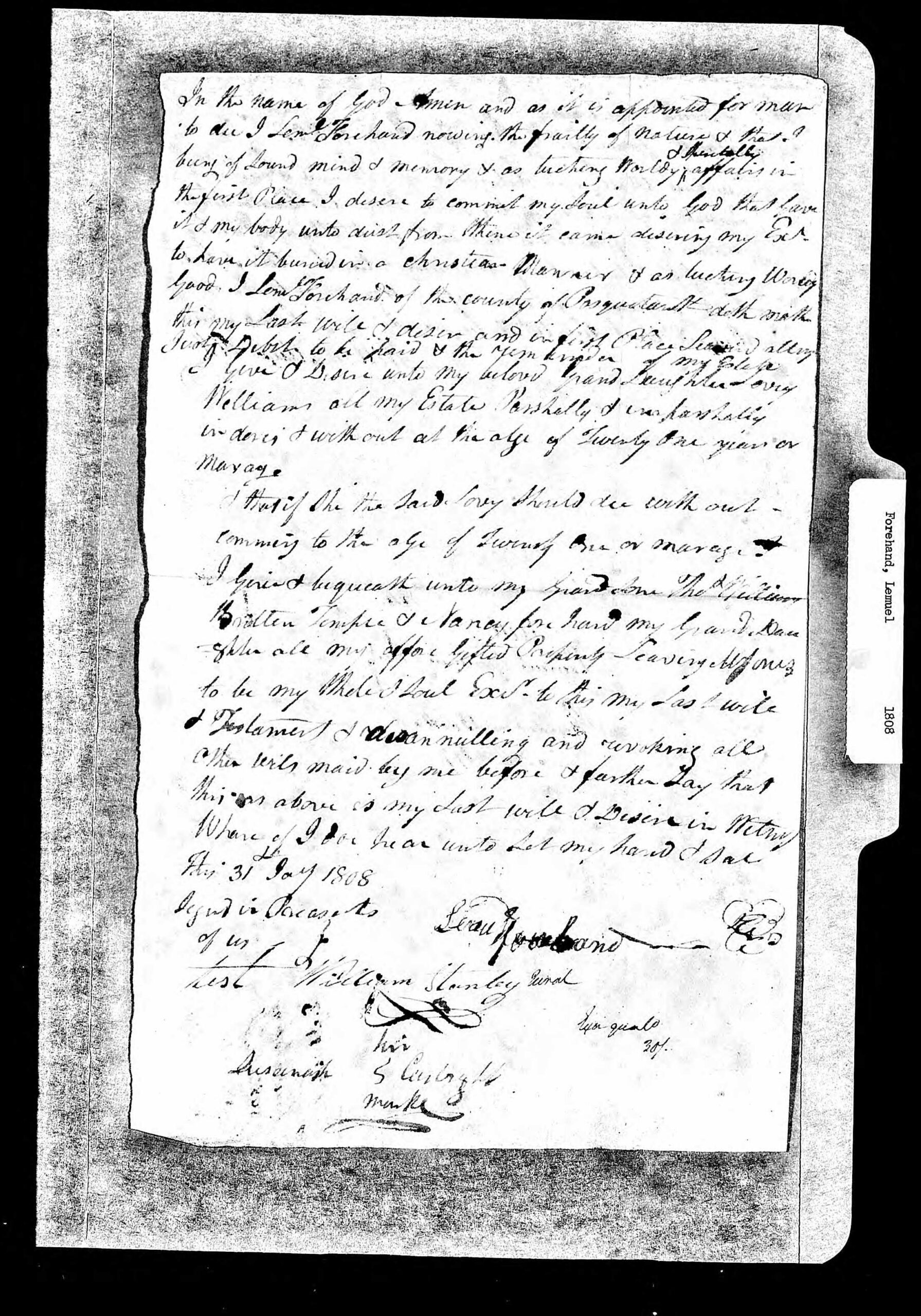
On 31 January 1808, Lemuel Forehand put his granddaughter Lovey Williams at the center of his will. After his debts were paid, she was to receive the remainder of his estate when she reached twenty-one or married. If she died before either event, the property would pass instead to the three people named in the next clause: Thomas Williams, Britten Temple and Nancy Forehand. Lemuel called Lovey his “beloved Grand Daughter.” He did not name her parents. That combination—a clear provision for a granddaughter and a missing generation behind her name—still shapes the family story. R01
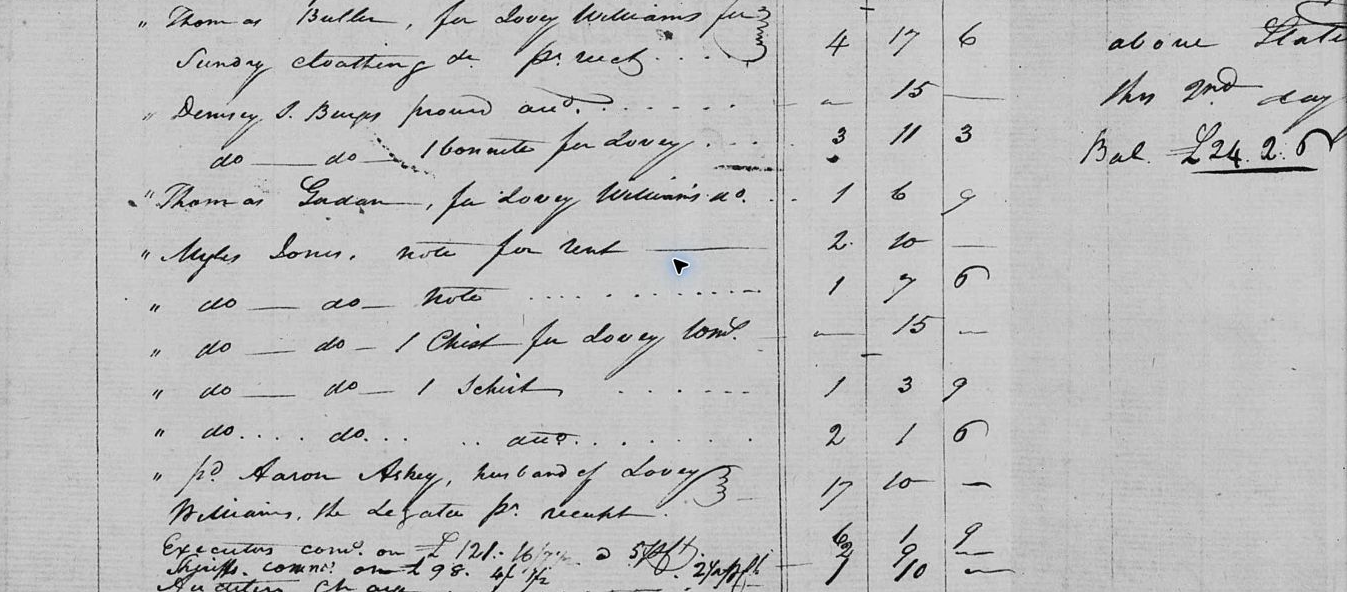
Within a few weeks, Lemuel himself was dead. His inventory and estate sale are dated 24 February. The executor’s account, settled in June 1809, records £17 10s paid to Aaron Askey, “husband of Lovey Williams the Legatee,” referring to a receipt. Lovey was married by the settlement date; the papers do not establish whether the marriage occurred before or after the will, or where the couple went afterward. O03
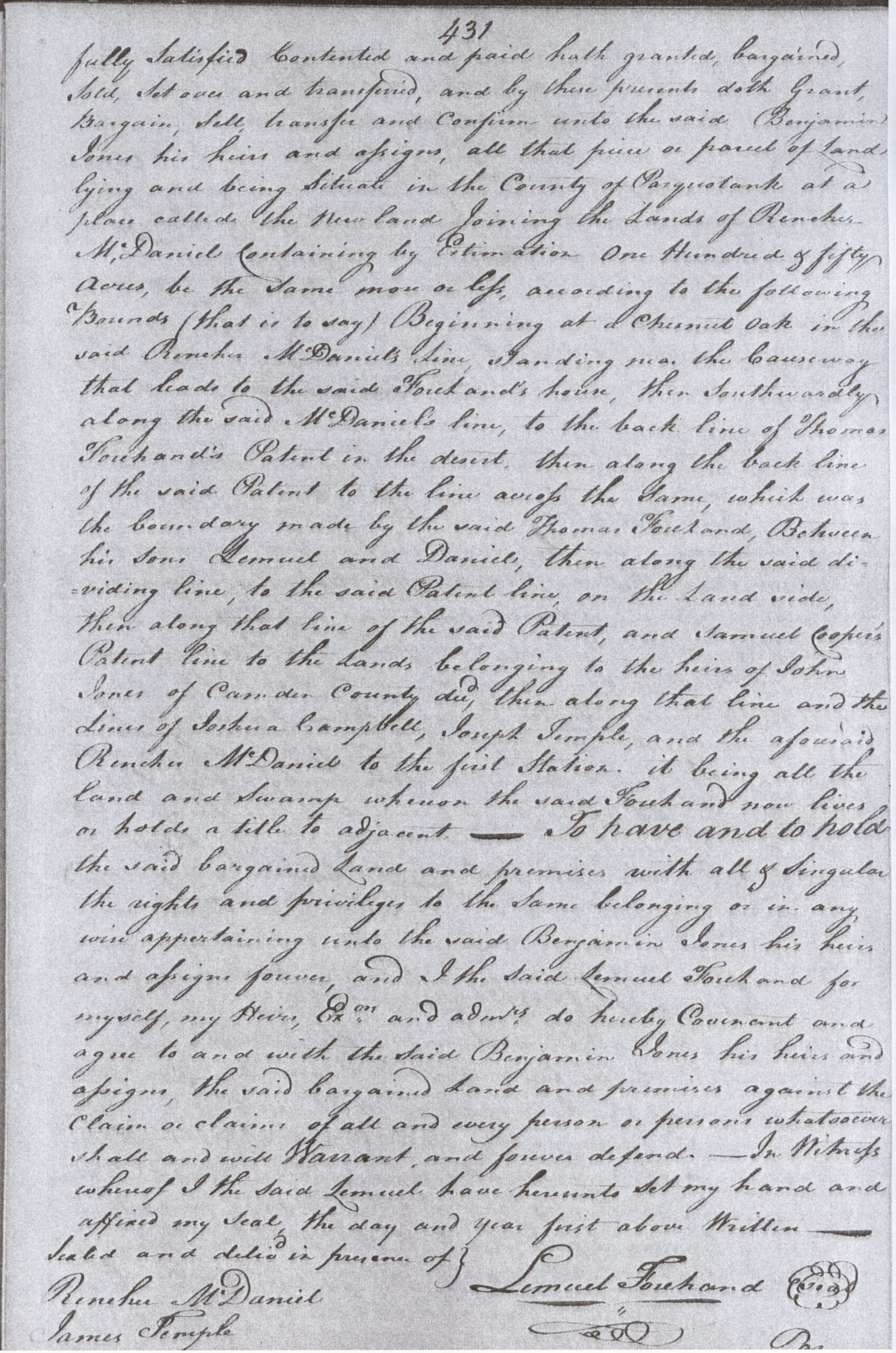
Lemuel’s earlier life belongs to Newland, on the southwest side of the Pasquotank River, where family land ran back toward the swamp. In 1796, a deed described a chestnut oak near the causeway leading to his house. Its boundary followed the back line of Thomas Forehand’s patent “in the desert,” then a division Thomas had made between “his Sons Lemuel & Daniel.” The old wording preserves both a landscape and a relationship. The house was the living seller Lemuel’s; the deed says that the land and swamp were where he “now lives.” Its modern site has not been located. D07
By then Lemuel’s name had appeared in local records for roughly three decades. A militia roll attributed to 1766 lists him as a corporal. Earlier tax material places him among other Forehands, although a damaged return saved under both 1764 and 1765 is one document with an uncertain date. The militia evidence supports a conditional birth no later than 1750, under ordinary enrollment rules. It does not establish the often repeated birth about 1740, and colonial militia service should not be turned into a claim of Revolutionary service. LH01 LH02
In September 1769, Thomas sold Lemuel sixty acres at Newland for £20. Two days earlier, Thomas had sold another tract to David Forehand. Lemuel and David witnessed one another’s purchases. The paired deeds put the men together in the same small landholding circle, but only later evidence explicitly calls Lemuel Thomas’s son. David’s place in the family remains less certain. Before the year ended, Lemuel had become administrator of Thomas’s estate. The transition from a father’s conveyance to a son’s administration is recorded within a single autumn and winter. D01 TH-R05 XT02
Lemuel continued to deal in the land Thomas had held. In October 1772 he sold Daniel two hundred acres from his father’s back land. A later conveyance by Daniel’s executor recited an inheritance from Thomas to Lemuel as heir at law, followed by a transfer to Daniel. Together with the express sonship clause, this makes Lemuel probably the eldest surviving son eligible to inherit that land. It does not give a complete birth order. The surviving deeds also contain differences in acreage and patent descriptions; they are not all interchangeable descriptions of one undivided farm. D02 D03 D07
The Revolution passed through the middle of this documentary life. Lemuel appears in tax records before, during and after it, but those records supply no battle or military campaign to attach to his name. They show land, livestock and taxable property. In 1782 he was charged with 150 acres, three horses or mules and ten cattle. The repetition of his acreage in several returns helps follow a continuing landholder, without proving that every return measured precisely the same ground. LH06 LH07 LH08
His locality was recognizable enough to serve as an endpoint in a proposed road. A 1784 bill described a route “from or near Lemuel Forehands or Caleb Coopers,” in upper Pasquotank, through the Great Dismal Swamp toward the upper bridge of the Perquimans River near Widow White’s. The proposal was laid over in November. It records an intended connection between communities on opposite sides of the swamp, not proof that this particular road was built. For Lemuel’s story, its value is immediate: his name served to identify a place from which travelers might begin the crossing. LH21
On 9 February 1796 he sold Benjamin Jones of Camden approximately 150 acres at Newland for 950 Spanish milled dollars. This is the deed that preserves the causeway, his house and the division between the brothers. It conveyed the land and swamp where Lemuel lived, together with adjacent land to which he held title. A home that appears only as a phrase in a boundary description was also part of a substantial transaction. The sale gives us a firm date in the history of his residence, but no reason for his decision to sell. D07
The records then extend beyond Newland. The Lemuel enumerated in Hertford County in 1800 had a household containing an older man, an older woman, a younger female and six enslaved people. Their names and relationships were not recorded. A February 1801 Camden deed calls its buyer Lemuel Forehand of Hertford County. Later deeds describe him in Camden while he continued to hold and sell Pasquotank land. The names, dates and repeated associates connect this sequence to the Newland man and the 1808 testator with High confidence, though no single instrument states the whole identification. An entry in a Pasquotank land-tax list is not, by itself, proof that he was then living there. JH01 D08 D09 LH16 LH17
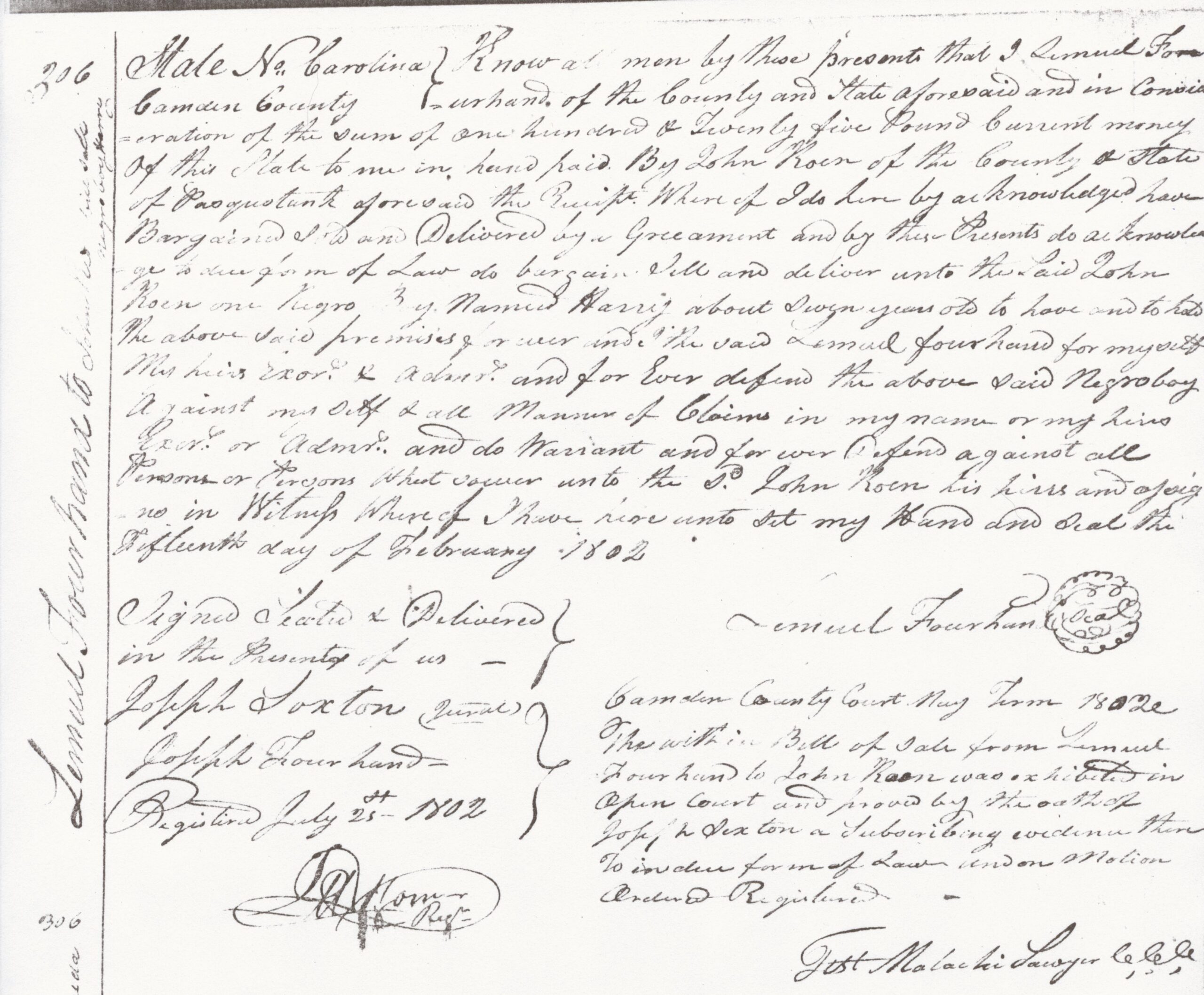
One Camden transaction gives a name to a child whom household totals would otherwise conceal. On 15 February 1802, Lemuel sold an enslaved boy named Harry, described as about seven years old, to John Koen of Pasquotank for £125. The bill of sale treated Harry as property, guaranteed the buyer’s title and recorded the price. It gives no account of his parents or what happened to him afterward. A seven-year-old child was being transferred between owners for money; that act belongs in the history of Lemuel’s property as surely as the sale of his Newland land. D11
The later land records also help keep the family identification from resting on a name alone. Smith Jones witnessed the 1801 Camden purchase and bought fifty acres from Lemuel in 1806. Joseph Wood bought Newland land from him in 1807. Men from this same circle reappear in the estate records. These are useful connections across the change in county descriptions, not new proof that every associate was a relative. D05 D08 D10 O03
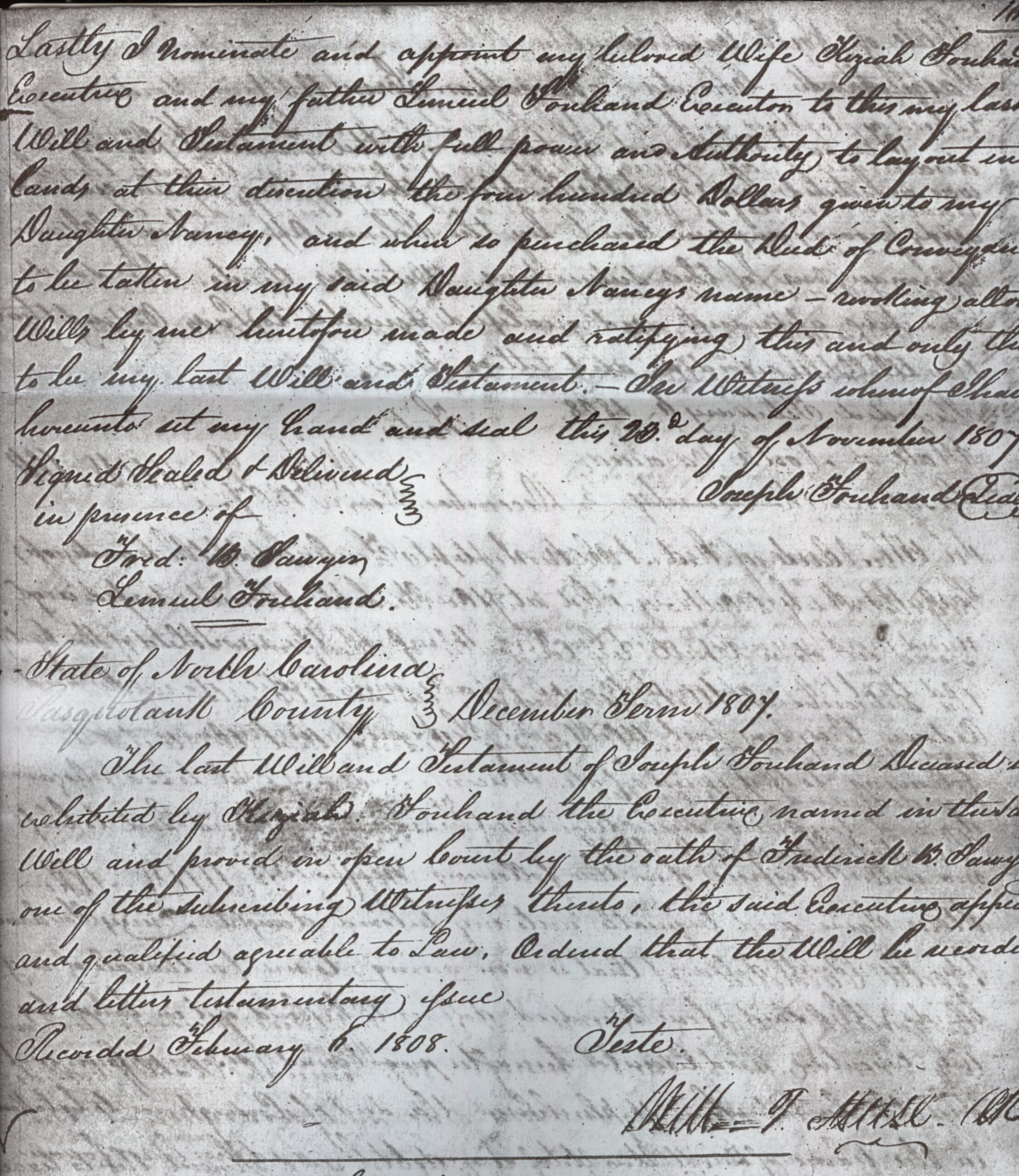
By November 1807, another family estate was about to begin. Joseph Forehand, describing himself as very sick, made his will on the twenty-third. He named his wife Keziah, his daughter Nancy and “my father Lemuel Forehand,” whom he nominated as executor alongside Keziah. Nancy was to benefit from $400 still owed for land Joseph had sold. The money was to buy land in her name, with Keziah allowed its use during widowhood. Joseph also left Nancy two feather beds and furniture. The residue was divided two-thirds to Keziah and one-third to Nancy. He did not expressly identify Keziah as Nancy’s mother. R04 R05
Joseph was dead by 5 December, when his property was inventoried and sold. The sale account records a mare bought by Lemuel for £36. The recorded purchase adds another link between the two men at the close of Joseph’s life. Joseph’s father is very likely the Lemuel who made his own will the following month. The matching locality, close dates, estate associations and granddaughter Nancy support that conclusion at High confidence. R06 O05
Lemuel’s own inventory followed on 24 February 1808. Its articles reduce a household to lines on a page: chairs, pewter plates, cooking equipment, tools, a coffee mill, livestock and a mare. The will had disposed of the residue after debts; the executor still had to account for goods sold, debts paid and money remaining. Lemuel’s death falls between 31 January and 24 February, inclusive. The December probate and January 1809 recording belong to the later work of the court, not to his lifespan. R01 R03 O03
In that accounting, Lovey becomes more than a name in a legacy. There are charges for clothing and a bonnet, followed by the payment to her husband. The account settled on 2 June 1809 still showed £24 2s 6d due to the estate. It does not prove that every remaining obligation had been paid or that Lovey had received the whole residue. It does show the executor, Miles Jones, carrying out business connected with the granddaughter Lemuel had singled out. O03
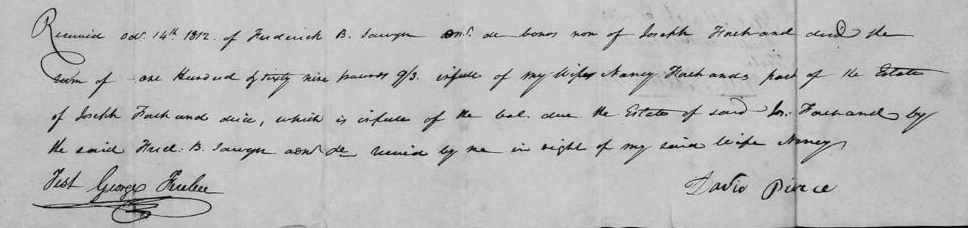
Joseph’s family continued through its own settlements. A division dated 10 February 1810 names Nancy as his orphan and Edward Beasley as the man who had married Keziah, Joseph’s widow. In October 1812, Isaac Price received Nancy’s part of Joseph’s estate “in right of my said Wife Nancy.” The estate papers thus document Lovey’s marriage to Aaron Askey, Nancy’s to Isaac Price and Keziah’s later marriage to Edward Beasley. They give the women’s changing legal and family circumstances without supplying a complete account of their lives. R07 O05
The missing parents of the Williams and Temple beneficiaries remain important, but they should not obscure what survives. Lovey’s conditional gift, Nancy’s land provision, the bonnet entered in an account and the receipt signed for a wife are specific acts affecting specific people. Lemuel’s will did not leave us a complete pedigree. It left arrangements for the next generation, and the estate papers let us follow some of those arrangements beyond his death.
Family Ties
Lemuel was a son of Thomas Forehand of Newland. The decisive 1796 deed expressly calls Lemuel and Daniel Thomas’s sons; the tax return attributed to 1769 identifies Jarvis and Daniel as his sons. Lemuel, Daniel and Jarvis therefore share a documented father, though their mothers are not identified. Thomas’s identification with the son named in Cornelius Forehand’s 1728 will remains High confidence. Lemuel’s wife is unknown. D07 LH03 XT01
Joseph Forehand expressly named his father Lemuel in his 1807 will. Identifying that father with this Newland man and the January 1808 testator is High confidence. Joseph’s wife Keziah and daughter Nancy are documented, but Keziah’s maternity of Nancy is unknown. Keziah subsequently married Edward Beasley; Nancy married Isaac Price. Both marriages have express statements in Joseph’s estate papers. R04 R05 R07 O05
Lemuel’s will explicitly calls Lovey Williams his granddaughter, Thomas Williams his grandson and Nancy Forehand his granddaughter. The identification of this Nancy with Joseph’s daughter has High confidence. Britten Temple appears between Thomas and Nancy in the alternate-beneficiary clause. Britten’s placement as a grandchild is also High confidence, inferred from that tightly framed list; the wording does not independently establish Britten’s sex. The parents connecting Lovey, Thomas Williams and Britten to Lemuel are unidentified. Nor does the shared Williams surname prove that Lovey and Thomas were siblings. Lovey’s marriage to Aaron Askey is explicit in the account settled in June 1809. R01 R03 O03
The tree retains those missing generations. Joseph is a documented son, not necessarily Lemuel’s only child, and the names of the grandchildren do not justify inventing daughters or husbands to complete the branches.
Between the Lines
Possibilities, not proven relationships.
David Forehand may have been Lemuel’s brother. The strongest positive evidence is the pair of purchases from Thomas in September 1769, two days apart, with reciprocal witnessing by Lemuel and David, reinforced by their local tax and militia association. Against a firm sonship conclusion, neither deed calls David a son, and David’s £45 purchase price matches Thomas’s earlier purchase price rather than identifying a family gift. The transactions concern different parent tracts and different prices. David could instead have been another relative or a close associate. David was very likely the man who later settled in Guilford County (High confidence), based on the repeated witness association and compatible chronology. Whether he was Thomas’s son remains a separate, less certain question. DAVID A will, division or deed expressly stating the relationship would change the case. TH-R05 LH02 LH03
The Williams and Temple branches are open questions with named people at their ends. The will establishes or strongly supports the grandchild generation but omits the parents. A shared surname, an estate purchase or a nearby family with the right surname cannot fill that gap. A guardianship, marriage record, distribution or later deed naming a parent would be more discriminating. Until such a record is connected to these beneficiaries, the unknown generations belong in the tree as unknowns.
The two Nancy references fit very well, without becoming one explicit statement. Joseph’s will names father Lemuel and daughter Nancy; shortly afterward, Lemuel names granddaughter Nancy Forehand. The matching family, locality and close chronology make the identification highly convincing. The remaining limitation is that Lemuel did not name Nancy’s father in his own will. Keeping that distinction visible lets the reader see why the connection is strong and what the documents actually say. R01 R04 R05
A Life in the Records
This is the currently identified record trail, not an exhaustive list of every surviving record. The earlier Newland man’s identification with the 1808 testator is High confidence. Court proof, registration and estate administration can occur after a person’s death.
Dated lifetime records
- 1766, dated by the official endorsement description — A Pasquotank militia roll lists Lemuel as a corporal. The photographed face is undated; enrollment does not establish combat. His conditional birth bound, by 1750, assumes the ordinary militia age rule and this identification. [LH02] [LH25]
- 7 and 9 September 1769; June 1770 — Lemuel witnessed Thomas Forehand’s 7 September conveyance to David and proved it in June 1770. On 9 September Thomas conveyed sixty acres in Newland to Lemuel for £20 proclamation money. That instrument was proved in September 1769 and registered 17 July 1770; the David deed was registered 18 July 1770. Registration is not another appearance by Lemuel. [TH-R05] [D01]
- 15 December 1769; March 1770 — Lemuel gave bond as administrator of Thomas’s estate and later presented the inventory. The £800 bond was penal security, not the estate’s appraised value. [XT02]
- 1770 — Lemuel appears with one white poll. The year is visible on the wider return’s first sheet, while his entry is on a later sheet. [LH04]
- 23 October 1772 — Lemuel conveyed two hundred acres to Daniel Forehand for £100, described as part of Thomas’s 320 acres of back land. Court proof followed in December 1772; registration was 13 April 1773. [D02]
- 1774; endorsement 14 September — The tax return brackets Lemuel with another man for two white polls. The endorsement names Pasquotank River Bridge; the bracket is not a complete household or kinship statement. [LH05]
- 1782 — A dated assessment lists Lemuel with 150 acres, three horses or mules and ten cattle, total value 225. [LH08]
- 10 August 1783, later title recital — Ezekiel Hollowell, Daniel’s executor, conveyed 150 acres to John Walmsley. It recites descent from Thomas to Lemuel as heir at law, and Lemuel’s conveyance to Daniel. September 1783 proof and 1 March 1786 registration do not establish Lemuel’s attendance or survival on those dates. [D03]
- 3 and 12 November 1784 — The catalog dates the road proposal to 3 November; the papers include a House layover on 12 November. Lemuel’s property was one of two alternative starting points for the proposed route across the Dismal toward the upper Perquimans bridge. These papers do not prove enactment or completion. [D16] [LH21] [LH22]
- 1786 — A return whose certificate actually says 1786 lists Lemuel with 150 acres and one white poll. A local filename calls it 1788; that filename does not create a second appearance. [LH09]
- 1789 — A visibly dated return again lists 150 acres and one white poll. [LH12]
- 1790 — The Pasquotank census household contains two free white males aged sixteen or over, one under sixteen, four free white females and one enslaved person. Their names and relationships are not supplied by the totals. [LH18]
- Preferred 26 November 1791 — Lemuel witnessed Thomas Temple’s will. The date favors “twenty six day of November”; this is an association, not evidence of a Forehand–Temple marriage. [D15]
- 11 July 1795 — Described as of Pasquotank, Lemuel sold Benjamin Perry of Perquimans forty-nine acres near the Turnpike. The record identifies an earlier purchase by Lemuel but supplies no date for that acquisition. Proof followed in September 1802. [D06]
- 9 February 1796 — Lemuel of Pasquotank sold Benjamin Jones of Camden his 150-acre Newland home property for 950 real Spanish dollars. The deed calls Lemuel and Daniel Thomas’s sons. Its “now lives” dwelling language refers to Lemuel. The inspected photographs do not supply the final proof and registration. [D07]
- 1800, Hertford census identification — The headed Hertford schedule records Lemuel with one free white male forty-five or older, one female ten to fifteen, one female forty-five or older, and six enslaved people. This is part of the High confidence reconstruction of his life across the counties; the unnamed women cannot be assigned identities. The original reads Lemuel despite an index reading Samuel. [JH01] [LH19]
- February 1801, execution day clipped — Robert Cartwright of Camden conveyed 150 acres of land and swamp in Newfound Land to Lemuel, expressly described as of Hertford County. The favored fresh reading is Hertford, not the town of Hertford in Perquimans. Acknowledged November 1801; registered 20 January 1802. [D08]
- 15 February 1802 — Lemuel, described as of Camden, sold Harry, an enslaved child about seven, to John Koen of Pasquotank for £125. The bill of sale was proved in May and registered 25 July 1802. Harry’s parents and later life are unknown. [D11]
- 1804 — The dated Pasquotank district-six tax return assesses Lemuel on ninety-six acres with no white poll. Land assessment alone does not establish his residence there. [LH16]
- 18 August 1804 — Lemuel of Camden sold Joseph Burnham 190 acres at Newfound Land for $805. November 1804 proof and 28 April 1805 registration followed. Similar bounds suggest a connection to the 150-acre purchase of 1801, but the forty-acre difference remains unexplained. [D09]
- 1805 — The visibly dated Pasquotank return again assesses ninety-six acres and no white poll. It is a separate return from 1804. [LH17]
- 31 March 1806 — Lemuel sold Smith Jones fifty acres for $200. The year is written as 1806, although the local photographs were labeled 1786. Proof in March 1808 and registration on 6 April 1808 occurred after Lemuel’s death. [D05]
- Preferred 2 June 1807 — A faint deed describes Lemuel and Joseph Wood as Pasquotank residents and conveys fifty-seven acres in Newland. The date and $625 price remain preferred readings. The court notation is June 1807. [D10]
- 2 September 1807, associated family deed — Joseph Forehand sold Adam Forbes fifty acres for $400. Its bounds resemble the 1806 Smith Jones tract, but the complete title connection is unresolved. Proved June 1808; registered 5 August 1808. This is Joseph’s transaction, not a fresh personal appearance by Lemuel. [D12]
- 23 November 1807 — Joseph’s will named wife Keziah, daughter Nancy and “my father Lemuel Forehand.” Lemuel was nominated as a coexecutor; the later probate identifies Keziah’s qualification, not his. [R04] [R05]
- 5 December 1807 — Joseph was already deceased when his inventory and estate sale were made. Lemuel bought a mare for £36 at the sale. Joseph’s death interval is 23 November through 5 December, inclusive. The sale was returned in March 1808. [R06] [O05]
- 31 January 1808 — Lemuel executed his will, naming Lovey Williams as principal conditional beneficiary and Thomas Williams, Britten Temple and Nancy Forehand in the alternate family gift. Miles Jones was named executor. [R01] [R02] [R03]
Attributed, disputed and undated evidence
- Attributed 1764 or 1765 — One damaged tax return names Lemuel. Family and county copies with conflicting year labels reproduce the same undated sheet; they are one appearance, not two. [LH01]
- Attributed 1769 — An undated tax crop lists Lemuel separately and calls Jarvis and Daniel Thomas’s sons. A separate poll entry does not establish marriage or age twenty-one. [LH03]
- Attributed 1778 — A property return lists 150 acres with land, houses, livestock and money. The year comes from the filename, not a visible date. [LH06]
- Attributed 1779 — A return again includes Lemuel and 150 acres. Its incomplete headings do not securely identify every numerical column. [LH07]
- Attributed August 1783, day unverified — A separate faint Lemuel–John Walmsley instrument survives. It must not be treated as the executor’s 10 August deed or as a securely dated additional appearance. [D04]
- Attributed 1787 — An undated return lists 150 acres and one white poll; the year is a filename attribution. [LH10]
- Attributed 1788 — A distinct county sheet lists 150 acres and one white poll. It is not the family photograph whose certificate actually dates it to 1786. [LH11]
- Undated prior acquisition, recited in 1795 — The 1795 conveyance says Lemuel had purchased its forty-nine acres earlier. No acquisition date is supplied by the inspected instrument. [D06]
Estate proceedings and later references
- December Term 1807; 6 February 1808 — Joseph’s will was proved in December and recorded on 6 February. These are Joseph’s estate dates, not a date for Lemuel’s death. [R05]
- 24 February 1808 — Lemuel’s inventory and estate sale describe him as deceased. With his 31 January will, this places his death on or after 31 January and by 24 February, inclusive. No exact day is established. [O03]
- December Term 1808; 20 January 1809 — Lemuel’s will was proved and Miles Jones qualified; the clerk recorded the will in January. The late probate must be retained beside the earlier inventory, not substituted for it. [R03]
- March Term 1809 — The court ordered settlement of Lemuel’s account; inventory and sale endorsements also carry March 1809 returns. These are administration dates, not new evidence that Lemuel was alive. [O03]
- 2 June 1809; June Term 1809 — Lemuel’s account was settled and returned. It records £17 10s paid to Aaron Askey, expressly Lovey Williams’s husband. The settlement supplies a latest marriage bound, not a ceremony date. [O03]
- Preferred 10 February 1810; June Term 1810 — Joseph’s division names Nancy as his orphan and Edward Beasley as the husband of Joseph’s widow Keziah. The division and another Nancy account were returned in June. The mother of Nancy is not identified by these clauses. [R07] [O05]
- December Term 1810 — A separate order concerns Nancy’s account with Keziah as Joseph’s executrix. It must not be silently made the initiating order for the February division; the order of the surviving proceedings remains unresolved. [R08] [O05]
- 12 and 14 October 1812 — The remaining estate account was examined on 12 October. Isaac Price’s receipt of 14 October identifies Nancy Forehand as his wife and acknowledges £169 9s 3d for her part of Joseph’s estate. It does not call her the sole legatee. [O05]
Reported leads and bounded negative checks
- Reported 1786 state census — An older narrative describes a state-census household, but the underlying schedule has not been recovered in this investigation. The verified 1786 tax return is a different source. [LH09]
- Attributed 1800, 1802 and 1803 tax sheets — No Lemuel was found in the inspected partial district-six F sections. These were incomplete checks, not proof that he had left Pasquotank, and are not three positive appearances. [LH13] [LH14] [LH15]
Relationship Confidence
Our scale: Established means supported as settled; High confidence means very likely; Moderate confidence means probable; Possible means a plausible connection with limited support. Unknown, Unsupported and Contradicted are separate judgments. These are qualitative assessments, not percentages.
Each rating applies to the specific relationship or identity stated. We weigh explicit wording, source quality, age, place, known namesakes, associates and alternatives. Direct evidence states a relationship; inferred evidence connects records. Reviewed 13 November 2026.
| Relationship or identity | Confidence | Evidence and limits |
|---|---|---|
| Cornelius’s named son Thomas = Thomas of Newland | High confidence | Inferred. The local family setting, generation and chronology fit, with no identified contemporary rival in the checked material. This is the assessment used in Thomas’s story. [TF] |
| Thomas → Lemuel, Daniel and Jarvis | Established | Direct and mixed. The 1796 deed calls Lemuel and Daniel his sons; the attributed 1769 tax return names Jarvis and Daniel as sons. This establishes paternal brotherhood, not a common mother. [D07] [LH03] |
| Newland Lemuel = the 1808 Pasquotank testator | High confidence | Inferred. Continuing deeds and repeated family and neighborhood associates connect the life stages. No single record expressly equates every appearance. [D05] [D07] [D08] [D10] [D11] [O03] |
| Lemuel as eldest surviving eligible son | Moderate confidence | Inferred. The heir-at-law recital and independently established sonship support this reading of the inherited land. They do not prove firstborn status or a complete birth order. [D03] [D07] |
| David as an additional son of Thomas | Possible | Inferred. Paired September 1769 purchases and reciprocal witnessing with Lemuel are concrete evidence of association. Another close relative or associate remains possible; no son clause is known. [D01] [TF] |
| Pasquotank David = the later Guilford testator | High confidence | Inferred. The repeated David–witness pairing in the 1790 and 1794 coastal deeds and the 1801 Guilford deed, supported by the 1799 Hertford residence and compatible chronology, strongly favors one man. No credible competing pair or conflicting life course was identified in the checked material; the search was not exhaustive. Thomas parentage remains Possible. [DAVID] |
| Joseph’s father was named Lemuel | Established | Direct. Joseph’s will says “my father Lemuel Forehand.” Identifying that father as the January 1808 testator is a separate High confidence inference from the family, place and close estate chronology. [R04] [R05] [O05] [R01] |
| Joseph → Nancy; Joseph and Keziah as spouses | Established | Direct. Joseph calls Nancy his daughter and Keziah his wife. The records do not establish that Keziah was Nancy’s mother. [R04] [R05] [R07] |
| Joseph’s Nancy = Lemuel’s granddaughter Nancy | High confidence | Inferred. The explicit Joseph–Lemuel generation, matching name, locality and adjacent estate proceedings converge. Lemuel’s own will does not name Nancy’s father. [R01] [R04] [R05] [R07] [O05] |
| Lovey Williams, Thomas Williams and Nancy Forehand as Lemuel’s grandchildren | Established | Direct. The will expressly calls Lovey and Nancy granddaughters and places Thomas immediately after “my grand Son.” Their parents are a separate question. [R01] [R03] |
| Britten Temple as Lemuel’s grandchild | High confidence | Inferred. Britten is included between an expressly named grandson and granddaughter in the alternate family gift. The wording does not separately repeat the relationship for Britten; sex and parents remain unknown. [R01] [R03] |
| Lovey Williams and Aaron Askey as spouses | Established | Direct. The account settled 2 June 1809 names Aaron as Lovey’s husband. This is a marriage-by date, not their wedding date; no later Askew identity is assumed. [O03] |
| Nancy Forehand and Isaac Price as spouses | Established | Direct. Isaac’s 14 October 1812 receipt expressly names Nancy as his wife and identifies her share of Joseph’s estate. [O05] |
| Keziah and Edward Beasley as spouses | Established | Direct. The division dated 10 February 1810 says Edward married Joseph’s widow Keziah. The separate December order’s place in the proceedings remains unresolved. [R07] [R08] |
| Lemuel’s wife; the Williams and Temple parents; Lovey and Thomas as siblings | Unknown | The records supply no name for Lemuel’s wife or the intervening parents of these grandchildren. A shared surname and grandparent do not distinguish siblings from cousins. No named daughter is inserted to fill a gap. [R01] [R03] |
The Family as We Currently Understand It
Solid lines mark Established relationships; long-dashed lines mark High or Moderate confidence, with the exact level stated; dotted lines mark Possible connections. Dashed boxes identify proposed placement or unresolved identity. Unknown-parent boxes preserve a missing generation, not a newly identified child. Dates retain the qualifications used in our directory.
Birth unknown · Died 1728
His will expressly names a son Thomas.
High confidence — named son identified with Thomas of Newland
Born by 1724 (conditional tax-age bound)
Died 1769
Father of Lemuel, Daniel and Jarvis. Their mother or mothers are unknown.
Established — documented sons, sharing Thomas as father
Born by 1750 (conditional militia-age bound)
Died 31 January–24 February 1808 (High confidence testator identity)
Named as Thomas’s son in the 1796 deed. The death interval is inclusive.
Born by 1754 (conditional tax-age bound)
Died 28 December 1781–July 1783 (High confidence Perquimans identity)
Named son in the tax return and 1796 deed.
Born by 1750 (conditional militia-age bound)
Died by 12 September 1788 (Moderate confidence Chowan identity)
Named son in the attributed 1769 tax return.
Separate possible branch from Thomas
This branch begins with Thomas of Newland, not with the brothers above.
Possible — additional son of Thomas, and brother of Lemuel
Born by 1750 (conditional militia-age bound)
Death unknown
Paired 1769 purchases and reciprocal witnessing connect him with Lemuel. No inspected clause calls him Thomas’s son.
Lemuel’s family and grandchildren
Starting again with Lemuel: the following descent is from him. The unnamed wife is not identified as the mother of Joseph or of any other child.
Birth and death unknown
A placeholder for the unresolved marriage history. The records do not establish one marriage or a common mother for all descendants.
From Lemuel to Joseph
The father in this branch is Lemuel. No maternal connection is assigned.
High confidence — Joseph’s named father Lemuel identified with the 1808 testator
Birth unknown
Died 23 November–5 December 1807, inclusive
His will explicitly calls Lemuel his father. Joseph is a documented son of a man named Lemuel; the cross-record identification is High confidence.
Birth and death unknown
Established wife of Joseph. Later Established wife of Edward Beasley, by the division dated 10 February 1810. The records do not establish that Keziah was Nancy’s mother.
Birth and death unknown
Established later husband of Joseph’s widow Keziah. This does not supply Nancy’s biological parentage.
Established — Joseph’s daughter; High confidence — same Nancy named by her grandfather
Birth and death unknown
Joseph’s will names her as his daughter; Lemuel’s will names a granddaughter Nancy. Their identification is High confidence.
Birth and death unknown
Established husband of Nancy by 14 October 1812, when he acknowledged receipt of her share of Joseph’s estate.
Other named descendants: the following lines begin with Lemuel, not Joseph. No connection to Joseph as their father is asserted. Separate unknown-parent boxes do not establish that these grandchildren had different parents.
Separate branch from Lemuel to Lovey Williams
Established — Expressly named granddaughter
Names and dates unknown
The will does not identify this generation. No daughter, son, marriage or Williams siblingship is supplied by the surname.
Missing generation — no identified parentage
Birth and death unknown
Principal conditional beneficiary: twenty-one or marriage. Her reasons for receiving this provision are unknown.
Birth and death unknown
Established husband of Lovey by the account settled 2 June 1809. Askey is the favored manuscript reading; no automatic identification with a later Askew couple.
Separate branch from Lemuel to Thomas Williams
Established — Expressly named grandson
Names and dates unknown
The will does not identify this generation. No daughter, son, marriage or Williams siblingship is supplied by the surname.
Missing generation — no identified parentage
Birth and death unknown
Named alternate beneficiary. Shared surname does not establish that he and Lovey were siblings.
Separate branch from Lemuel to Britten Temple
High confidence — Grandchild interpretation of the will’s family list
Names and dates unknown
The will does not identify this generation. No daughter, son, marriage or Williams siblingship is supplied by the surname.
Missing generation — no identified parentage
Birth and death unknown
Named alternate beneficiary. Sex and parentage remain unresolved; the grandchild placement is qualified.
Tree sources: 1796 sons clause; Lemuel’s will; Joseph’s will; Lemuel’s estate account; Joseph’s division; Nancy’s receipt. Earlier generations and qualified birth bounds follow the reviewed Thomas Forehand story.
Sources and Notes
Codes identify the preserved research source groups. A family photograph of a historical register is a copy of the record; repeated images of one instrument are not independent corroboration. Online links may require an archive account.
- TF. Thomas Forehand’s published story and its source-linked relationship and date assessment. Reuses the separately reviewed High confidence identification of Newland Thomas with Cornelius’s named son and the qualified dates of his sons. This synthesis is not an additional independent historical source. Thomas Forehand story.
- XT01. Cornelius Forehand, will executed 24 February 1727/8, proved July Court 1728, Pasquotank. Original-record photographs name his son Thomas; the adult Newland identity is a separate High confidence inference.
- XT02. Thomas Forehand estate, Pasquotank, administrator’s bond 15 December 1769 and inventory presented March 1770. Six overlapping local photographs, source LR02 in the Thomas study. The bond’s £800 is penal security, not an appraisal.
- TH-R05. Pasquotank Deed Book I, pp.98–99, Thomas to David, 7 September 1769, and Thomas to Lemuel, 9 September 1769. Historical register copy, FamilySearch DGS 7517570, images 101–102. Lemuel witnesses and later proves the David deed; the paired deeds do not expressly call David a son. Register p.98; continuation p.99 is linked in D01.
- D01. Thomas Forehand to Lemuel Forehand, 9 September 1769, Pasquotank I:98–99, sixty acres. September proof; registered 17 July 1770. Historical register copy; FamilySearch DGS 7517570, images 101–102. Register p.99.
- D02. Lemuel to Daniel Forehand, 23 October 1772; December proof, registered 13 April 1773. Three family photographs of the Pasquotank register; book/page not recovered. Two hundred acres, part of the recited 320-acre back land. The 1773 filenames refer to registration, not execution.
- D03. Ezekiel Hollowell, executor of Daniel Forehand, to John Walmsley, 10 August 1783; proved September 1783, registered 1 March 1786. Pasquotank register photographs ending at p.405. Recites Lemuel as Thomas’s heir at law. Its parent-patent quantity/date remain as written, not silently substituted from another grant.
- D04. Separate, faint Lemuel–John Walmsley instrument, attributed August 1783, day unverified. Family register photograph. It is not automatically the same transaction as D03.
- D05. Lemuel to Smith Jones, 31 March 1806; proved March 1808, registered 6 April 1808. Pasquotank register photographs ending at p.217. Written execution year corrects local filenames saying 1786.
- D06. Lemuel to Benjamin Perry, 11 July 1795, forty-nine acres near the Turnpike; proved September 1802. Pasquotank register photograph, book/page not established. Recites an earlier, undated purchase from Isaac Sawyer.
- D07. Lemuel to Benjamin Jones, 9 February 1796, 150 acres in Newland, Pasquotank register pp.430–431. Local photographs of the register. The sons clause and dwelling language are on the continuation, p.431; final proof/registration are outside the inspected views.
- D08. Robert Cartwright to Lemuel Forehand, February 1801, day clipped; acknowledged November 1801; registered 20 January 1802, Camden I:233. Register photograph. The residence favors Hertford County; the land is in Camden’s Newfound Land.
- D09. Lemuel to Joseph Burnham, 18 August 1804; proved November 1804, registered 28 April 1805, Camden K:321–322. Register photographs. One hundred ninety acres and $805; the difference from the 1801 purchase’s 150 acres is unresolved.
- D10. Lemuel to Joseph Wood, preferred 2 June 1807, fifty-seven acres, preferred $625; June 1807 court notation, Pasquotank register p.100. Exceptionally faint photograph and faithful details; date and price remain qualified.
- D11. Lemuel Fourhand to John Koen, bill of sale for Harry, 15 February 1802; proved May, registered 25 July 1802, Camden I:306. Historical register photograph. Harry is described as about seven, not given a surname.
- D12. Joseph Forehand to Adam Forbes, 2 September 1807; proved June 1808, registered 5 August 1808, Pasquotank register p.443. Fifty acres and $400; title resemblance to D05 does not establish the entire chain.
- D15. Thomas Temple’s will, preferred 26 November 1791, Pasquotank; three family photographs of manuscript evidence. Lemuel is a witness. Archive book/page not independently recovered. This does not name Lemuel’s wife or establish a Forehand–Temple marriage.
- D16. 1784 Turnpike proposal, petition and draft papers, twelve local archival reproductions. General Assembly Session Records, October–November 1784, Box 2, call 3A.464, MARS 66.8.36.19. Catalog date 3 November; House layover 12 November. Alternative endpoints and draft status must be retained.
- R01. Lemuel Forehand, original loose will front, Pasquotank, 31 January 1808. Full front in the family collection; reverse absent. Registry cross-reference M1:196. Compare with R02–R03, versions of the same instrument.
- R02. Lemuel’s will, historical register copy M1:196, first photographed portion. Principal conditional gift to Lovey Williams. Not a second independent will.
- R03. Same will, register continuation; December Term 1808 probate and 20 January 1809 recording. Edge-clipped photograph compared with the loose original. Miles Jones qualifies as executor.
- R04. Joseph Forehand’s will, historical register copy M1:168, first photograph. Wife Keziah, daughter Nancy, $400 land-sale debt and residue shares. Executed in 1807 although filed under 1808.
- R05. Joseph’s will, register continuation. Execution 23 November 1807, probate December Term 1807, recording 6 February 1808. Names “my father Lemuel Forehand.” The photographed right edge is clipped; the father clause is legible.
- R06. Joseph’s original inventory, 5 December 1807, Pasquotank, local reproduction. Calls him deceased; Keziah’s mark. No book/page supplied by the photograph.
- R07. Joseph estate division, preferred 10 February 1810, returned June Term 1810, Book C:42. Original-paper reproduction. Names widow Keziah, her subsequent husband Edward Beasley, and orphan Nancy. These clauses do not identify Nancy’s mother.
- R08. Separate Joseph/Nancy accounting order, December Term 1810, Pasquotank, original court-paper image crop. Its relationship to the earlier division remains unresolved; do not alter the dates to make an order-and-compliance sequence.
- O03. Lemuel Forehand loose estate packet, Pasquotank: FamilySearch images 894–907, next folder boundary 908 checked. Inventory and sale 24 February 1808; March 1809 returns/order; account settled 2 June 1809 and returned June Term. Image 897 names Aaron Askey as Lovey Williams’s husband. Browser captures are records, not index abstracts. Referenced individual receipt was not separately recovered. Account image 897; settlement image 898; inventory image 895; sale image 902.
- O05. Joseph Forehand loose estate packet, Pasquotank, selected FamilySearch images 880–893; earlier folder boundary not checked. Sale 5 December 1807 (mare to Lemuel £36), returned March 1808, Book A:469–470; Nancy account returned June 1810, Book C:44; December 1810 order; account examined 12 October 1812 and Isaac Price receipt 14 October. Selected original-paper images, not a claim of complete packet retrieval. Account and Nancy/Isaac receipt image 892.
- LH01. One undated damaged Pasquotank return reproduced under conflicting 1764/1765 filenames in Family–Forehand and Places/Pasquotank. The duplicate views are one source.
- LH02. Pasquotank militia roll, corporal Lemuel, dated 1766 by the State Archives endorsement/catalog description. The photographed face is undated; no combat is established.
- LH03. Tax crop attributed 1769 by filename; no date visible. Thomas entered with sons Jarvis and Daniel; Lemuel separately. Family-record photograph.
- LH04. 1770 Pasquotank return, wider first sheet dated, Lemuel on fourth sheet; family crop compared with county photographs.
- LH05. 1774 Pasquotank return; endorsement 14 September 1774, Pasquotank River Bridge. Bracketed two white polls. Family crop and wider county photographs compared.
- LH06. Property return attributed 1778 by filename. 150 acres; partial valuation evidence. Year not visible.
- LH07. Tax return attributed 1779 by filename. 150 acres; incomplete headings limit interpretation of other figures.
- LH08. Visibly dated 1782 Pasquotank assessment: 150 acres, three horses/mules, ten cattle, total 225.
- LH09. Pasquotank district-six return explicitly certified 1786, despite family filename 1788. 150 acres, one white poll. Not the reported state census.
- LH10. Undated tax sheet attributed 1787 by filename: 150 acres, one white poll.
- LH11. Different county tax sheet attributed 1788, no date visible: 150 acres, one white poll. Distinct from LH09.
- LH12. Visibly dated 1789 Pasquotank return: 150 acres, one white poll.
- LH13. Partial district-six tax image attributed 1800; inspected F block lacks Lemuel. Not a whole-county absence.
- LH14. Partial district-six image attributed 1802 by annotation/filename; original year not visible. Bounded negative only.
- LH15. Partial district-six image attributed 1803 by annotation/filename. Bounded negative only.
- LH16. Pasquotank district-six return headed 1804: Lemuel 96 acres and no white poll. Family photograph, heading freshly checked 13 November 2026.
- LH17. Separate Pasquotank return headed 1805: Lemuel 96 acres and no white poll. Heading freshly checked 13 November 2026. No neighboring person’s acreage is used here.
- LH18. 1790 Pasquotank federal census, family photograph of headed schedule. Household 2/1/4/0/1. Counts do not identify relationships or the enslaved person.
- LH19. Older 1800 Hertford family crop, superseded for headings by the complete JH01–JH03 sequence recovered 13 October 2026. One census record, not corroboration by two sources.
- LH21. 1784 road papers, all twelve local pages in the earlier inspected set. See D16. The surviving petition/draft is not an enacted road law.
- LH22. Official archival catalog transcription: General Assembly, October–November 1784, Box 2, call 3A.464, MARS 66.8.36.19; description dated 3 November 1784 and says laid over. Finding aid, not another contemporary record.
- LH25. North Carolina militia law 1764, chapter I, §§ II and XXVI, continued 1766 chapter VI, § IV. Printed State Records 23:596,601 and 25:496, facsimiles previously checked. Ordinary enrollment 16–60 supports only the conditional birth bound.
- JH01. 1800 Hertford federal census, original headed sequence, FamilySearch DGS 004956032: image 654/page 698 (Lemuel’s row), image 653 connecting page, image 652 headings. Recovered 13 October 2026. Lemuel’s sequence 00001/01001/0/6; online Samuel is a mistaken index reading. Original census row.
- DAVID. David Forehand to Tulle Vardin, 20 February 1790, Pasquotank register ending p.145; David to Lodwick Williams, 29 December 1794 (not the filename year 1796), register ending p.305; Robert Dean to David of Hartford/Hertford County, 1 May 1799, Guilford land; Timothy McCiver to David of Guilford, 14 February 1801, proved November 1802. Preserved photographs of historical register copies, David investigation LD05, LD07–LD09; book designations are not visible in these local views. Jordan Forehand witnesses the 1790, 1794 and 1801 deeds. David’s 6 July 1802 Guilford will names son Jordan (original manuscript photographs WR01–WR02; indexed in Will Book A:121). The cumulative identity is assessed High confidence after separate review, 13 November 2026; the witnesses’ identities remain inferred and no explicit migration recital has been recovered. Related David discussion and source note in Thomas’s story.