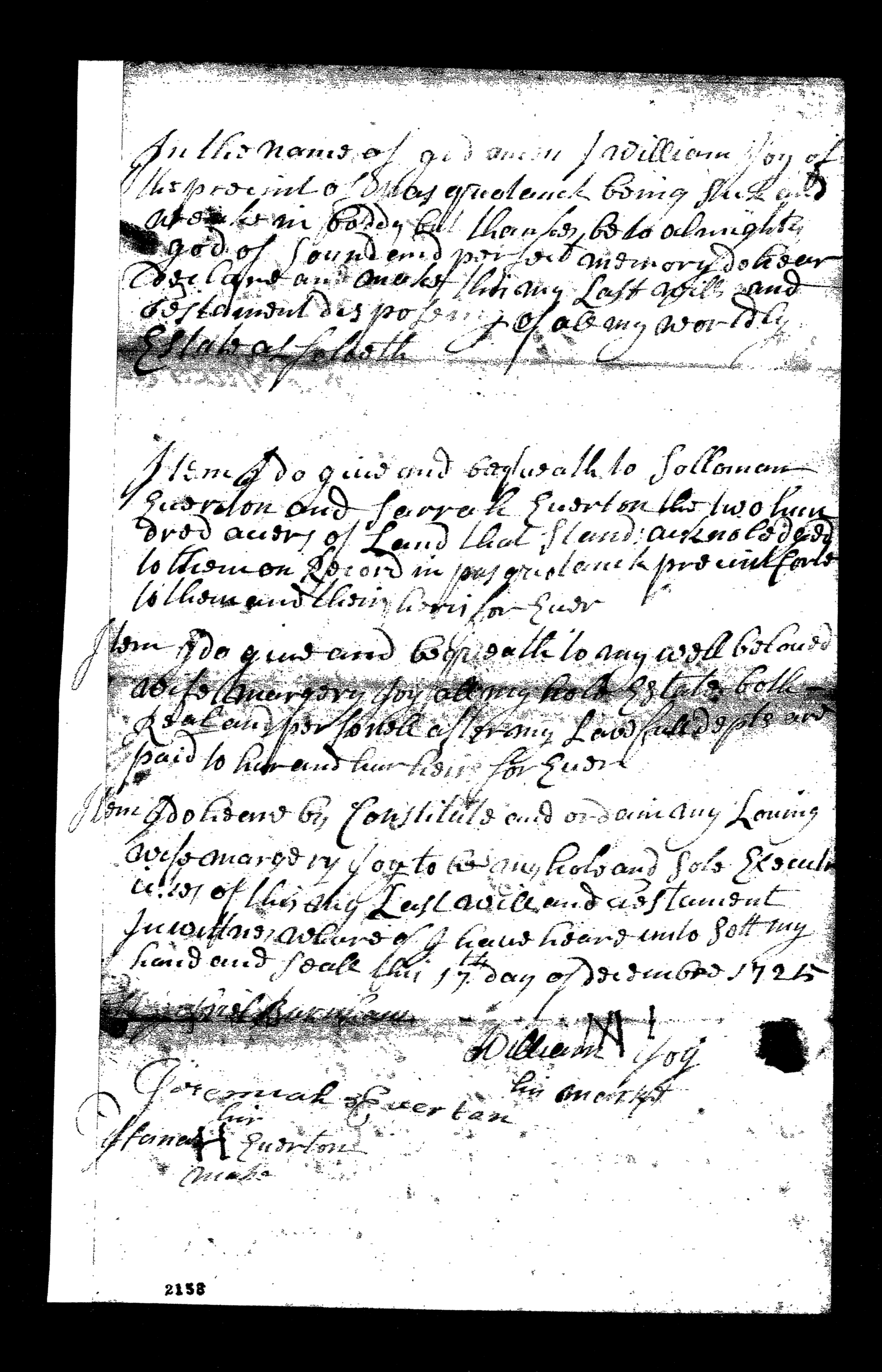
William Joy had already acknowledged two hundred acres to Solomon Everton and Sarah Everton when he made his will on 17 December 1725. He named them together, preserving an arrangement made in the Pasquotank precinct court before the will was written. Jeremiah and Hannah Everton witnessed the document. Within that short passage lie land, a family and a question that has outlasted them: which Forehand did Sarah marry?[1]
Her father supplied the married surname. In a will dated 3 January 1736/7, Jeremiah Everton left one shilling to “my Daughter Sarah Forhand.” He named no husband. Together, the two wills preserve her change of surname without identifying her husband.[6]
The earlier trail leads to Maryland. In the All Hallows parish register of Anne Arundel County, one entry records Sarah, daughter of Jeremiah and Hannah Everton, born on 8 November 1703 and baptized on 30 April 1704. The matching names make this child a strong candidate for the later Pasquotank woman. The identification is persuasive family evidence, though no recovered record carries Sarah herself from one colony to the other.[2]
Jeremiah Everton and Hannah Irish had married by licence at All Hallows on 21 March 1702/3. The register writes 1702; the double year reflects its old-style calendar. Irish was Hannah’s surname at marriage. It does not establish her birth surname or tell us where her family originated.[3]

By April 1713, the North Carolina land records show an Everton household dealing with William Joy’s land. Jeremiah conveyed to Griffith Jones the western two hundred acres of a four-hundred-acre tract bought from Joy; Hannah joined the acknowledgment as his wife. The deed referred to a draft dated in July 1708, although the surviving copy leaves the day uncertain. A December 1716 patent to James Spence repeated the succession from Joy through Everton and Jones to Spence.[4]
That two hundred acres must be treated as a separate land matter until a title record connects it to the land later named for Sarah and Solomon. The repeated acreage is tempting, but no recovered title establishes their relationship. What the transactions securely add is a history of dealings between the Everton household and Joy before Sarah appeared in his will.[1][4]
Another deed brings a Forehand name into the same land network. On 23 April 1735, Solomon Everton sold Gabriel Burnham one hundred acres “in the fork of Pasquotank,” adjoining James Forehand and Burnham. It was once reported as a 1739 sale; the inspected record gives 1735. It also lacks the recital that would identify these hundred acres as Solomon’s share of the joint two hundred. James’s presence on the boundary is a useful lead, not the name of Sarah’s husband.[5]
Jeremiah’s will gives the clearer family picture. Sarah belonged with his eldest son Solomon, his son James, and his daughters Rachel Everton and Katherine Chamberlain, also written Catharine. He named Hannah as his wife. Several children received small monetary gifts, so Sarah’s shilling cannot by itself explain her relationship with her father or what she may already have received. Its lasting value is the explicit statement that Sarah Forehand was his daughter.[6]
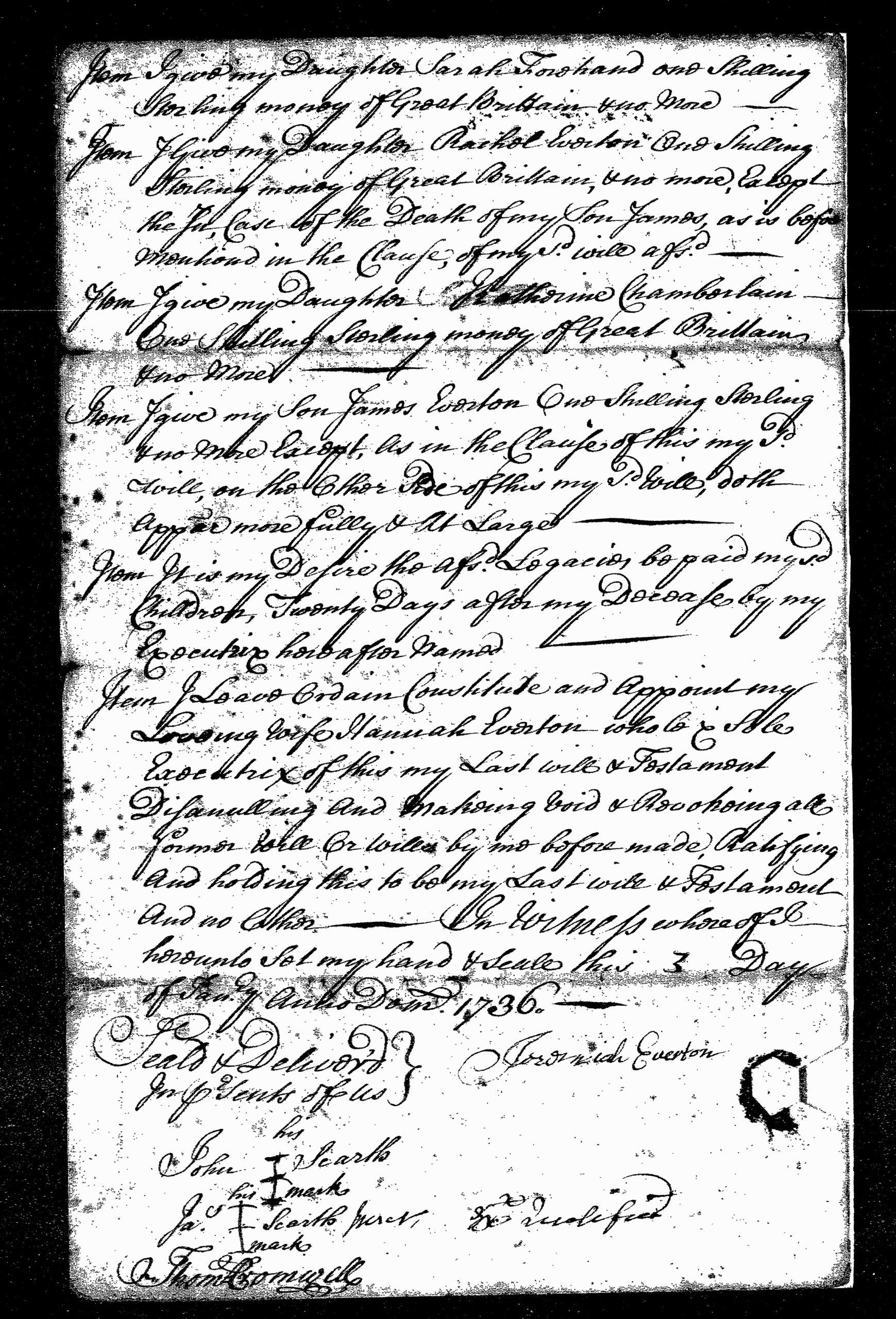
The will came to court at Broomfield on the second Tuesday of October 1740. That later proceeding preserved her name; it does not independently establish that she was still living then. Nor does a later silence settle her fate. Hannah Abercrombie, probably the former Hannah Everton on the strength of her Chamberlain and Everton family connections, made a will in 1754 without naming Sarah. The omission supplies neither a death date nor a story of estrangement.[6][7]
Family Ties
Jeremiah Everton is Sarah Forehand’s documented father. Hannah is directly named as the mother of the Maryland Sarah and as the wife of the Pasquotank Jeremiah. Treating the two families as the same is a strong working identification, with the intervening migration still undocumented. Hannah’s maternity of every child in the Carolina will is not separately stated.[2][3][6]
Sarah’s documented siblings through Jeremiah are Solomon, James, Rachel and Katherine/Catharine. Catharine’s marriage to John Chamberlain is supported by a deed explicitly calling her Jeremiah’s daughter and John her husband. The deed’s copied year and regnal year conflict, but that does not obscure the relationship language.[6][8]
Sarah married a man surnamed Forehand, whose given name remains unknown. No children have been established for her. If she was the Maryland child, she was twenty-two when Joy made his will and thirty-three when her father named her Forehand. Marriage between those wills is a reasonable working interval, but the 1725 boundary is not absolute: Joy referred to an earlier acknowledgment and did not expressly call her unmarried.[1][2][6]
Between the Lines
Possibilities, not proven relationships.
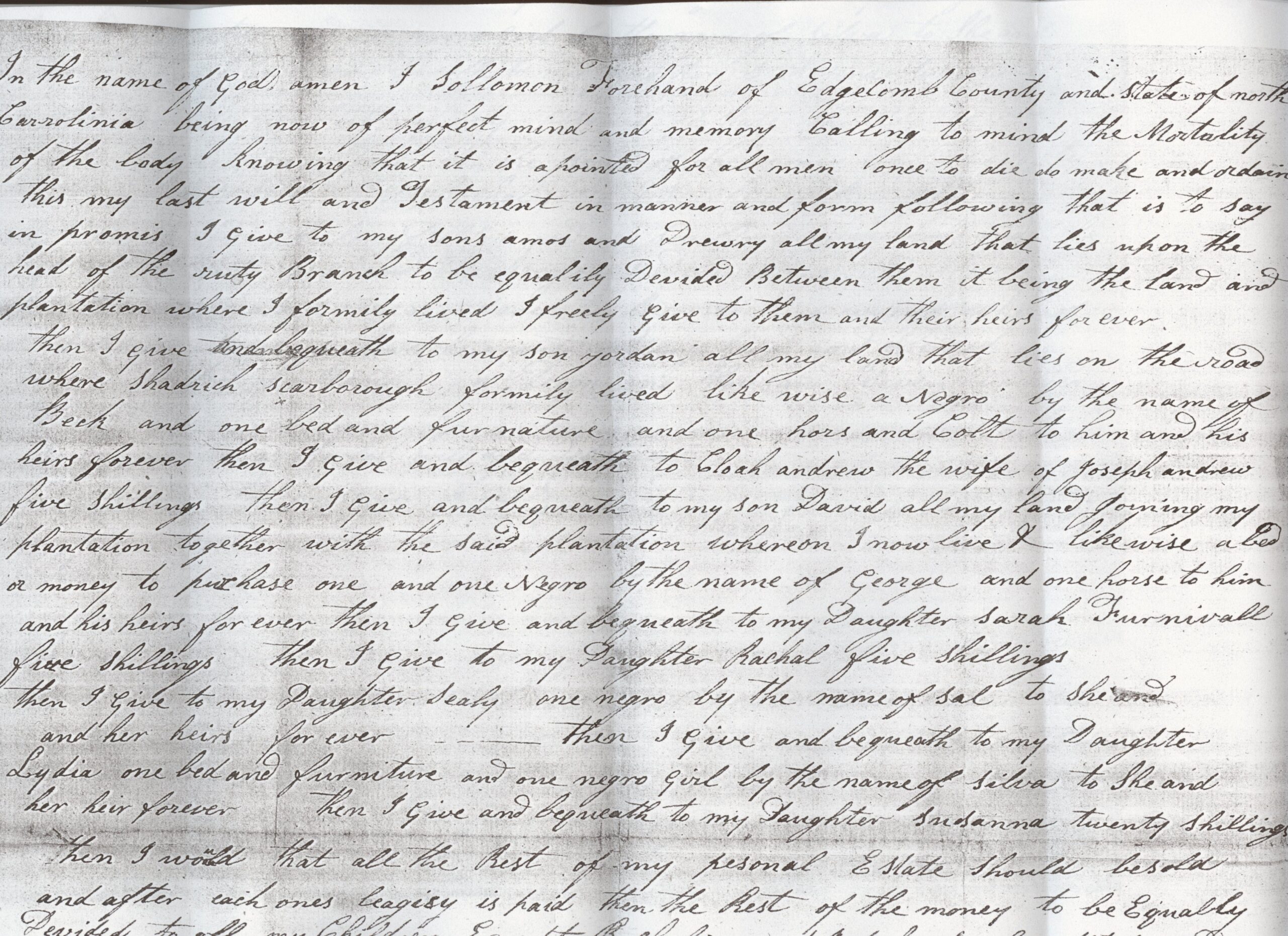
If we make a tentative choice among Cornelius Forehand’s five sons, John offers the strongest working hypothesis. This is a naming-based preference, conditional on two unproved connections: that Cornelius’s Pasquotank son was the later Edgecombe John, and that Sarah was the mother of Edgecombe John’s son Solomon. Cornelius Forehand’s 1727/8 will named five sons: John, Cornelius, James, Thomas and Richard. Separately, on 24 March 1768, an Edgecombe John Forehand conveyed land to “my loving son Solomon Forehand.” The Solomon associated with that family named daughters Sarah and Rachel in his 1798 will. Solomon, Sarah and Rachel also occur together among Jeremiah Everton’s children.[6][9][10][11]
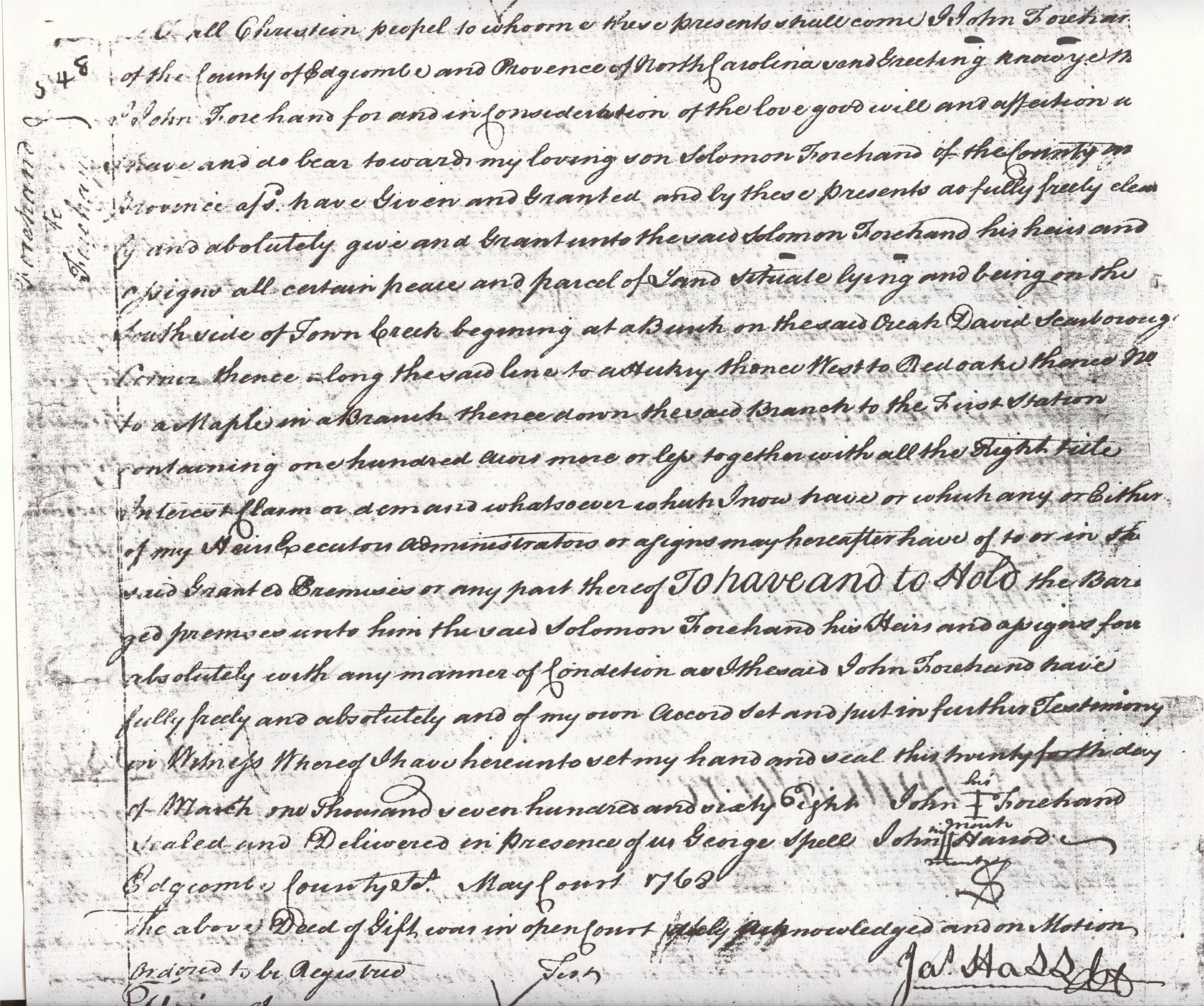
Even if the two Johns were proved to be the same man, Sarah would not thereby become Solomon’s mother. The deeds name no mother. The names could have come from another parent’s family, other relatives or choices unrelated to the Evertons. The identification of the 1798 testator with the earlier son also rests on family correlation.[10][11]
Thomas remains a serious alternative, with the clearest traced tradition. The revised 14 August 1998 Ross and Baker draft of The Forehand Family of Northeastern North Carolina says that Joel, or Jody, Forehand’s website showed Thomas married to Sarah Everton. Its footnote identifies the website and the year 1998. That tells us where the draft obtained the assertion; it supplies no contemporary marriage record and does not explain how Jody reached the conclusion. The first originator and reasoning remain unknown.[12]
The Newland Thomas who died in 1769 is himself only provisionally identified with Cornelius’s son Thomas. His inspected estate papers do not name Sarah. Still, the old argument that Sarah would have been too old to bear his sons Jarvis and Daniel does not eliminate him: their “born by” dates are latest possible limits, not actual birthdays. They could have been older. The tradition deserves less weight than a named-wife record, but Thomas remains eligible for investigation.[13]
James has a concrete local association: a James Forehand adjoined Solomon Everton’s 1735 sale. Yet the adjoining man is not automatically Cornelius’s son, and a boundary does not establish a marriage. Cornelius the younger remains in consideration through the later Fork land network, without a wife identified in the relevant conveyance. Richard is the least developed lead because his securely identified later record is sparse. Neither lack of a distinguishing clue nor an incomplete paper trail excludes a husband.[5][9][15]
Thus John is a tentative research preference, Thomas a substantial alternative, and the other three lower-priority leads rather than rejected candidates. These five brothers are not the only possible Forehands. The most useful next evidence would name Sarah’s husband or heirs in the history of her two hundred acres: an acknowledgment, a deed, a release or a later title recital. Until then, the acreage preserves a question as well as a possession.[1][6]
A Life in the Records
The entries below distinguish Sarah’s own documentary trail from later proceedings and family clues. They describe the evidence currently identified, not every record that may survive. The Maryland–Carolina identification remains qualified throughout.
Sarah’s documentary trail
- 8 November 1703; 30 April 1704: Birth and baptism of Sarah, daughter of Jeremiah and Hannah Everton, in the All Hallows register. These are two events in one entry.[2]
- Before 17 December 1725, exact date unknown: Joy had acknowledged two hundred acres to Solomon and Sarah Everton in precinct court, according to his will. The acknowledgment itself remains unrecovered.[1]
- 17 December 1725: Joy’s will names the pair for that land. It gives neither separate shares nor Sarah’s marital status.[1]
- 3 January 1736/7: Jeremiah’s will, dated 1736 as written, calls Sarah Forehand his daughter and leaves her one shilling. This is the last recovered document naming her that supplies a securely interpreted execution date.[6]
- Marriage and death: Marriage to a Forehand is established by the surname in her father’s will; its exact date and her husband’s given name are unknown. No identified death or burial record presently dates her death.[6]
Later proceedings and relevant family clues
- 21 March 1702/3: Jeremiah Everton and Hannah Irish married in Maryland.[3]
- [20/30] July 1708, recited in 1713; 21 April 1713; 20 December 1716: The disputed draft date, Everton’s deed to Jones and Spence’s patent belong to the earlier Joy–Everton title chain. They do not date Sarah’s arrival or identify her joint parcel.[4]
- 18 and 22 January 1725/6: Joy’s will was proved; Margery’s executrix oath followed. The proof writes 1725, while the oath gives the double year. Neither is a fresh appearance by Sarah.[1]
- 24 February 1727/8: Cornelius Forehand’s will named the five sons considered above.[9]
- 23 April, 14 October and 7 November 1735: Solomon’s sale to Burnham, court proof and registration respectively. A 12 June 1735 tax return includes Solomon Everton, John Forehand and James Forehand in the same upper district of the northeast parish; that is district association, not proof of kinship.[5][14]
- 7 June 1740; second Tuesday of October 1740: A tax return includes Jeremiah and Solomon Everton, John Forehand and Thomas Forehand. Jeremiah’s will was later proved at Broomfield. Neither record establishes a new appearance by Sarah.[6][14]
- 12 August 1754; January Court 1755, with Catherine qualifying 27 January: Hannah Abercrombie’s will and its estate proceedings. Sarah’s omission does not date her death.[7]
- 24 March 1768; 3 March 1798; August Court 1802: The John-to-Solomon deed, Solomon’s will naming Sarah and Rachel, and its probate. These are later family clues, not records of Sarah Everton herself.[10][11]
- 14 August 1998 revision: Ross and Baker’s draft attributes the Thomas–Sarah marriage to Jody Forehand’s website. This dates a documented transmission of the tradition, not the marriage or necessarily the tradition’s beginning.[12]
No verified personal tax or militia appearance has been identified for Sarah in the material examined. The names that most securely place her remain those in the wills: Sarah Everton beside Solomon, and Sarah Forehand among Jeremiah’s children.
The Family as We Currently Understand It
Jeremiah Everton’s will names five children: Solomon, James, Rachel, Katherine and Sarah. Sarah’s husband had the surname Forehand; his given name and their children remain unknown.
Birth unknown
Death between 3 January 1736/7 and the second Tuesday of October 1740, inclusive
The father named in the will. His identification with the earlier Maryland father and Pasquotank landowner remains qualified.
Birth and death unknown
Wife and executrix in Jeremiah’s will
Probably the Hannah Irish who married Jeremiah in Maryland. Irish is her surname at that marriage, not a proved birth surname.
Documented husband and wife
The Carolina will names Hannah as Jeremiah’s wife. The Maryland marriage of 21 March 1702/3 belongs to their probable earlier record identities.
Children expressly named by Jeremiah
These solid connections show their documented father. They do not establish Hannah as the mother of every child.
Birth and death unknown
Named eldest son
Birth and death unknown
Named son; the 1754 estate identity remains unproved
Birth and death unknown
Named daughter
Birth and death unknown
Also recorded as Catharine or Catherine Chamberlain
Probably born 8 November 1703
Death unknown
The parish register names Sarah Everton, born 8 November 1703 and baptized 30 April 1704, as the daughter of Jeremiah and Hannah. Identifying that child as the later Carolina Sarah is a strong working conclusion, not a documented migration.
Husband: a Forehand, given name unknown
Children: unknown
Solid lines denote the documented marriage and Jeremiah’s named children. The dashed box marks Sarah’s probable cross-record identity. The will writes its year as 1736; 1736/7 is the conventional year normalization. No death day is inferred from probate.
Sources
- William Joy, will, 17 December 1725; proof 18 January 1725 as written, read in sequence as 1725/6; executrix oath 22 January 1725/6. Pasquotank, North Carolina; original-record scans preserved in the research collection, Sarah source S03. Right margins partly clipped; earlier acknowledgment recited, not reproduced. View the illustration above.
- All Hallows Parish register, 1669–1721, Anne Arundel County, Maryland, folio 28, Sarah Everton birth/baptism entry; Maryland State Archives SC2458-1-1, microfilm SCM221, PDF page 30. Original register facsimile. Sarah source S26; original entry, not merely the later index card. View the illustration above.
- Same register, folio 26, Jeremiah Everton–Hannah Irish marriage, 21 March 1702 as written, PDF page 31. The register’s March 25 year transition at folio 31, PDF page 28, supports 1702/3. Sarah sources S27–S28.
- Jeremiah/Jermy/Jerry Everington to Griffith Jones, 21 April 1713, old Pasquotank A:47, surviving 1874 copy pp. 51–52, FamilySearch DGS 7517567, images 54–55: opening, continuation. Copy includes an internal John variant; registered 22 July 1713, copied 30 April 1874. James Spence patent, 20 December 1716, North Carolina Patent Book 111-B:123, stamped file 127, film frame 77. Joy sources S30/S25. Neither is Sarah’s earlier acknowledgment.
- Solomon Everton to Gabriel Burnham, 23 April 1735; proved 14 October, registered 7 November 1735; later register copy pp. 444–446, FamilySearch DGS 7539385, images 453–454: deed, copy history. Sarah source S25.
- Jeremiah Everton, will, 3 January 1736 as written, normalized 1736/7; Southwest Parish, Pasquotank; proved second Tuesday of October 1740 at Broomfield by witness James Scarf. Loose will/probate and recorded copy beginning p. 164 preserved in the research collection, Sarah source S02. The recorded copy and loose images were compared; some loose-page margins are clipped. No husband is named for Sarah. View the illustration above.
- Hannah Abercrombie, will, 12 August 1754; January Court 1755; Catherine Chamberlin qualified 27 January 1755. Original-record scans preserved in the research collection, Sarah source S04. Identification with Hannah Everton is a family correlation, not an inspected remarriage record.
- Jeremiah Everton to daughter Catharine and John Chamberlain, 15 acres; execution 11 December 1735 as copied conflicts with the eighth regnal year of George II, which points to 1734; acknowledged April Court 1739, registered 14 July 1739. Later copy pp. 605–606, FamilySearch DGS 7539385, images 538–539: opening, continuation. Sarah source S30.
- Cornelius Forehand, will, 24 February 1727/8, Pasquotank; dispositive-page image preserved in the research collection, Sarah source S05. Explicit sons John, Cornelius, James, Thomas and Richard; no wives or express birth order supplied.
- John Forehand to Solomon Forehand, 24 March 1768, Edgecombe deed register p. 546, May Court 1768; original-register image preserved in the research collection, Sarah source S10. The local scan does not show the book designation. Explicit father–son wording; no mother or Pasquotank origin. View the illustration above.
- Solomon Forehand, will, 3 March 1798, Edgecombe; August Court 1802; two recorded-will images preserved in the research collection, Sarah source S11. Daughters Sarah and Rachel are explicit; no explanation of their names. Identification with the 1768 son remains correlated. View the illustration above.
- Elizabeth (Betsy) Ross and Michael V. Baker, The Forehand Family of Northeastern North Carolina, revised draft 14 August 1998, printed p. 3, note 14 and associated paragraph; East Carolina University, Elizabeth (Betsy) Ross Genealogy Files, collection 1454, Box 7, folder m, Part 1 PDF page 2. ECU finding aid. The cited 1998 website was Joel (Jody) Forehand’s
geocities.com/Heartland/2662/home.html; the draft is evidence of attribution, not of the marriage. Later preserved Hannan correspondence expressly says the marriage source was unknown. - Thomas Forehand, Pasquotank estate papers, 1769, Sarah source S13; tax evidence naming Jarvis and Daniel as Thomas’s sons, source S14 and the reviewed Daniel/Jarvis studies. The 1769-attributed return’s dating remains qualified; a dated 1770 return supplies the alternative latest-birth limits. These records name no mother. Newland Thomas and Cornelius’s named son remain separate record identities pending proof.
- Pasquotank tax returns, 12 June 1735, northeast parish upper district, and 7 June 1740; inspected county-wide scans compared with family crops, Sarah source S31. Neither return names Sarah; district membership is not adjoining residence or kinship.
- James Forehand to Richard Fothergale, 10 April 1739, Pasquotank B:264, FamilySearch DGS 7517571, image 269, register copy; Cornelius Forehand to Caleb Burnham, 30 October 1750, later register copy dated 30 June 1819, preserved in the research collection. These title records support separate local comparisons; neither names Sarah as a wife. Sarah source S17 and current Joy title research.