Cornelius Forehand of Pasquotank is often the man our family histories begin with when they tell how the Forehands came to North America. My earlier account began there, too. On a sheet drawn up in October 1719 for the northeast side of the Pasquotank River, the writer put two words beside Cornelius’s name. You can still read them in the left column: “Irish man.” Five years earlier, Cornelius had bought a hundred acres from William Joy. The deed gives us a place to look for him in Carolina. Those two words give us a country in which to look for him across the ocean.1
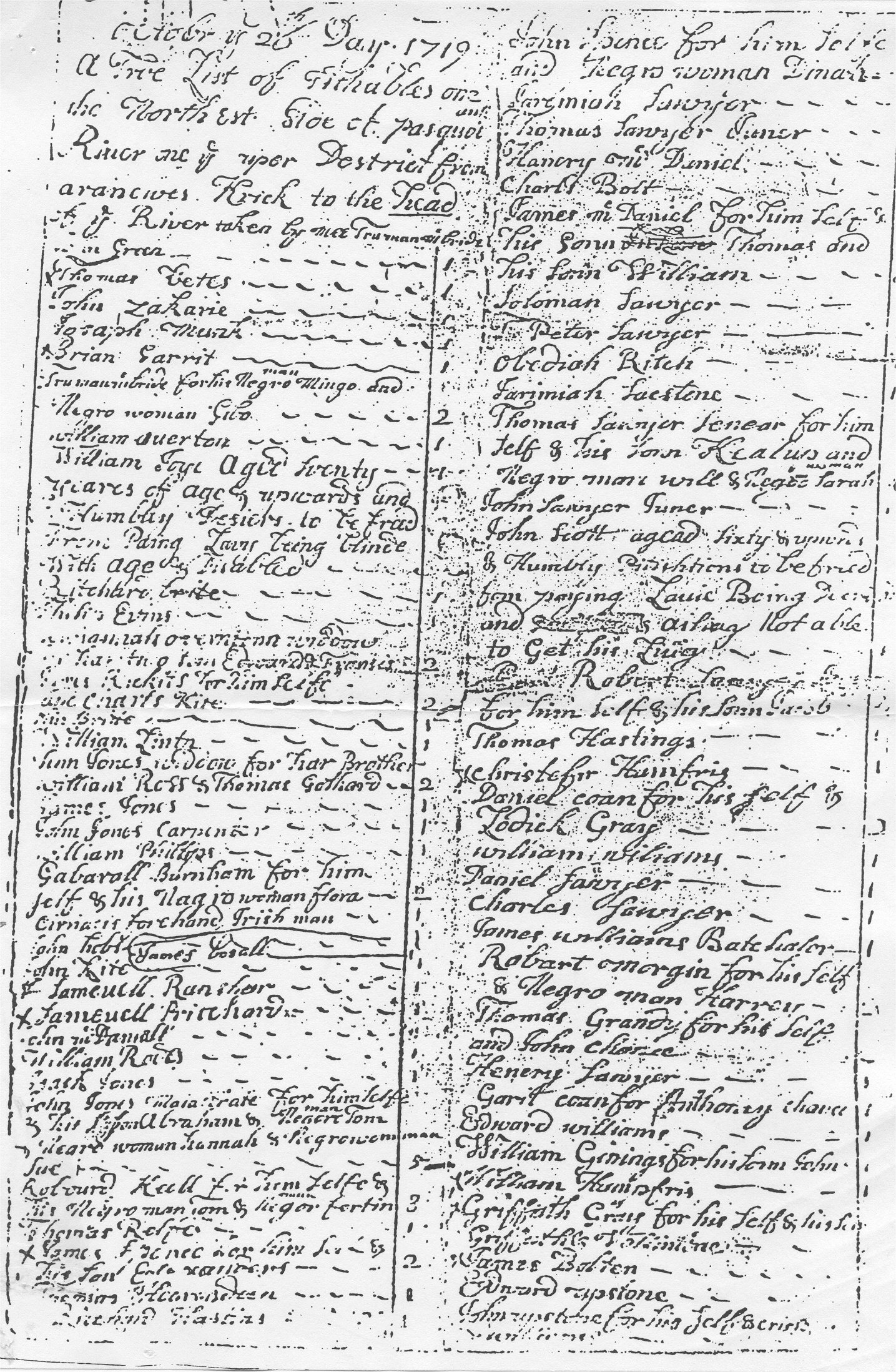
The sheet calls itself “A True List of Tithables.” There is a separate Carolina corn list, dated by its editor to about 1716, on which Joy appears. It is the October 1719 tax list that preserves the description of Cornelius. Whoever wrote it left us no county or parish in Ireland. Yet almost eighty years earlier, a widow in County Limerick had occasion to remember a man whose name she gave in much the same form.1
A name in the household at Kilfinney
On 29 September 1642, Anne Sowthwell gave sworn testimony about the rebellion in Ireland. In a line added to her account she named “John O forehand seruant to the Lady Dowdall of Kilfinney.” She reported that he had been hanged around the preceding Candlemas. Whether she saw his death herself is unknown. What survives of John is his name, the household he served, and the fact that someone remembered him when she came to give her evidence.2
John’s name comes to us through the scholarly transcription of the deposition. The final d, so familiar on this side of the Atlantic, is there in the transcription. So is the Irish O. Elsewhere in the Limerick depositions a soldier appears in March 1643 under the spelling “Tho: ô fforane.” Within months, two statements from the same county had brought two different spellings into writing. Neither witness identified the men as kin.2
What the name meant in Ireland
Irish gives us a better starting point for the name than either of the English words we hear in it. The Dictionary of American Family Names treats Forehand as probably a variant of Forhan, itself a form of Foran. Patrick Woulfe, writing about Irish surnames in 1923, grouped Forehan, Forehane, Forhan and Foran under the Gaelic forms Ó Fuarráin and Ó Fuartháin. The sense is “descendant of Fuarrán” or “descendant of Fuarthán.” The personal name in turn carries the Irish root fuar, meaning “cold.” Woulfe found these forms particularly in Waterford, Cork, Kerry and Limerick. How early the first family used the name is an open question.3
One sometimes encounters “cold little ford” as the meaning. The Oxford surname dictionary traces that explanation to a later interpretation of the personal name, which helped give some families the English name Ford. It also points out the Irish word fuarán, a spring or pool. Several distinct Irish names became Ford in English. The spelling makes sense as a search lead when a household, a marriage or a piece of land can carry us from one form to another.3
The oldest lead in this inquiry comes from a footnote. Under the year 1175, the Annals of the Four Masters name an O’Foirthchern in an account of a killing. The annals were compiled in the seventeenth century. Much later, their editor suggested that O’Foirthchern was probably the name anglicized Forehan or Foran. The medieval event has a date. The proposed surname connection belongs to the editor.4
In what is now County Laois there is firmer ground, quite literally. A rental of 1518–19 calls a place Grange O Woheran. A Crown survey in 1540 calls it Gragoforan. The Placenames Database of Ireland identifies the townland as Graigavern, in the parish of Lea, and explains the Irish name as the hamlet of the Uí Fhuaráin. An individual resident has yet to step out of either entry.4
Two Tudor pardons do give us individuals. At a place called the Wodhouse, probably Woodhouse near Stradbally in County Waterford, a pardon dated 2 September 1566 lists Dermot and William, each entered with a form of m’Donell Forhane, among the husbandmen. On 4 November 1573 the same place appears beside Derbe m’Donell O Forhane, a serjeant, and William m’Donell O Forhane, a yeoman. William’s name recurs seven years apart. The published calendars and the dictionary give us a promising neighborhood to investigate, although the William entries still rest on searchable calendar text. No relationship between the men is stated.5
Stall eighteen at Bandon Bridge
There is another Cornelius in our family papers. The recollection puts him and a son at Bandon Bridge in County Cork. In one telling they were blacksmiths. The printed source gives them a very different livelihood. When Bandon’s new meat market opened in 1754, the stalls stood at the north end of the bridge and rented for a pound a year. George Bennett’s town history lists the occupants. Beside stall eighteen is “Cornelius Forehane and Son.”6
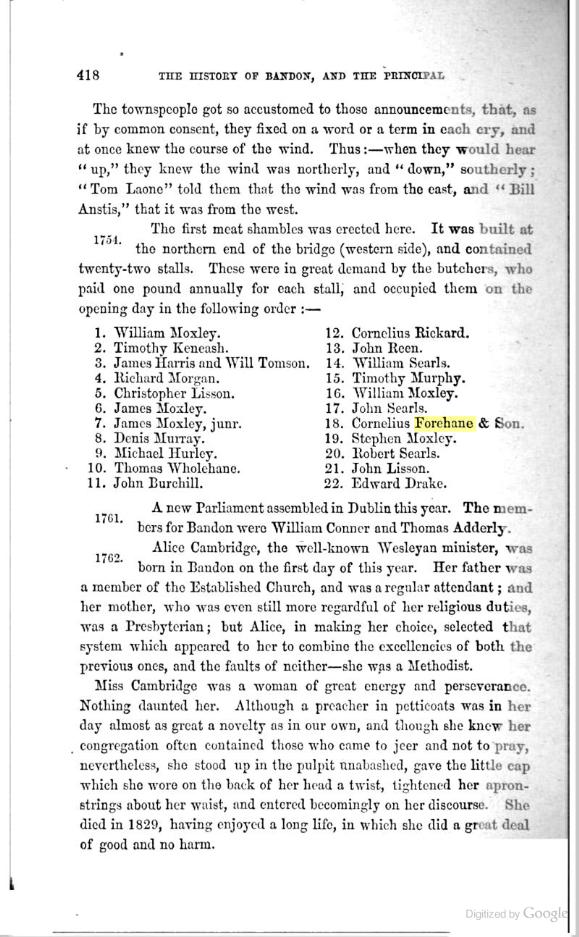
Bennett published the list in 1869 and gave the son no first name. By the time that market opened, the will of the Pasquotank Cornelius had been through court for more than a quarter of a century. The butcher is worth knowing on his own account. We have his workplace, his trade and a son working beside him. A surviving rent account could tell us more about that Cork household.6
The name across Britain
At Bunny in Nottinghamshire, the published parish register records the marriage of Gervas Forehand and Ann Bush on 22 June 1672. Ann was from Bradmore. The printed register calls Gervas “of Stableford.” A Bradmore compilation gives him as Farrand or Forehand of Stapleford. My earlier English survey looked toward Staffordshire. The original Bunny entry is the place to settle what the clerk wrote before choosing between places on a map. By the spring of that same year Gillian Forehand’s name had already been entered in Maryland.7
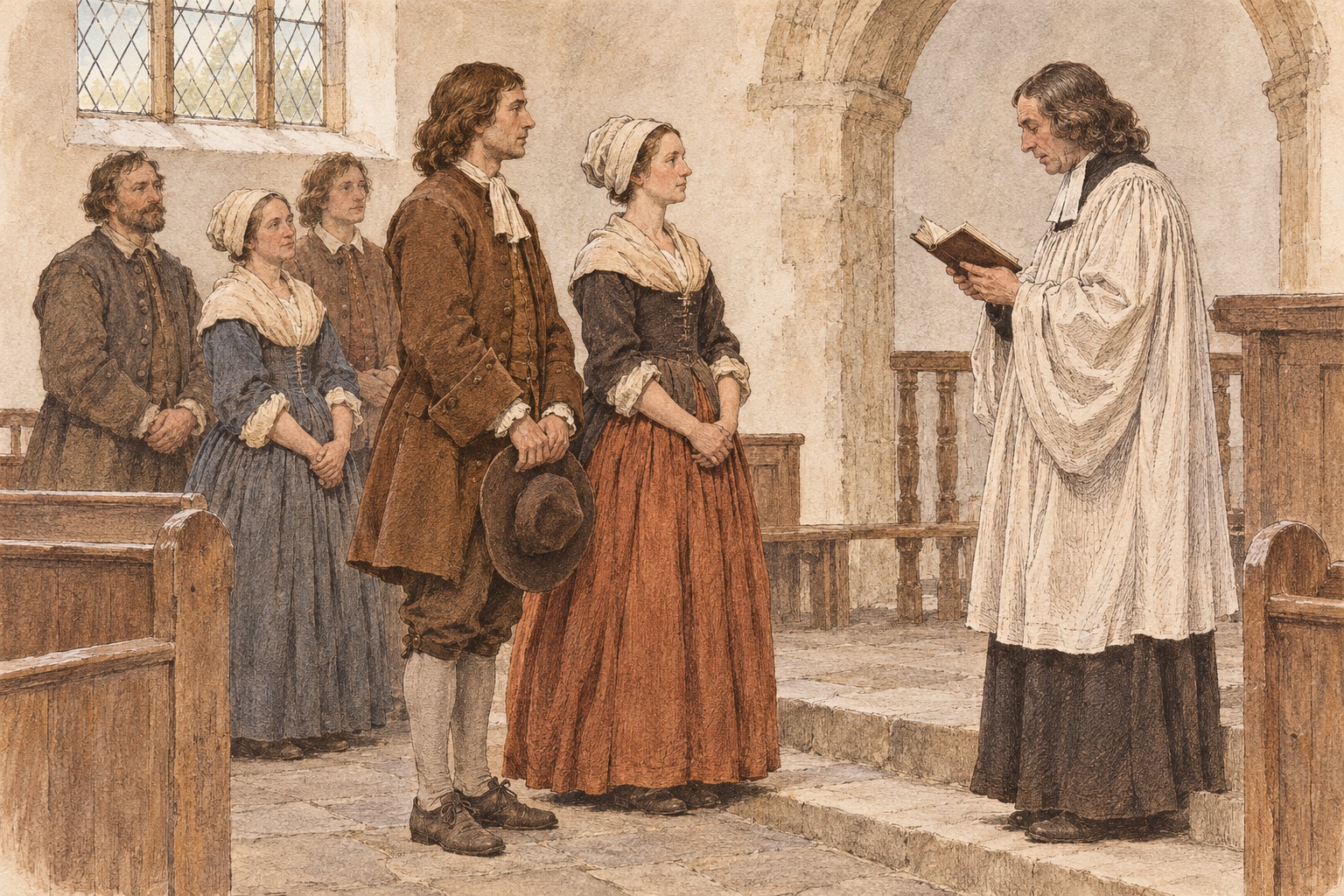
Fourteen years later, on 12 August 1686, Thomas Forehand married Sabry Lane at St Mary le Bone in Middlesex, now part of London. The printed register gives the couple a single line, with no parish of residence or parents named. How Thomas might have been related to Gervas, or to the Forehands already recorded across the Atlantic, remains an open question.7
Scottish records offer an older-looking name with a history of its own. William of Foreth witnessed a charter dated between 1238 and 1250. The University of Glasgow’s place-name survey identifies Foreth with the lands of Forret in Fife. William’s designation tells where he belonged. A much later court index puts a John Foran at Ayr on 10 April 1820, without giving his birthplace. We can place these men in Scotland. A family path from Fife or Ayr to the Pasquotank has yet to emerge.7
The red hand and the race to shore
A correspondent whose account survives in our family papers told a story about a race to the Cork shore. The first settler to touch land could choose his property. One man cut off his hand and threw it ahead of him. To the teller the deed explained the name “fore-hand.” Readers who know the Red Hand of Ulster may recognize the race. It is easy to see why a family telling its own history would remember such a tale.8
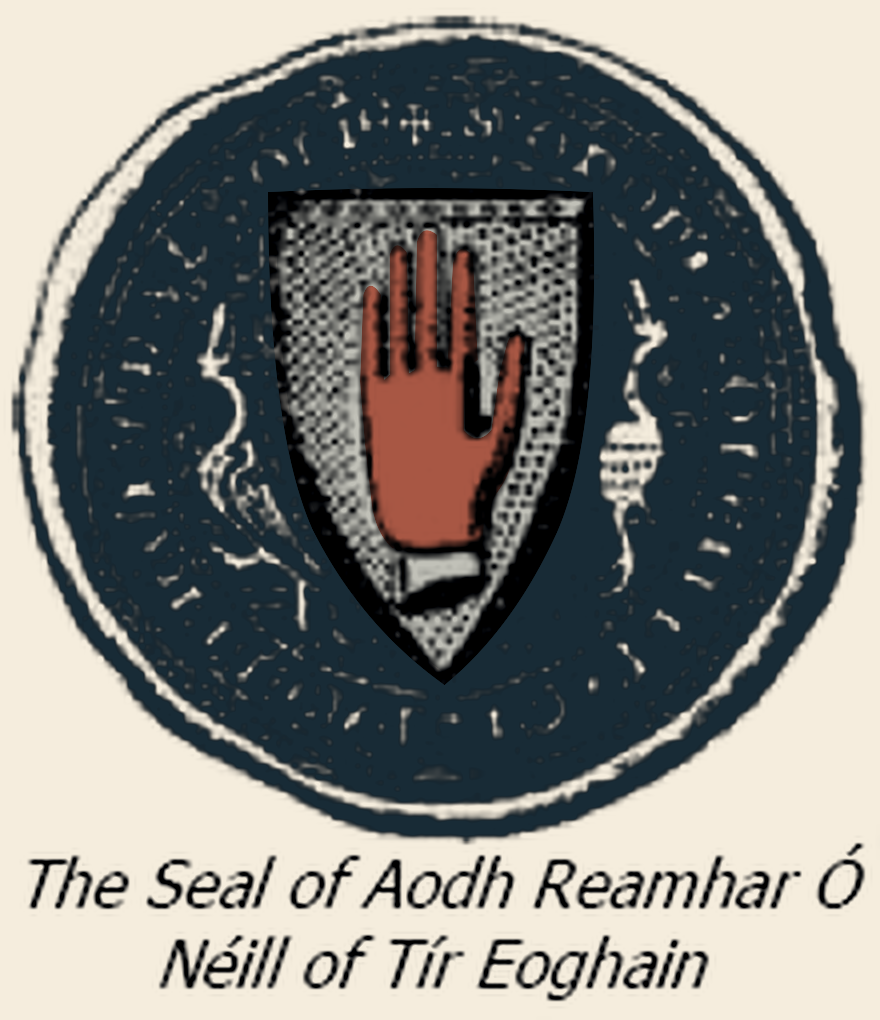
The seal illustrated here belonged to Aodh Reamhar Ó Néill of Tír Eoghain, who died in 1364. An upright hand stands inside the shield, with the inscription running around it. William Reeves, who studied the seal, described it as a right hand. The old illustration supplies the design. The muted colors were added for this website. In 1892 John O’Hart described the arms in his Foran pedigree as a red left hand shown palm outward on silver. Whether a member of our Pasquotank family used such arms remains unknown.8
Another picture preserved with the family papers has two birds, three roses and the motto Lucrum Christi mihi. The lion above the helmet is the crest. Those features closely resemble the arms recorded for Sir Ambrose Forde, also written Forthe, knighted in Ireland in 1604. The differences in the field and the birds are visible on comparison. No grant or line of inheritance has been found that would assign that shield to Cornelius.8
Printed genealogies tell us something about the people who collected the legends. O’Hart associated his Foran pedigree with a word he glossed as “preparation.” John Rooney, writing in 1895, gave the meaning as “Vengeance” and carried the family back to a king of Spain. A contributor from County Waterford remembered a Viking origin through Limerick. The accounts differ even about where to begin. The Irish surname dictionaries give us the Gaelic personal name, and the records at Woodhouse and Kilfinney give us actual people who bore forms of it.3 8
Across the Atlantic
In Maryland on 7 March 1671/72, William Jones, master of the Joseph of Bristol, proved rights to land for transporting a list of people. Gillian Forehand heads the list. The year would be 1672 on a calendar beginning in January. Gillian’s name turns up again when the rights were used to obtain land. Both entries come from the same claim. The register supplies neither Gillian’s parish nor the day the ship sailed.9
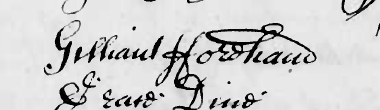
There is one reason to look for that ship in Ireland. On 20 September 1671, at Limerick, a different man, John Steephens, made a service agreement naming a Joseph of Bristoll and providing for his term to begin when the vessel anchored in Virginia. Gillian is absent from that agreement. The Bristol wharfage book that covers the interval offers a way to compare the masters and movements of the ships.9
Virginia supplies its own early evidence. A land patent dated 15 March 1672/73 lists “Tho. Fourehands” among people whose transportation supported the claim. At Henrico on 23 July 1676, Thomas Forehand witnessed the will of James Crewes. He swore to it the following year. The transportee and the witness may have been one man. Neither record identifies him as kin to Gillian or to Cornelius in Carolina. Each has a story worth following in its own right.10
Back on the Pasquotank, the family appears in records of a different kind. There are Cornelius’s purchases from William Joy, his name on the tithables list, and finally the will in which he left two cows to his son Thomas. We are still looking for a record that names a relative of Cornelius on the Irish side of the crossing.1 11
I have heard several Forehand families tell of three brothers or cousins who came to North America together. In a family-book chapter written in 2003, the oldest written three-person version I have found in our collection, the writer suggested that Cornelius was one of them and placed their arrival from Ireland near the Virginia–North Carolina border about 1700. The writer called the account unproved. A separate 1998 family message tells of two brothers in the nineteenth century. The people who told me the three-person story left a different sort of detail, one a list of passengers might never think to record. In the family’s memory, they came together.12
Between the Lines
Possibilities, not proven relationships. A Waterford or Limerick origin is worth testing because related surname forms appear there and the North Carolina compiler described Cornelius as Irish. Several Munster counties have a claim on the name, however. A record that names Cornelius with a relative or associate who can also be identified in Pasquotank would do more to establish a parish than another occurrence of the surname alone. Likewise, identifying Gillian’s port of departure would require a document placing Gillian aboard a particular voyage. The three travelers in family tradition have yet to be named together in a contemporary record.
A Life in the Records
These dates follow the name into the early Carolina records. A date on a pardon, a land patent or a will belongs to that document. The dates of the Atlantic passages themselves are unknown.
| Date and place | What the record preserves |
|---|---|
| 1175 · Ireland | A later annal names O’Foirthchern. Its editor’s identification with Forehan or Foran is tentative. [4] |
| 1518–19 and 1540 · present County Laois | A rental and a Crown survey record early forms of the place-name Graigavern. [4] |
| 1566 and 1573 · the Wodhouse | The pardon calendars name people called Forhane and O Forhane. [5] |
| 1642–43 · County Limerick | Depositions name John O forehand and a separate soldier, Tho: ô fforane. [2] |
| 1671–73 · Limerick, Maryland, Bunny and Virginia | A September 1671 service agreement names a ship in Limerick. In March 1671/72 Gillian appears in a Maryland transportation proof. Gervas and Ann married in England that June. A Virginia patent lists Tho. Fourehands in March 1672/73. [7] [9] [10] |
| 1676–77 · Henrico, Virginia | Thomas witnessed a will on 23 July 1676 and swore to it on 10 December 1677. His identity with the man in the patent is possible. [10] |
| 12 August 1686 · Marylebone, Middlesex | Thomas Forehand married Sabry Lane at St Mary le Bone. [7] |
| 1714 and 1718 · Pasquotank Precinct | Joy sold Cornelius 100 acres on 19 April 1714, acknowledged 20 April and registered 6 May. A second 100-acre purchase followed in October 1718. Register copies made in 1816 and 1874 differ on the days of execution and registration. [1] |
| October 1719 and 1723 · Pasquotank | The tithables list describes Cornelius as an “Irish man.” A 1723 jury roster lists “Cor: Forehand,” no. 124, without documenting attendance on a jury. A separately reported 1715 tax appearance is unverified. [1] |
| 24 February 1727/28 and July 1728 · Pasquotank | Cornelius made his will in February. It came before the court in July. The day he died is unknown. [11] |
| 1754 · Bandon, County Cork | The town history published in 1869 lists a later Cornelius Forehane and his unnamed son at the meat market. [6] |
Sources and reading notes
- Pasquotank Precinct, A True List of Tithables, northeast side of the Pasquotank River, October 1719, photographed manuscript in the Forehand collection, lower left column. The day has been read as both 21 and 26. For the separate corn list see Raymond A. Winslow Jr., “North Carolina Corn List Circa 1716,” North Carolina Genealogical Society Journal XII (1986), 213–219, at 217. Joy deed of 1714, Pasquotank deed book B, p. 264, and 1718 deed. William Joy and the Land at Joys Fork. Pasquotank juror list under the North Carolina act of 23 November 1723, no. 124.
- Trinity College Dublin, 1641 Depositions, MS 829, Anne Sowthwell, fol. 256r and the March 1643 deposition, fol. 312r. The readings here follow the university’s transcriptions.
- Dictionary of American Family Names, 2nd ed. (2022), entries Forehand and Forhan. Patrick Woulfe, Irish Names and Surnames (1923), p. 534. Oxford Dictionary of Family Names in Britain and Ireland (2016), entry Foran.
- John O’Donovan, ed., Annals of the Kingdom of Ireland, III, p. 20, note g. Placenames Database of Ireland, Graigavern, Lea parish, Kildare rental p. 288 and Crown survey p. 161. The database marks the proposed Irish form as non-validated.
- Calendar of Irish fiants, Elizabeth I, nos. 935 and 2335. The Oxford dictionary also prints the Dermot and Derbe readings from these calendars. The William entries were located in searchable calendar text.
- George Bennett, The History of Bandon (1869), p. 418, stall 18. The blacksmith recollection survives in family correspondence.
- W. P. W. Phillimore and T. M. Blagg, eds., Nottinghamshire Parish Registers: Marriages, IX, p. 130. Compare the Bradmore compilation and Nottinghamshire Archives, Bunny register PR 398. For the second marriage, see W. Bruce Bannerman and R. R. Bruce Bannerman, eds., The Registers of Marriages of St. Mary le Bone, Middlesex, part I (1917), printed p. 140, under August 1686. For Scotland, see the University of Glasgow’s Fife place-name survey, Forret, and the Ayr High Court index, JC26/1820/122.
- Forehand family correspondence, Cork race-to-shore account and 2005 Waterford account. Benjamin Hazard, “At Ó Néill’s Right Hand,” History Ireland. Black-and-white seal illustration. William Reeves, “The Seal of Hugh O’Neill” (1853), p. 258, identifies the right hand and describes the wax impression used for his drawing. John O’Hart, Irish Pedigrees, Foran (1892). John Rooney, A Genealogical History of Irish Families, Foran (1895). Bernard Burke, General Armory (1884), p. 367, Forde. For the funeral manuscript locator, see the study citing National Library of Ireland, GO MS 66, vol. III, p. 19, note 35.
- Maryland State Archives, Land Office, Patent Record, Original, WT, pp. 465–466, 479. Archives of Maryland, LIV, pp. 543–544, the separate Steephens agreement. Bristol Archives, Society of Merchant Venturers, wharfage book, 1669–1672, SMV/7/1/1/4. Gillian Forehand and the Joseph of Bristol.
- Library of Virginia, Patent Book 6, p. 446. Henrico County court record, will and proof. Thomas Forehand and the Will of James Crewes.
- State Archives of North Carolina, Cornelius Forehand, Pasquotank County, will, dated 24 February 1727/28, with endorsement of proof in July Court 1728. The later catalog uses “county” for records kept when Pasquotank was a precinct.
- Steven Forehand, oral accounts heard from several Forehand families and his 2013 account of Cornelius. Forehand family collection, 2003 family-book chapter on North American origins, and Joyce Louise Forehand’s separate 1998 mailing-list account. The date, route and identification of Cornelius in the three-person version come from the 2003 telling.
