On the left-hand page of a Pasquotank County register, 24 May 1765 appears three times in succession. Thomas Forehand comes first, Lemuel next, and Jarvis below him. Each entry sets down a different arrangement of cuts in an animal’s ears. Thomas’s description is particularly plain: a crop and a hole in the right ear, and a crop and a hole in the left. More than two and a half centuries later, those few lines add another dated record to the Forehands’ history in the county.1
What cattle marks were—and why they mattered
A livestock mark was a sign of ownership carried on the animal itself. An earmark was made by cutting the ear: a crop removed part of the tip, while other marks used notches along an edge or a hole through the ear. A brand served the same identifying purpose by burning a distinguishing design into the hide with a heated iron. These were different methods, and the three Forehand entries describe earmarks. They tell us neither the species nor the number of animals that bore them.1, 5, 7
Such signs mattered when an animal was separated from its owner. North Carolina’s 1741 law anticipated strange cattle entering another person’s cowpen and required public notice describing their marks. It also addressed the killing of cattle and hogs in the woods, requiring identifying ears and hides to be produced. These were practical safeguards against losing livestock or disguising its ownership.2
The county register gave those physical signs a written record. The law required owners to record their marks and brands with the clerk of the county where the animals were, and directed that disputes about a mark or brand be decided by the clerk’s book. That is why these short descriptions deserved a place in Pasquotank’s records—and why their exact wording matters when we read them now.2
The three registrations of 24 May 1765
Thomas Forehand
Left ear: Crop and hole.
Right ear: Crop and hole.
Lemuel Forehand
Left ear: Crop and upper keel.
Right ear: Under square.
Jarvis Forehand
Left ear: “An Under,” followed by no recoverable shape word.
Right ear: Under keel is readable; the opening is obscured by ink. The additional crop comes from the earlier Haun-derived quotation.
All three registrations bear the same date. The terms upper keel, under keel and under square should remain attached to their descriptions; a modern drawing is an interpretation of those words, not a surviving illustration from the register. Jarvis’s unfinished left-ear description especially resists a tidy picture. Supplying square because Lemuel used it, or keel because Jarvis’s other ear had one, would create evidence the page does not contain.1
The original also changes the standing of a familiar research lead. Correspondence preserved in the family collection quoted these marks from Weynette Parks Haun’s 1981 abstracting volume. That quotation guided the search. The recovered manuscript image now verifies the three names and dates directly, while exposing the limits of Jarvis’s wording. His entry has an ink-obscured opening; farther along, “an Under” is followed on the next line by “in the left Ear.” The missing description cannot presently be completed.1, 3
What the marks may have looked like
Compare the original entries


The modern interpretation
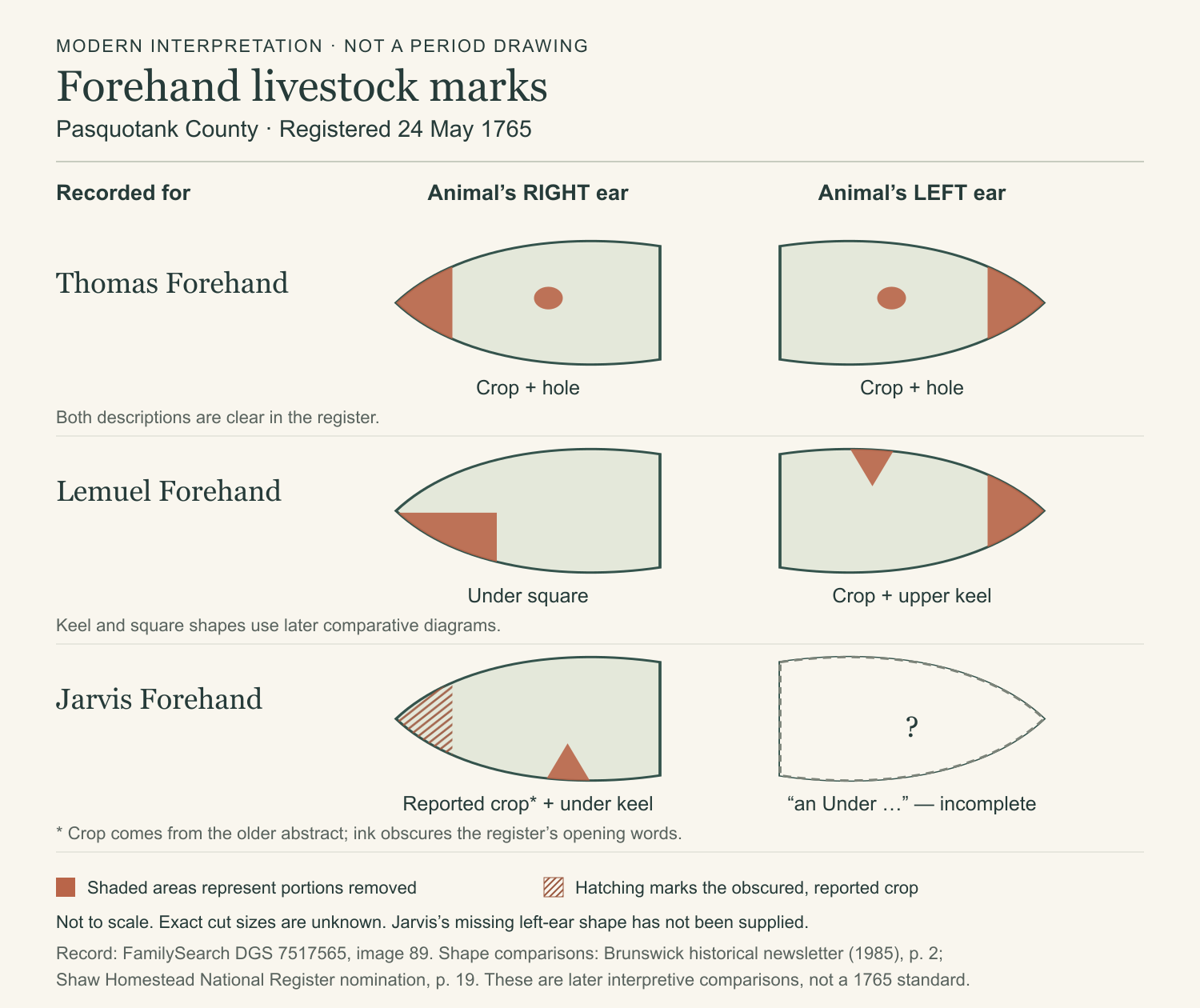
Modern explanatory drawing, not a historical image. Shading shows portions removed; the animal’s own right and left ears are labeled. Crop and hole follow the register’s plain descriptions. The keel and undersquare shapes use later comparative illustrations, rather than a demonstrated Pasquotank convention from 1765. Exact dimensions and cut positions are interpretive. Jarvis’s reported crop is hatched because ink obscures the original wording, and his missing left-ear shape is left unknown.5
The damaged Forehand entry attributed to John has now been found in the original register. Its surviving words still do not provide enough detail for a complete drawing; see John’s reported mark: the original recovered below.
What the page adds to the family research
For Thomas, Lemuel and Jarvis, the immediate gain is a securely dated registration in each name, independent of the deed and tax records already being studied. The grouping fits the established Pasquotank research context. Identifying those registrants with the men followed through the wider family records remains a cross-record judgment; the page itself supplies no ages, wives or parentage.
Other records do state the relationships. The tax return used in the Thomas investigation calls Jarvis his son; the 1796 deed describes the division Thomas made between his sons Lemuel and Daniel. Those are the sonship clauses. The earmark page adds a shared date and county association to that family reconstruction without replacing its documentary foundation.4
The legal geography is equally important. The statute directed registration where the animals were, not necessarily where their owner lived. Its cowpen provision expressly allowed for an absent owner represented by an overseer or manager. These entries therefore strengthen the case for a livestock and property connection with Pasquotank. They do not locate a home at Newland, prove that all three men appeared at court together, or mark their arrival in the county. Nor do the law’s animal-age thresholds supply minimum ages for the men.2
For the present land investigation, that distinction keeps the record useful without making it carry a survey’s burden. There is no creek, neighbor, road or acreage in these three descriptions. They cannot put Thomas’s patent or Lemuel’s house on a modern map. Their more promising use lies in comparison: a later estate inventory, stray-animal notice or ownership dispute that names one of these marks might connect a person or transaction with this registration. Such a match would still need its own date, wording and identity check.
John’s reported mark: the original recovered
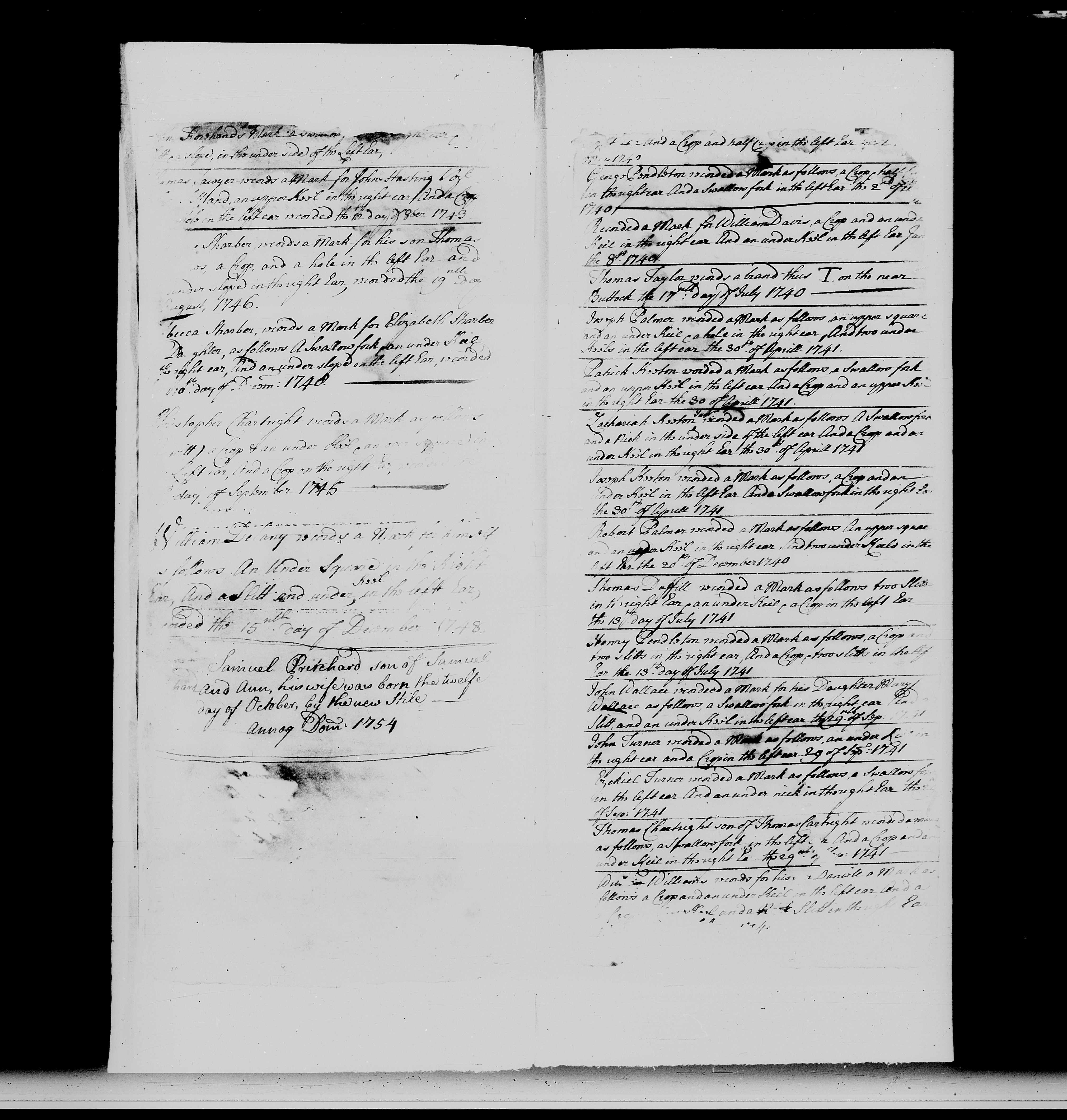
The search has now reached the original Forehand entry behind the mark attributed to John Forehand. At the top left of the recovered register image, the surviving words include “Forehand’s Mark” and a slope on the underside of the left ear. This is a useful advance: we can compare the family’s quotation with the manuscript itself, rather than rely on the quotation alone.8
Steven’s research manuscript preserved the lead in this damaged form:
“54- (torn) __hn Forehand’s Mark a swall__ (torn) ___ & ___litt & a slope, in the underside of the left ear.”6
The recovered image confirms the Forehand surname and part of the mark, but the given name, date and full arrangement of cuts remain incomplete. John remains an attributed identification, and the reported date of circa 1740 is still unconfirmed. Other entries on the opening carry dates from the 1740s and 1754; their mixture does not supply a date for this damaged entry.8
For that reason, John’s mark is still omitted from the modern explanatory diagram. We now have an original source for the surviving fragment, but not enough checked wording to draw both ears without inventing missing cuts. The discovery strengthens the record’s foundation while leaving its owner’s full name, recording date and complete design open for further comparison.
The 1765 page gives us three names, three identifying descriptions and one exact recording date. The cuts were intended to distinguish ownership of livestock. Preserving their differences—and Jarvis’s missing words—helps us distinguish the surviving evidence just as carefully.
Sources and Notes
- Pasquotank County register, 24 May 1765. FamilySearch catalog 347478, film 19496, DGS 007517565, image 89, left face. Original manuscript register inspected through a digital microfilm image; no secure manuscript page number assigned. View the register (archive access may require sign-in).
- North Carolina, 1741, chapter VIII, §§V–IX, in James Davis, A Complete Revisal of All the Acts of Assembly … Now in Force and Use (Newbern, 1773), pp.62–64, particularly p.63. Contemporary printed revisal inspected. Section VI directs registration where the animals were; section IX addresses absent cowpen owners.
- Family collection, Forehand marks correspondence, quoting Weynette Parks Haun’s 1981 abstracting volume on Old Albemarle births, marriages, deaths, brands and flesh marks, 1691–1833. The correspondence was the finding aid; Haun’s original printed page was not newly inspected. The three 1765 entries were subsequently checked against the original register.
- Thomas Forehand research, source LR19, tax return naming Thomas and sons Jarvis and Daniel (attributed 1769; dating qualification retained); LR07, Pasquotank deed pp.430–431, 9 February 1796, recording Thomas’s division between sons Lemuel and Daniel. These are separate relationship records. Thomas’s story and source notes; Lemuel’s story and source notes.
- Comparative shapes only: Brunswick County Historical Society newsletter, November 1985, p.2; Shaw Homestead, National Register nomination, section 8, p.19, held by the Mississippi Department of Archives and History. The latter chart credits Gulf Coast Community Design Studio’s Livestock & Open Range Booklet, p.7. Inspected 13 November 2026. These later regional illustrations inform the modern diagram; neither establishes a standardized 1765 Pasquotank cut geometry.
- Steven Forehand’s later research manuscript, rendered p.28, source S22 in the John Forehand study; preserved extraction covers pp.28–31. Its quotation supplied the lead for the original-register recovery described in source 8. This quotation remains a research narrative, distinct from the manuscript image. The prefixed “54” remains an unverified locator; p.28 belongs to the research manuscript. Both “John” and circa 1740 remain attributed.
- Smithsonian Institution, National Museum of American History, “Branding iron,” record nmah_1427183, object dated circa 1940. The museum description explains how a heated metal design sears an identifying ownership brand into an animal. Cited only to explain the method; this later object does not establish a particular colonial North Carolina tool or design. The 1741 North Carolina act in source 2 supplies the period legal context.
- Pasquotank County vital records/brands and marks register, undated damaged Forehand entry, FamilySearch film 19496, DGS 007517565, image 49, top left. View the recovered original-register image. Inspected 13 November 2026. The Forehand surname and a slope on the underside of the left ear are readable; the complete given name, date and bilateral mark description remain unresolved. Nearby entries are not uniformly chronological. The earlier “John, circa 1740” attribution is retained as unconfirmed, not supplied by this original.
Research and illustration: 13 November 2026. The original-register readings, historical-law interpretation, article and modern diagram received separate source checks. The damaged Forehand original was subsequently recovered; the given name, reported date and complete mark remain unresolved.