A farm in Guilford, a widow living beyond North Carolina, and a deed signed in Tennessee follow one Forehand family west from the Pasquotank.
In October 1821, a group of Tennessee residents sold sixty acres back in North Carolina. The property lay on the waters of Allamance in Guilford County; the sellers lived in Davidson and Rutherford Counties, hundreds of miles away. Three Forehand men joined four married couples in the conveyance. Several of their names had appeared six years earlier in a court notice concerning the estate of David Forehand. The land and the people together provide a probable connection between David’s Guilford household and the expanding Forehand families of Middle Tennessee. [1821 deed]
David himself had died in 1802. His known westward movement ended in Guilford, where he left a home farm, other land, livestock and a wife named Prudence. To follow the probable continuation of this family into Tennessee, we must begin farther east, near the head of the Pasquotank River.
From Newland to Guilford
On 7 September 1769, Thomas Forehand sold David sixty acres in Newland for £45. The tract came out of a larger holding of 503 acres on the northwest side of the Pasquotank River. Lemuel Forehand witnessed the transaction. Two days later, David witnessed Thomas’s separate conveyance to Lemuel. These were transactions among men who belonged to the same small Forehand neighborhood, and they are an important part of the case for David’s possible place in Thomas’s family. [1769 deeds]
David remained in the coastal records for decades. Tax returns and land transactions place him there through the years of the Revolution and into the new republic. The dated 1789 District 6 return lists David Fourhand with one hundred acres and two white polls, although it does not name the second taxable person. In 1790 he sold fifteen acres to Tulle Vardin. Four years later he conveyed a much larger holding to Lodwick Williams: a principal tract of 125 acres and a twenty-acre addition. Jordan Forehand witnessed both sales. [Coastal records]
The deeds then carry David inland in stages. When he bought 112 acres and 79 poles from Robert Dean on 1 May 1799, the register described him as a resident of “Hartford County,” North Carolina—a spelling reasonably understood as Hertford. The property was in Guilford, on both sides of Allamance. By 14 February 1801, when he purchased another tract on the waters of Polecat from Timothy McCiver, David was expressly described as a Guilford resident. Jordan Forehand was again a witness. [1794–1801 deeds]
We identify the Pasquotank landholder and the Guilford testator with High confidence. The recurring David–Jordan association, the sequence of residence clauses and the later estate title make a strong cumulative case. The records do not give a continuous itinerary or an exact moving day; they give something more useful than a family tradition alone—dated places, transactions and associates. Thomas’s proposed fatherhood is a separate question and remains Possible.
The household David left
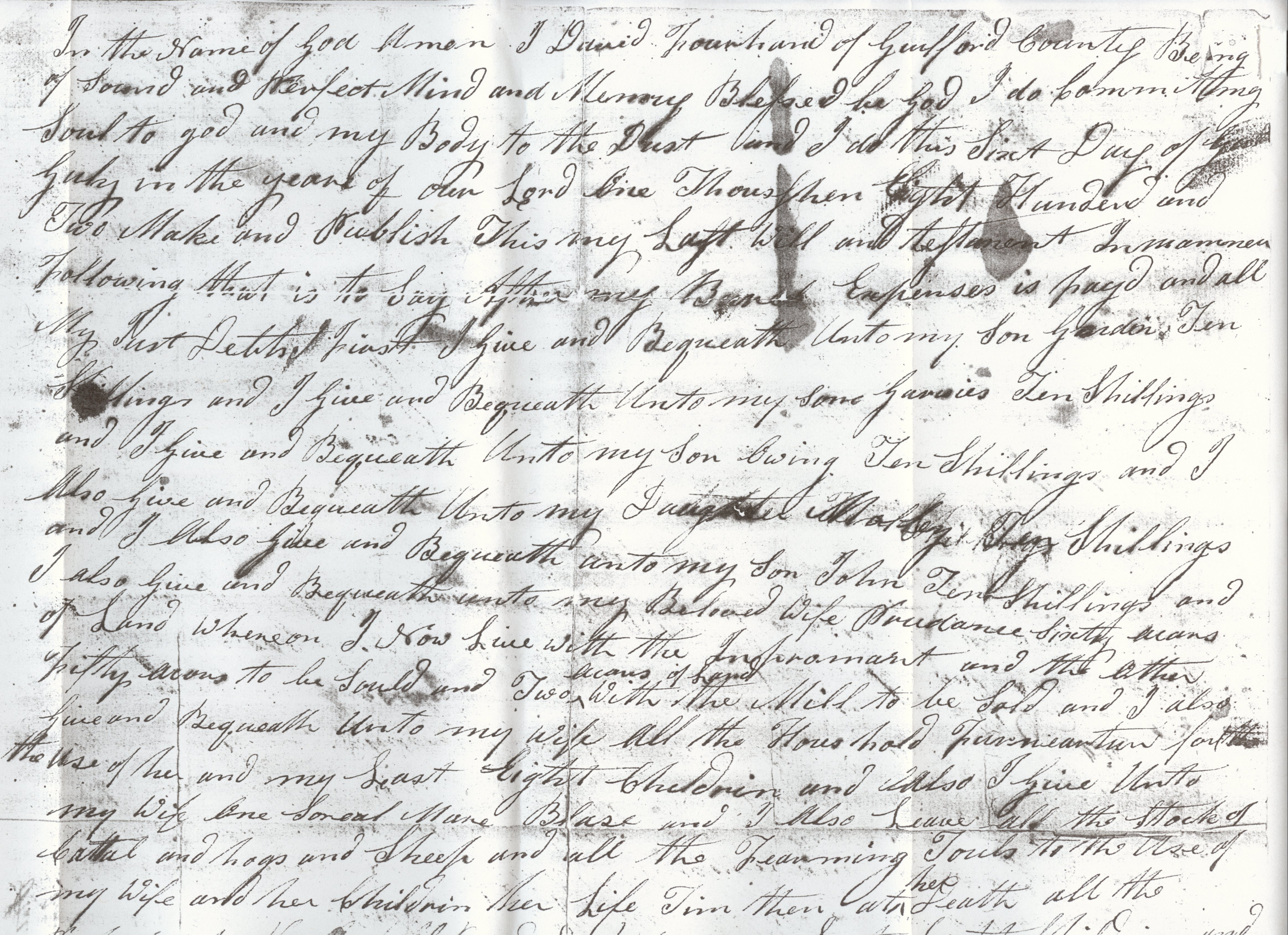
David made his will on 6 July 1802. Its most substantial provision concerned Prudence, whose name the manuscript spells “Prudance.” She was to have the use of the sixty acres where he lived, with the improvements, household furniture, livestock and farming property provided for her and the children. A sorrel mare appears among her provisions. These were the means of keeping a household and farm going after David’s death. [1802 will]
Five individually named children—Jordan, Jarvis, Owing, Molley and John—were each left ten shillings. Thomas received a brown colt. David also referred to “my last eight children” as a group. We retain that expression without turning it into a fixed total of thirteen children: the will does not identify all eight or explain exactly how its individual bequests and collective provisions overlap.
In this story, Allen is the son identified with the will’s “Owing.” Allen appears by that name in the later notice concerning David’s estate. This is our working identification across the two records; a literal transcription of the will must still read Owing. Henry, who also appears in the estate notice, is a separate person. [1815 notice]
David directed that other property be sold, including land apart from the home farm and two acres associated with a mill. The executors, Roger Kirkman and Nehemiah Causey, put the instructions into effect. On 1 December 1802 they sold James Rumbley the Pole Cat tract David had acquired from McCiver. On 5 January 1803 they sold Roddy Hannah fifty acres on both sides of Alamance. The deeds identify them as executors acting under David’s will, linking the land he purchased to the estate administered after his death. [Executor deeds]
The will and first executor conveyance establish his death in 1802. A court-minute transcription narrows the interval to 6 July–19 August, when the will was proved. It supplies no exact death day. Prudence survived him by many years: she was still named as his widow in 1815.
North Carolina land, Tennessee families
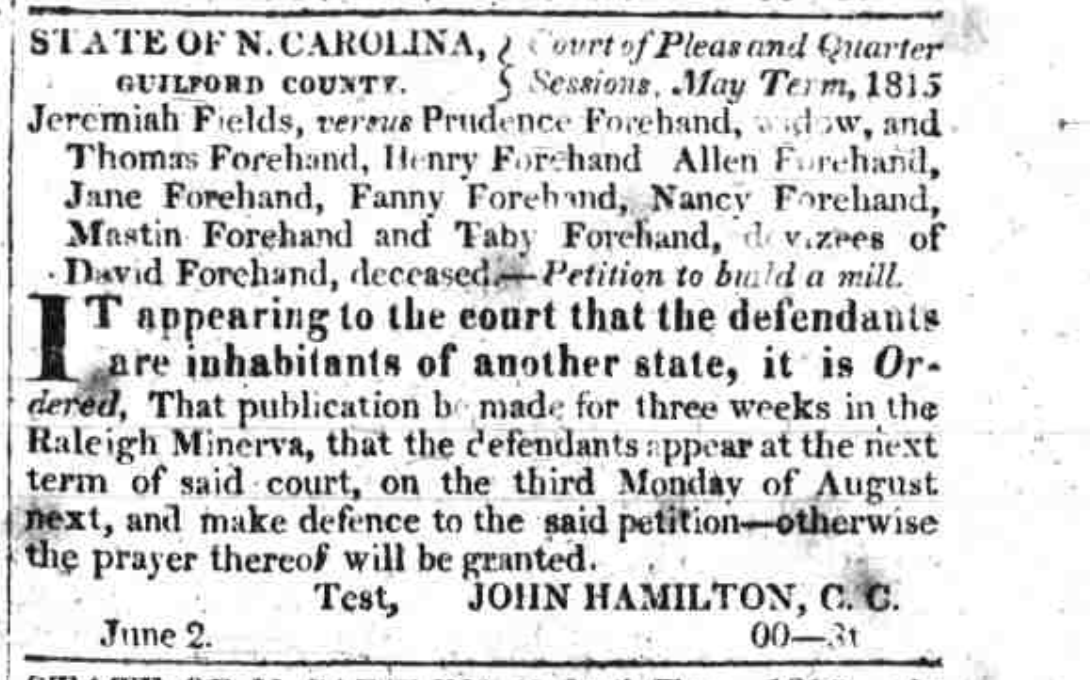
In May 1815, Jeremiah Fields petitioned the Guilford court concerning a mill. The resulting newspaper notice named Prudence Forehand, widow, and Thomas, Henry, Allen, Jane, Fanny, Nancy, Mastin and Taby Forehand as devisees of David’s estate. They were described as inhabitants of another state. North Carolina land still required their attention after they had left North Carolina. The notice does not say which state had become their home. [1815 notice]
The 1821 deed supplies Tennessee addresses. Thomas and Martin Forehand were among the Davidson County sellers, as were Alson and Fanny Lenton, James and Nancy Rhodes, and William and Phebe Spence. Henry Forehand and Brittain and Jane Spence were specifically identified in the continuation as Rutherford County residents. The acknowledgment proceedings establish the four marriages. The land they conveyed to Jeremiah Field, for $120, remained in Guilford. [1821 deed]
The identification of this group with David’s estate family, and of its sixty acres with the home tract, is Moderate confidence—probable. Several given names recur from the estate proceeding, Field connects the two transactions, and the boundaries return to the neighborhood and boundary lines of David’s earlier Allamance purchase. This is more than a coincidence of acreage. The remaining gap is the absence of a complete intervening title or an express recital naming David as the former owner; the deed itself does not call its sellers his children. Mastin’s possible identity with Martin, and Taby’s with Phebe, also require separate treatment.

A North Carolina name near Nashville
Pasquo gives this family movement a wider setting. The community is in Davidson County near Nashville, at the northern end of today’s Natchez Trace Parkway. Historical Highlights of Camden County, published in 1977, recounts a wagon-train migration from northern Camden and Pasquotank in 1797 and includes Forehand and Linton among the participating surnames. It describes the Tennessee settlement’s name as Pasquotank, shortened first to Tank and then to Pasquo. A later Tennessee genealogical publication also preserves the explanation that the name came from Pasquotank families. [Pasquo sources]
That remembered migration helps explain why familiar northeastern North Carolina surnames appear together in Middle Tennessee. The 1977 account gives no individual Forehand names, however, and does not place David or a named child in its wagon train. David’s own records still place him in North Carolina afterward. Pasquo belongs here as the history of a broader movement; the deeds and estate proceedings provide the particular evidence for his family.
Family Ties
Prudence was David’s wife, explicitly named in the will and later described as his widow. Her maiden surname, marriage date and exact birth and death dates are unknown. The records do not establish that she was the mother of every child. She must remain distinct from the earlier Prudence Forehand whose estate was administered in 1751. [Will and family evidence]
Thomas of Newland is David’s possible father. If that connection is correct, Lemuel, Daniel and the older Jarvis—Thomas’s documented sons—belong among David’s brothers. Cornelius belongs one generation farther back through the High-confidence identification of his named son Thomas with the Newland landholder. That strong Cornelius–Thomas identification does not remove the uncertainty in the Thomas–David link. [Parentage evidence]
The children and later beneficiaries are best followed individually. “Named child” below means David’s will explicitly supplies the relationship; “devisee” means a person named as a beneficiary in the 1815 proceeding.
- Jordan — named son
- Ten shillings in the will. A Jordan witnessed David’s coastal and Guilford deeds; whether each was this named son remains unproved. No Tennessee residence for him is established here.
- Jarvis — named son
- Ten shillings. His proposed identity with a later western Jarvis remains Possible. He is distinct from the older Chowan Jarvis who died by 12 September 1788.
- Allen, written “Owing” in the will — working identification of a named son
- Ten shillings under Owing; Allen appears separately from Henry among the 1815 devisees. He does not appear among the inspected 1821 sellers.
- Molley — named daughter
- Ten shillings. A married surname and western residence have not been established.
- John — named son
- Ten shillings. Neither the adult Guilford land seller of 1802 nor the later Williamson County John is automatically this son.
- Thomas — named son and 1815 devisee
- A brown colt in the will. The 1821 Davidson County seller probably continues his record through the estate-associated group.
- Henry — 1815 devisee
- Probably the 1821 Rutherford County seller. His place among David’s children is inferred from the estate context, rather than an individual son clause in the will.
- Jane — 1815 devisee
- Probably Jane, wife of Brittain Spence, of Rutherford County in 1821. That marriage is explicit; her identification as David’s daughter rests on the estate connection.
- Fanny — 1815 devisee
- Probably Fanny, wife of Alson Lenton, of Davidson County in 1821. Her marriage is documented in the deed proceedings; daughterhood is inferred.
- Nancy — 1815 devisee
- Probably Nancy, wife of James Rhodes, of Davidson County in 1821. Her marriage is documented; her placement as David’s daughter follows the estate evidence.
- Mastin and Martin — possible same person
- Mastin is the printed name in 1815; Martin is a Davidson County seller in 1821. Their equivalence remains Possible. A much younger Martin, aged thirty-two in a census crop attributed to 1860, belongs to another generation.
- Taby and Phebe — possible same person
- Taby appears in 1815. Phebe is explicitly William Spence’s wife in 1821. The proposed identification remains Possible; the women may be distinct.
This comparison draws on the 1802 will, 1815 notice and 1821 conveyance. Later namesake comparisons are detailed in the western-family research. It does not turn the eleven sellers in 1821 into eleven children.
Between the Lines
Possibilities, not proven relationships.
The case for Thomas as David’s father begins with geography and association: David was in the same Newland Forehand community, bought part of Thomas’s holding, and appeared with Lemuel in the paired 1769 transactions. Those facts make sonship worth pursuing. They also fit another close family relationship, and the currently examined records have not narrowed those alternatives enough to raise the rating beyond Possible. An inheritance recital or another record expressly connecting David to Thomas’s household would materially strengthen the case.
The western questions need the same attention to generations. In the 1830 Williamson County household, if its sole adult male was the named head John, his age places his birth after 1 June 1800 and by 1 June 1810. To be David’s named son, he would have to have been born by 6 July 1802. That is possible, but this young man cannot also be the adult John who sold land in 1802. Jarvis’s possible western identity likewise needs a connected sequence, rather than a repeated first name. Lambert and Vinson belong to important Tennessee Forehand investigations, but neither is established here as David’s son. [Western identity studies]
What David’s estate already gives us is substantial: a household established in Guilford after years on the Pasquotank, a widow and beneficiaries living outside North Carolina by 1815, and a probable continuation of that family in two Tennessee counties by 1821. The sixty acres on Allamance kept those distant people together in a single transaction. Through it, the history of one North Carolina farm becomes part of the history of the Forehands in Tennessee.
A Life in the Records
The Pasquotank and Guilford records are treated as belonging to the same David with High confidence. Attributed dates and collateral identities are identified below. This is the currently identified record inventory, not an exhaustive account of every surviving record. Later proof and registration dates do not imply that David was still alive.
- Attributed 1764/1765. One damaged, undated Pasquotank tax return names David with Thomas, Lemuel and James Forehand. The differently dated photographs are the same source. [Tax records]
- Attributed 1766. David appears as a soldier on a Pasquotank militia list. The saved image carries no visible date; it does not establish Revolutionary War service. [Militia return]
- Attributed 1769. A tax return gives David a separate entry with one white taxable. The explicit sons named under Thomas are Jarvis and Daniel. [Tax records]
- 7 and 9 September 1769. Thomas sold David sixty acres in Newland for £45; Lemuel witnessed. Two days later David witnessed Thomas’s separate sale to Lemuel. The David deed was proved in June 1770 and registered 18 July 1770. [1769 deeds]
- 1770. David appears with one white taxable on a dated Pasquotank return. [Tax records]
- 1774. David again appears with one white taxable. The return’s concluding page is dated at Pasquotank River Bridge, 14 September 1774. [Tax records]
- March 1778 — collateral identification. A David Forehand bought eighty acres and an additional twenty acres from Reuben Davis at the heads of Pasquotank. The execution day is disputed [2/3 March]; acknowledgment was September 1778 and registration 23 March 1779. The buyer remains a separately tracked record identity while the title is compared. [1778 deed]
- Attributed 1778. A tax return lists David with 100 acres, houses valued at £50, livestock and money. The saved wider view and family crop are one source; the date is not visible. [Tax records]
- Attributed 1779. A tax-list crop associates David with 100 acres. Its date remains a filename attribution. [Tax records]
- 20 September 1779 — index only. A derivative road-petition index names David. Its event date is 20 September 1779, although the database labels his residence 1780. The original petition has not been inspected. [Petition index]
- Attributed 1782. A tax crop lists 100 acres, four horses and ten cattle; the year is attributed. [Tax records]
- 12 September 1782. David sold Timothy Burnham 34 acres and 32 poles. Court proof followed that September; registration was 15 March 1783. [Coastal deeds]
- Attributed 1783. David’s deed to Peter McDaniel describes sixty acres out of a 503-acre tract on the northwest side of the head of Pasquotank River. It likely continues the 1769 parcel, but the saved crop lacks the execution date and conclusion. [Coastal deeds]
- 18 January 1784 and 22 August 1786 — catalog. The State Archives catalog lists David’s 94-acre Pasquotank land entry and resulting grant: entry 15, grant 55, grant book 64:13, file 452. The original grant has not been inspected in this review. [Grant catalog]
- 21 August 1785 — transcription. A researcher’s transcription describes a 94-acre survey at Middle Swamp and White Oak Ground in Newland, southwest of Pasquotank River. It names Anthony Gray and Sam Forehand as chainbearers. The original survey remains unverified. [Survey transcription]
- 1786. An expressly dated tax certificate lists David with 100 acres and one white poll. This corrects the photograph’s 1788 filename. [Tax records]
- Attributed 1787. A tax crop lists 100 acres and two white taxables. The second person is unnamed. [Tax records]
- 1789. The dated District 6 return lists David Fourhand with 100 acres and two white polls. It names no relationship between them. [Tax records]
- 20 February 1790. David sold fifteen acres in Pasquotank to Tulle Vardin. Jordan Forehand witnessed. [Coastal deeds]
- Census attributed 1790. David’s Pasquotank household contained four free white males aged sixteen or older, four younger males and three free white females—eleven people. The schedule does not identify their relationships. Jordan had a separate household. [Census]
- 2 March 1792. David sold Samuel Forehand eighty acres for £100. Samuel is not called his son. [Coastal deeds]
- 29 December 1794. David, expressly of Pasquotank, sold Lodwick Williams 125 acres and an additional twenty acres. Jordan Forehand witnessed. The execution date corrects the photograph’s 1796 label. [Migration deeds]
- 1795 — bounded negative finding. David was not found in the complete printed District 6 tax list, pages 96–98. This limited derivative search cannot date his departure from the county. [Tax records]
- 1 May 1799. Robert Dean sold David 112 acres and 79 poles on both sides of Allamance in Guilford. David was described as of “Hartford County,” North Carolina—reasonably normalized as Hertford. This proves Guilford landholding before it proves Guilford residence. The deed’s May 1803 proof followed his death. [Migration deeds]
- 14 February 1801. David was expressly of Guilford when he bought 86 acres on the waters of Polecat from Timothy McCiver. Jordan Forehand and John Caulk witnessed. Court proof followed in November 1802. [Migration deeds]
- 6 July 1802. David made his will in Guilford, naming wife Prudence, individual children and “my last eight children.” The will and its beneficiaries are discussed above. [Will]
- 19 August 1802 — court transcription. A published transcription records proof of David’s will and qualification of its executors. This places his death between 6 July and 19 August 1802 on transcription-supported evidence; the original court minutes were not inspected. [Court minutes]
- 1 December 1802. Roger Kirkman and Nehemiah Causey, executors of David’s estate, sold James Rumbley 86½ acres on Pole Cat under the will’s authority. The deed expressly traces this tract to Timothy McCiver. Later court proof appears to be February 1808. [Estate deeds]
- 5 January 1803. The same executors sold Roddy Hannah fifty acres on both sides of Alamance under the will’s authority. The deed was proved in May 1804. [Estate deeds]
- February 1803 — court transcription. A list of sales of David’s estate was returned to court. The transcription records that return, not the contents of the sale list. [Court minutes]
- May, August and November 1803 — court transcription. The May court appointed men to provide a year’s allowance for the widow; August entries record the return of the provision and inventory, and November records a settlement. The transcription identifies proceedings, not a recovered itemized estate inventory. [Court minutes]
- May Term 1815; notices 2 and 23 June. A mill petition identified Prudence as David’s widow and named eight devisees. The notice said the defendants inhabited another state, without naming it. The two printings represent the same proceeding. [Estate notice]
- 20 October 1821; acknowledgments 24 October and 6 November. Thomas, Henry and Martin Forehand, with the Lenton, Rhodes and Spence couples, sold sixty acres on Allamance to Jeremiah Field. The deed and examinations place the grantors in Davidson and Rutherford counties, Tennessee. The tract and family cluster strongly invite comparison with David’s estate, but the deed does not name David or call the sellers his heirs. [1821 deed]
- Undated or unverified service leads. Local Revolutionary account-index notes contain David Forehand and D.Forehand references. They have not been connected securely to this man. The Edgecombe/Nash pensioner who testified in 1832 was a different David, alive thirty years after the Guilford testator’s death. [Service leads]
The Family as We Currently Understand It
The lines distinguish documented relationships from proposed connections. The birth bounds are conditional estimates from tax or militia appearances, not exact birth years. David’s by-1750 bound depends on the attributed 1766 militia date and an assumed minimum age of sixteen. The wider family bounds are discussed in the linked family stories. [Family dates]
Cornelius Forehand
Birth unknown · Died 1728
Thomas Forehand of Newland
Born by 1724, conditional tax-age bound · Died 1769
Wife unknown. The mother of each son has not been established.
Lemuel Forehand
Born by 1750, conditional militia-age bound
Died 31 January–24 February 1808, under the High confidence identification with that testator.
Daniel Forehand
Born by 1754, conditional tax-age bound
Died on or after 28 December 1781 and by July Court 1783.
High confidence identification with the Perquimans testator.
Jarvis Forehand
Tax-record son: birth and death unknown.
Moderate confidence: probably the Chowan man who died by 12 September 1788. The conditional by-1750 militia-age bound belongs to that proposed identity.
David Forehand
Born by 1750, conditional militia-age bound · Died 1802
High confidence: the Pasquotank man and the Guilford testator were very likely the same David. He is shown once here.
David and Prudence
David names Prudence as his wife in his will of 6 July 1802. The 1815 estate notice calls her his widow.
Prudence Forehand
Birth unknown · Death unknown
Named in 1802 and 1815. Her birth surname and marriage date are unknown.
Jordan Forehand
Birth unknown · Death unknown
Son named in the 1802 will.
Jarvis Forehand
Birth unknown · Death unknown
Son named in 1802; not the older Jarvis who died by 1788. Identification with the western Jarvis remains Possible.
Allen Forehand
Birth unknown · Death unknown
The will names a son as “Owing”; the 1815 estate notice names Allen. This is our working identification of one child, preserving both readings.
Molley Forehand
Birth unknown · Death unknown
Daughter named in 1802. No married surname established.
John Forehand
Birth unknown · Death unknown
Son named in 1802. Later men of this name remain separate candidates.
Thomas Forehand
Birth unknown · Death unknown
Son named in 1802; also named among the 1815 devisees. Probably the 1821 Tennessee grantor.
The 1815 devisees and the Tennessee sellers
The 1815 notice names Thomas and Allen above, along with Henry, Jane, Fanny, Nancy, Mastin and Taby. It calls them devisees, not individually sons or daughters. Prudence and the devisees lived “in another state.”
Henry Forehand
Birth unknown · Death unknown
Devisee in 1815. Probably the 1821 grantor living in Rutherford County, Tennessee.
Jane Forehand
Birth unknown · Death unknown
Devisee in 1815. Probably Jane, wife of Brittain Spence, living in Rutherford County in 1821.
Brittain Spence: birth and death unknown. His marriage to the 1821 Jane is documented; her identification with the devisee is inferred.
Fanny Forehand
Birth unknown · Death unknown
Devisee in 1815. Probably Fanny, wife of Alson Lenton, living in Davidson County, Tennessee, in 1821.
Alson Lenton: birth and death unknown. His marriage to the 1821 Fanny is documented; her identification with the devisee is inferred.
Nancy Forehand
Birth unknown · Death unknown
Devisee in 1815. Probably Nancy, wife of James Rhodes, living in Davidson County in 1821.
James Rhodes: birth and death unknown. His marriage to the 1821 Nancy is documented; her identification with the devisee is inferred.
Mastin Forehand
Birth unknown · Death unknown
Name as printed in the 1815 notice.
Martin Forehand, the Davidson County grantor of 1821, may be the same person. Martin’s birth and death are unknown for this record identity.
Taby Forehand
Birth unknown · Death unknown
Name as printed in the 1815 notice.
Phebe Spence, wife of William Spence, appears in the Davidson County group in 1821. Their marriage is documented; identifying Phebe with Taby remains uncertain. Both birth and death dates are unknown for Phebe and William.
Thomas, Henry and Martin are the three Forehand men named in the 1821 conveyance. Jane, Fanny, Nancy and Phebe appear with the four husbands shown above. Prudence and Allen are absent from that deed; their absence alone does not establish that they had died.
Solid: Established relationship. Long dashed: High or Moderate confidence, as labeled. Dotted: Possible. A dashed card marks an inferred identity or placement.
Sources and Research Notes
Record images, abstracts, transcripts and later histories are distinguished below. Some deeds survive in this collection as photographs or incomplete register views whose book identifiers have not yet been recovered. Dates in the chronology distinguish personal acts from later court proof and registration. Research and separate source review completed at the stated scope on 13 November 2026.
- The Newland family and the 1769 deeds. Pasquotank Deed Book I, pages 98–99: Thomas Forehand to Lemuel Forehand, 9 September 1769, and Thomas Forehand to David Forehand, 7 September 1769. Historical register images, FamilySearch digital film 7517570, images 101–102: page 98 and page 99. David’s deed was proved in June 1770 and registered 18 July 1770. Thomas’s documented sons are supported by the tax return attributed to 1769 and Lemuel’s 9 February 1796 deed to Benjamin Jones, ending page 431, which recalls Thomas’s division between his sons Lemuel and Daniel. See also Thomas’s story.
- Pasquotank tax returns. Historical-record photographs in the Steven Forehand collection: one damaged undated return labeled both 1764 and 1765; the return attributed to 1769; Jonathan Herring’s dated 1770 and 1774 returns (the latter concluded at River Bridge, 14 September 1774); property returns attributed to 1778, 1779, 1782 and 1787; the certificate visibly dated 1786, previously filed under 1788; and the complete supplied District 6 page expressly dated 1789. Wider county views were compared with family crops where available. The 1789 image’s supplied repository object is p16062coll33_1862; its repository location has not been independently resolved. Memories and Records of Eastern North Carolina, pages 96–98, supplies the printed 1795 District 6 list searched for David; that is a derivative district list, not proof of county-wide absence.
- Militia appearance. Pasquotank company return headed by Jarvis Jones, within Thomas Taylor’s regiment, attributed to 1766; historical image in the Steven Forehand collection. The saved view carries no visible year. David is in the soldier column, Lemuel among the corporals. It is not evidence of Revolutionary War service. The conditional birth estimate assumes both the attributed year and a minimum age of sixteen; neither supplies an exact birthday.
- Later coastal deeds. Pasquotank register photographs in the Steven Forehand collection: David Forehand to Timothy Burnham, 12 September 1782, 34 acres and 32 poles, registered 15 March 1783; incomplete David-to-Peter-McDaniel opening, attributed to 1783, sixty acres from 503; David to Tulle Vardin, 20 February 1790, fifteen acres, ending page 145; David to Samuel Forehand, 2 March 1792, eighty acres, pages 140–141. Book identifiers are not established from the saved views. A common surname and a conveyance do not themselves establish sonship.
- Collateral 1778 purchase. Reuben Davis to David Forehand, March 1778, Pasquotank Deed Book I, pages 708–709; FamilySearch digital film 7517570, images 718–719: opening and conclusion. The execution day remains disputed as 2 or 3 March; acknowledgment September 1778; registration 23 March 1779. The buyer is retained as a separate record identity while the title is compared with the 1794 sale.
- Land-grant catalog. State Archives of North Carolina catalog: David Forehand, Pasquotank, 94 acres, entry 15 dated 18 January 1784, grant 55 dated 22 August 1786, Grant Book 64, page 13, file 452, archival identifier 12.14.97.457. Catalog evidence, not a newly inspected original patent.
- Survey transcription. Ben Askew Jr.’s attributed transcription of a 21 August 1785 survey for David Forehand, 94 acres at Middle Swamp and White Oak Ground, Newland, southwest of Pasquotank River; Anthony Gray and Sam Forehand, chainbearers. The original survey image has not been verified, and corrupt fractions or missing words have not been reconstructed.
- The residence sequence. Historical deed-register photographs in the Steven Forehand collection: David Forehand to Lodwick Williams, 29 December 1794, Pasquotank, ending page 305 (filed under 1796); Robert Dean to David Forehand, 1 May 1799, 112 acres 79 poles on Allamance, Guilford, purchaser of “Hartford County” NC, proved May 1803; Timothy McCiver to David Forehand, 14 February 1801, 86 acres on Polecat, both parties of Guilford, proved November 1802. Jordan Forehand appears as witness in 1794 and 1801, as in the 1790 coastal deed. Book/page identifiers for the Guilford purchase crops remain unverified.
- David’s will. David Fourhand, Guilford County, 6 July 1802; two overlapping manuscript photographs in the Steven Forehand collection. Catalog locator: Guilford Will Book A, page 121; State Archives identifier 5200.46.585, series 818520. These are views of one instrument, not independent sources. The first view appears above. The manuscript reads Owing; identifying him with Allen in the later estate notice is a cross-record interpretation, not a silent correction of the handwriting.
- Probate and 1803 administration. Guilford Court Records, 1801–1811, modern transcription: PDF pages 56 and 58–59 for the August 1802 probate context; page 76 for the February 1803 return of the estate sale list; page 90 (original page 257) for the May 1803 widow’s provision appointment; page 87 (original page 253) for August returns; page 104 for November settlement. PDF page order is irregular. The original minutes and detailed returned estate inventory were not inspected in this story review.
- Executor conveyances. Roger Kirkman and Nehemiah Causey, executors of David Forehand, to James Rumbley, 1 December 1802, 86½ acres on Pole Cat for £71; register ending page 332, later proof read as February 1808. The deed expressly traces the land to McCiver’s conveyance to David. The same executors to Roddy Hannah, 5 January 1803, fifty acres on both sides of Alamance for £75, proved May 1804. Historical register photographs; exact book identifiers remain unverified.
- The widow and devisees outside North Carolina. Guilford May Term 1815, Jeremiah Fields’s petition to build a mill; Raleigh Minerva, 2 June 1815, page 3, column 4, repeated 23 June 1815, page 4, column 4, DigitalNC. Printed source images checked. Two publications repeat the same proceeding. The notice names Henry and Allen separately and says “another state,” not Tennessee.
- The Tennessee sellers and sixty Guilford acres. Thomas, Henry and Martin Forehand, Alson and Fanny Lenton, James and Nancy Rhodes, Brittain and Jane Spence, and William and Phebe Spence to Jeremiah Field, 20 October 1821; Guilford deed register, visible pages 475 and 479, six saved views, book identifier unverified. Davidson acknowledgments/private examinations dated 24 October; Rutherford proceedings 6 November; gubernatorial certificates 30 October. The opening’s general Davidson description is qualified by the express Rutherford residence of Henry, Brittain and Jane in the continuation. The North Carolina registration date is not established. Original register images support the marriages and residences; the David-family and retained-home-tract identification is a separately reviewed inference.
- The coastal household. Pasquotank census schedule attributed to 1790, historical image in the Steven Forehand collection. The county heading is visible; the year comes from the image provenance. David’s household totals eleven free white people. An alphabetically arranged schedule supplies neither the identity of each household member nor the location of neighboring farms.
- Road-petition lead. Saved entry from U.S. Census Reconstructed Records, 1660–1820, referencing a 20 September 1779 petition for a road through the Dismal Swamp. The database labels the residence year 1780 and jurisdiction Camden; the underlying petition was not inspected. This remains an index lead.
- Service and the other David. Derivative Revolutionary account notes contain David Forehand and D. Forehand entries without a secure link to this testator. A pension-declaration image for the Edgecombe/Nash David reports a birth about 1754 in Edgecombe; the pension file places that man alive in 1832. The Guilford testator died in 1802. The service of the surviving pensioner must not be attached to him.
- Pasquo and the regional migration. Camden County Historical Society Book Committee, Historical Highlights of Camden County 1777–1977 (Elizabeth City: Carolina Printing Company, 1977), printed page 8, DigitalNC: retrospective account of the 1797 wagon train and Pasquotank–Tank–Pasquo name sequence, with surnames but no individual Forehand identified. Martha Cooke, contributor, “Forehan/Forehand Bible Record,” Middle Tennessee Journal of Genealogy & History XII, no. 1 (Summer 1998), page 41: editorial note accompanying a Bible transcription gives the Pasquotank-derived name; it is not a Bible entry or proof of descent from David. Holly Anne Rine, “Natchez Trace Parkway,” Tennessee Encyclopedia, updated 1 March 2018, supplies modern orientation at Highway 100 and Pasquo in Davidson County. It does not establish the Forehands’ travel route.
- Western identities. The comparison uses David’s will and estate records above; John Forehand to John Wheat, 26 August 1802, Randolph land sold by a Guilford resident, surviving opening and continuation, entry 193, ending page 165, proof May 1807; and the Williamson County 1830 census page 247 showing John’s household with one adult male aged twenty to twenty-nine. The birth calculation is conditional on that male being the named head; National Archives census guidance supplies the 1 June 1830 census date. The attributed 1860 Martin crop gives age thirty-two and Tennessee birth but lacks the page header. These are distinct identity tests, not a merged western pedigree. The local John–Cummins, Jarvis and Lambert investigations preserve the competing candidates and source inspection limits.
- Wider family and conditional dates. See the reviewed family evidence in Thomas Forehand of Newland, Lemuel Forehand and a Granddaughter’s Inheritance, and Daniel Forehand: Sarah, the Children, and the Land He Left. Tree dates retain conditional tax/militia-age bounds and separate cross-record identity ratings; probate dates are not exact death dates. The older Prudence’s 1751 administration belongs to a separate woman from David’s widow in 1815.